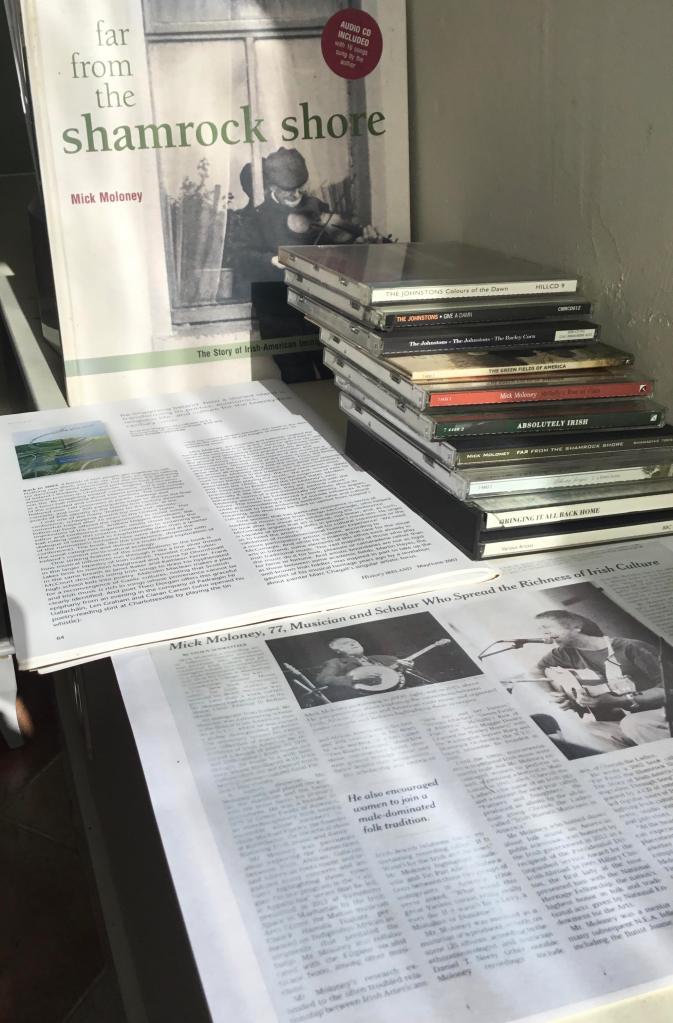
Mick Moloney is a giant figure in the Irish music universe. His sudden passing last week at age 77 has left musicians and music lovers all over the world reeling with grief. Coming so quickly on the heels of other major departures, Dennis Cahill, Tony Mac Mahon, and Paddy Moloney, makes this a sad season of mortality. Each represents an enormous loss to the diverse rainforest of Irish music and Moloney is another huge tree whose fall echoes throughout the ecosystem. However, the roots he put down in Ireland and the United States, and the seeds he has sown in many other corners of the world will nourish new growth for years to come. Even his shade will be fertile.
Mick Moloney could be described as a universal unitarian since he did not recognize clear-cut musical borders between Irish, Irish American, folk, and other cultural traditions. The outpouring of eloquent, dignified, and heartfelt tributes on social media has been overwhelming. Many are from musicians who knew him, were mentored or taught by him, had their first performances engineered by him, or were touched by him at critical moments in their development. Many are well-known names, others less so. What is crystal clear, is that every encounter with him was enlightening and uplifting, sometimes life-changing, and often memorable.
He was a brilliantly accomplished musician but his modesty meant that he rarely hogged the limelight, preferring to praise and honor other musicians. He loved ensemble playing and the list of his collaborators is extensive. His style was composed and cool but he wanted always to be known as a banjo-driver.
I met him through his music, initially with The Johnstons whose Colours of the Dawn album was a mind-blowing experience that still has resonance fifty years later. It was one of an early series of ear-opening Irish music performances that stretched from Sean O’Riada, the Clancy Brothers, and The Dubliners to Planxty and Horslips. For many years, my go-to party piece song was The Old Man’s Tale (by Ian Campbell) appropriated from Mick’s rendition on that album. And, I can still sing a couple of verses of The Fields of Vietnam (by Ewan MacColl) from his 1973 solo album, We Have Met Together.
Then there is the song, Kilkelly, composed by Peter Jones from letters sent to his great, great grandfather by his father back in Ireland. I first heard this on the compilation album, Bringing It All Back Home in 1991, played by Moloney, Jimmy Keane and Robbie O’Connell. This poignant song became emotionally powerful for me in 1994 when my father died in Dublin and I did not get home in time to say a last goodbye.
He is an archetypal Good Ancestor who landed in a nurturing family in Limerick and spent summers with his grandparents in Sliabh Luachra, that mysterious space that borders Cork and Kerry whose music belongs to neither county. Heeding the biological imperative to bloom where you are planted, Moloney absorbed the cultural and musical riches around him. When he moved to Pennsylvania in 1973 to study ethnomusicology at the University of Pennsylvania, he sought out, acknowledged, and proclaimed some of the Irish musicians who had toiled in the U.S. for years, notably Ed Reavy, Mike Flanagan, Eugene O’Donnell, and Sean McGlynn. He was determined to honor these living ancestors who kept the music alive in often inhospitable circumstances.
Our paths crossed a few times, most memorably at Charlottesville, Virginia, in 2003 when a Who’s Who of Irish artistic, literary, musical, political, and cultural characters participated in the Reimagining Ireland Conference. Moloney was a compelling, lively, and witty talker and he was in his element at this extraordinary gathering. When he chaired the panel on Irish Music in Charlottesville (an occasion when there really were “good people on both sides” in that gracious city) he opened the session by commenting on the “almost frightening display of punctuality” he was witnessing at an Irish event.
I had some informal interviews with him when he played in the Bay Area. You always knew a little more about music, culture, or social history after a conversation with him. He oozed erudition. In 2016, he performed a program of song, dance, and poetry at the Freight in Berkeley for the centenary of the Irish Rebellion, a pivotal and cathartic moment in modern Irish history. In typical fashion, he was more keen to sing the praises of his fellow musicians that night: Billy McComiskey on button accordion, dance champion Niall O’Leary, and Athena Tergis on fiddle.
I was a very minor figure in his Irish music universe but nevertheless, he generously responded to my requests and messages. We remained in contact via email for many years and I was surprised to find how many messages I had received from Moloney, oftentimes from his adopted home in Bangkok.
Moloney was an unabashed liberal with a life-long passion for social justice. He was woke before it was popular or profitable inspiring Joanie Madden to form the all-women group Cherish The Ladies, still going strong after almost 40 years. He was, as the Irish Times obituary described him, a renaissance man with many strings to his bow. He also received a half-page obituary in The New York Times. His capacity for positive and progressive work in and around the music was immense and he was playing right up to his final days.
In the follow-up publication from the Reimagining Ireland conference, Moloney contributed an insightful and incisive essay on Irish music. He was fundamentally optimistic about its future. The music has preserved a core identity, he argued, while accommodating a variety of outside influences. It has shown itself to have enduring aesthetic value and cultural meaning and thus may be hard to uproot from Ireland’s cultural ecology. Moloney deserves a big share of the credit for that rootedness.
Additional Resources
By Memory Inspired, Mick Moloney Songbook is a riveting series created during the Covid era and available on YouTube. Each episode features a song or tune around which Moloney weaves a tapestry of social, cultural, and historical context. Start with this one but take the time to view them all: you will be enriched and uplifted.
The book on the Charlottesville Conference is:
Re-Imagining Ireland: How a storied island is transforming its politics, economics, religious life, and culture for the twenty-first century. Book and DVD, Edited by Andrew Higgins Wyndham, University of Virginia Press, Virginia & London, 2006. 288 pages.
https://www.upress.virginia.edu/title/2357
My review of The Johnstons Reunion concert in 2011 can be read here:
https://theoldblognode.blogspot.com/2011/07/johnstons-reunion-concert.html
And I recently found an excellent recording of highlights from that concert posted on YouTube. It’s nicely organized into segments, so you can easily find your favorite Johnstons song.
 The Old Blog Node
Thoroughly enjoyed the video and this Blog, Tom. Your Blogs serve to bring together some important historical notes about Ireland and itâs musicians and music, a kind of weaving all of this together into a lasting fabric.
J
>
LikeLike
Great piece about the wonderful Mick, love his voice and his interpretation of songs. We have lost too many great musicians in the last few years. Proud to be your sister. Marie.
LikeLike