Author Archives: An Fear Blog Eireannach

Unknown's avatar

About An Fear Blog Eireannach

Lacking any musical talent, I started writing about Irish music and arts more than 20 years ago. My writing has appeared in Irish Music Magazine, the Irish Herald in San Francisco, History Ireland, and several artists' websites. More recently, I have been writing about the Women's World Cup in Australia and New Zealand.

Sad Farewells to Eithne Vallely, Bob Breheny, and Dolly Parton

Eithne Vallely

The unexpected, tragic death of Eithne Vallely last week is a huge blow to Irish traditional music in Ireland and the wider world. As matriarch of the legendary Vallely clan, she is the epitome of “the good ancestor.” The founder of the Armagh Pipers Club in 1966, with her husband Brian, she was an inspirational teacher of a wide range of traditional instruments. Eithne grew up steeped in Donegal music and Irish-speaking culture. Her mother, grandmother and grandfather were fiddle players, and she began playing at age nine.

Three of her children are distinguished musicians and part of the traditional music avant-garde: Niall is a concertina player who formed the Cork-based band Nomos and later recorded two albums under the name, Buille, with his brother Caoimhin on piano; Caoimhin co-founded the group North Cregg and is also a fiddle player; Cillian is a piper and has been the calm center of the high-powered group Lunasa since 1996.

Eithne’s husband, Brian, is a teacher, organizer, and pipes and flute player. In addition, he is a highly-regarded painter who focused on Irish music and musicians in his work. His portraits featured in many publications, including the Companion Guide to Irish Music edited by his first cousin, Fintan Vallely.

The Irish Times report on her death noted that the Armagh Pipers Club said it was with “great sorrow” that they shared news of her death, extending “heartfelt sympathy” to her family. “Eithne brought music into the lives of children for six decades,” the club said. “Her enormous contribution to Irish traditional music was recognised nationally with many awards and honours.” Thousands of musicians got their start at the Armagh Pipers Club, and many are still active performers.

Bob Breheny

And, in the SF Bay Area, we mourn the passing of Bob Breheny, the quiet dynamo of the Celtic Music scene in the South Bay for over forty years. I had several fruitful and funny encounters with him over the years at concerts featuring Tony Mac Mahon, Martin Hayes and Dennis Cahill, Molly’s Revenge, among others.

Michael Black knew him well and wrote this elegant, eloquent tribute for the Celtic Society of the Monterey Bay. I particularly liked this summary:

He was incredibly well read, quietly observant, and full of unexpected humor. I will admit it took me a while to get used to his puns, but they became part of who he was, and part of what made him unmistakably Bob.

Bob was well known for his quirky ways as a host and his very wry (but never awry) sense of humor. He liked nothing more than drawing you into a bout of high-level banter where his erudition would flash and frolic.

I pulled up a couple of his old email messages, which illustrate his mischievousness. From 2011,

Cheers Tom.

Thanks for the bellow below.

Bugger. Wish I did espy in the sky your review of Brendan & Caoimhin ere churning out the cheesy newsletter. Had I done so, I’d filched the whole thing. Of course, permission would be good too. Maybe I’ll figure out how to include in October update or at least refer folks to same. Saxophone!

There’s also a bit on your blog about Moya Brennan in T with the Maggies, arriving anon for only No. California appearance in Santa Cruz. Her manager and better half, Tim Jarvis, will also be along, so I hope we get a good showing or it’ll be my guts for garters.

Imbibed your riff on ‘The Guard.’ Ever see Brendan Gleeson flick ‘I Went Down?’ Mighty stuff. Thought I read somewhere that he was directing film of what I’d thought to be unfilmable, Flann O’Brien’s ‘At Swim-Two-Birds.’ Anything, other than 12 inches, afoot there? 

your palindrome pal, -BoB

And this exchange from 2008:

Hey Bob: Thanks for the blog menchkin (which, as you know, is an old Gaelic word for a little mention) in the latest newsletter. You’ve got some great stuff coming up. I saw the Molly’s last night rattling the pews in an Episcopal church in Castro Valley….. Can I use “blogtrotting” if I give you credit? As you said once to me, I wish I’d thought of that…. -Tom

Mazel tov, Tom.

Use what you wish sans credit, it’s not as if I’d be calling you and come after your blog with a bludgeon.

Did I say ‘I wish I’d thought of that?’ Maybe I was thinking of the Wilde-Whistler exchange:

Whistler: (says something or other)

Wilde: I wish I had said that, James.

Whistler: You will, Oscar, you will.

(discom) Bob (ulated)

Bob hosted the late Tony Mac Mahon during a 2002 visit at the Resource Center for Non-Violence in Santa Cruz. Tony was in fine form and partnered up with Japanese guitarist Junji Shirota. It was a magical evening with Tony responding wholeheartedly to the energy generated by an audience of aficionados. Pete Haworth of Molly’s Revenge recorded the concert and gave me a copy. So here’s a rare live recording of a suitably mournful slow air called Amhrán na Leabhar:

https://on.soundcloud.com/ztlQwlc1xmRcuggSqv

Dolly Parton

And, finally, Irish music fans join the mourning for the great Dolly Parton. She enhanced and beautified every musical genre she touched, including Irish traditional songs. She understood well the underlying connections to country music from early Irish immigrants to the United States. Her primary collaboration was with the Donegal band Altan. Her voice blended gloriously with Mairéad Ní Mhaonaigh on the songs “The Pretty Young Girl” and “In the Sweet By and By.” Mairéad recalls the great fun she had working with Dolly in this RTE interview. This YouTube video features their duet of “The Sweet By and By”, from the Women’s Heart- A Decade On album
Mr. Nobody Wins an Oscar

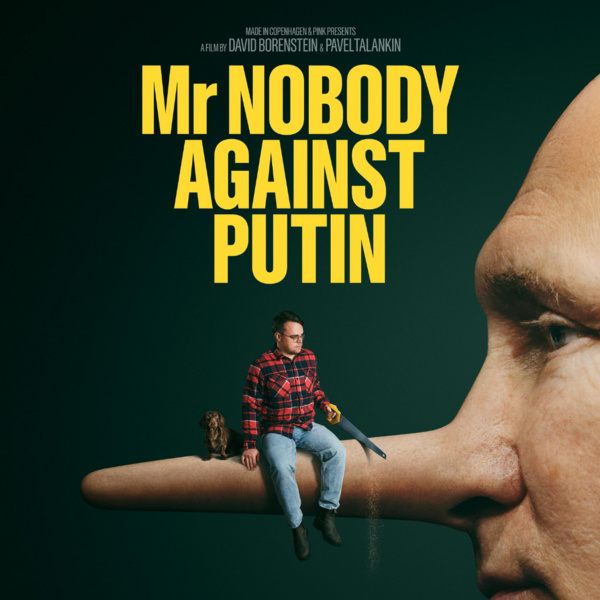
In February, I had the privilege of attending a special screening of Mr. Nobody Against Putin at the Smith Rafael Film Center with the director, producer, and Mr. Nobody in attendance for a Q&A. Last night, the film surprisingly won an Oscar for Best Documentary, beating the other nominees. In my last blog post, I recommended the film as an anti-authoritarian double-feature with the Ukrainian documentary Porcelain War from 2025.

Mr. Nobody is Pavel Talankin, Pasha, a primary school teacher in a small Russian town, who uses his role as school videographer to fight back against Vladimir Putin’s propaganda campaign justifying his war in Ukraine. Pasha is increasingly frustrated and outraged, and as his opposition to the propaganda becomes more evident, his position is increasingly precarious. He clearly sees the effects of mobilization and conscription on the school’s graduates. Young men with few good options join the army and serve in Ukraine. Some do not return.

Each documentary is a heart-wrenching testimony to resistance. They offer mirror images of the same story. Porcelain War focuses on the existential threat faced by Ukrainians under Russian attack, while Mr. Nobody reveals the evil depths to which Putin is going to justify his war by spreading lies and misinformation. In this respect, there are striking similarities between Donald Trump and Benjamin Netanyahu’s war on Iran. Truth is always the first casualty in war, and Trump is shamelessly using Putin’s playbook, page by page.

As Dan Rather puts it today in his Team Steady newsletter:

Every wartime administration has sugarcoated the news, but Trump’s effort for a truth-free war is more complex and potentially life-threatening than most. Three weeks in, we know there is no quick fix and no way for Trump to lie his way out of it, as the Iranian government says it sees no reason to negotiate.

Mr. Nobody will likely be shown at independent film theaters such as the Smith Rafael Film Center in the Bay Area. It is also available for streaming on Apple TV. Porcelain War is streaming on the PBS POV series from your local station.

The lesson from these films is to do whatever you can; every little gesture of resistance is essential. Support local arts organizations, especially for music, movies, theater, and visual arts. Stay informed by supporting independent and local media outlets while we still have some. Find community groups doing work for the common good and volunteer to help. Speak out on behalf of the most vulnerable, demonized people and groups. Try to be as courageous, honorable, and resourceful as Ukrainians and muted Russian dissenters.

A Companion film for Porcelain War?

Mr. Nobody Against Putin is an Oscar-nominated documentary with a compelling portrait of resistance to autocracy and fascism. I had the privilege of seeing a special screening of this film at the Smith Rafael Film Center with the director, producer, and Mr. Nobody in attendance for a Q&A. Mr. Nobody is Pavel Talankin, Pasha, a primary school teacher in a small Russian town, who decides to use his skills to fight back against Vladimir Putin’s school-based propaganda campaign justifying his war in Ukraine. It begins with his annoyance at how Moscow’s demands are making his work and that of other teachers more burdensome, then quickly pivots into filming an undercover documentary in his role as the school videographer.

The propaganda campaign becomes more and more intrusive until students are marching in military-style uniforms and getting weapons presentations from Wagner Group mercenaries. Pasha is increasingly frustrated and outraged, and his opposition to the propaganda becomes more evident. He clearly sees the effects of mobilization and conscription on the young people in his town. Young men with few good job options join the army and serve in Ukraine. Some do not return.

It would make an excellent double-feature with the film Porcelain War, which I wrote about in 2025. This film is available for streaming in the PBS POV series. Both films offer a close-up view of how ordinary people exercise their agency and courage to resist oppression. And both films focus more on acts of grace, love, and humanity than on war. That’s what makes the films so dramatically powerful.

The film is now showing at the Smith Rafael Film Center and other independent film theaters in the Bay Area. It is also available for streaming on Apple TV. Putin, like Trump, is a big believer in HIS freedom of expression. This film shows how ruthlessly he peddles his big lies to school children and teachers. Trump has not extended his propaganda in this sector, but you can be sure he admires the roadmap.

Porcelain War film now streaming on PBS

The war in Ukraine is still with us, a seemingly endless, everyday tragedy. I described the documentary, Porcelain War,as a terrible beauty of a film when I reviewed it earlier this year. Christy Moore’s album of the same name features a track called Sunflowers, another commentary on the war. Initially, the film had a limited theatrical release but no streaming deal. Now, it has been acquired by the Public Broadcasting Service’s POV series, and is available to watch on the PBS Player and on KQED in the San Francisco Bay Area. The film remains hugely relevant as the U.S. and Russia seem bent on forcing a one-sided resolution on Ukraine where the autocratic aggressor gets all its demands met, and the democratic state gets shafted.

Manchán Magan, an unforgettable spirit, departs

Tabharthas was one of the lovely, loamy Irish words I learned from Manchán Magan’s brilliant book, Thirty Two Words for Field. The word has several meanings, including gift, tribute, and bequest. Magan died this week, leaving a gap in the energy field of Irish land-rooted, indigenous spirituality. His loss will echo across the world. His life was a full-blooded tribute to his Irish heritage, lineage, land, and culture.

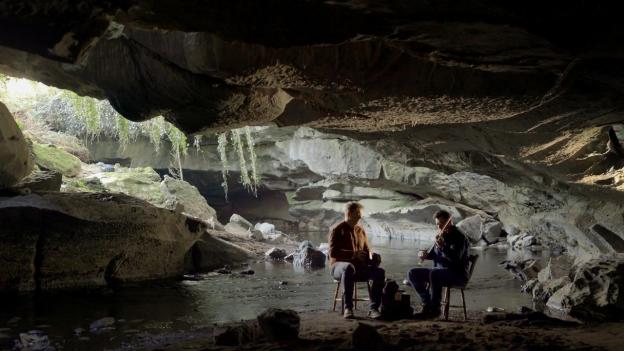
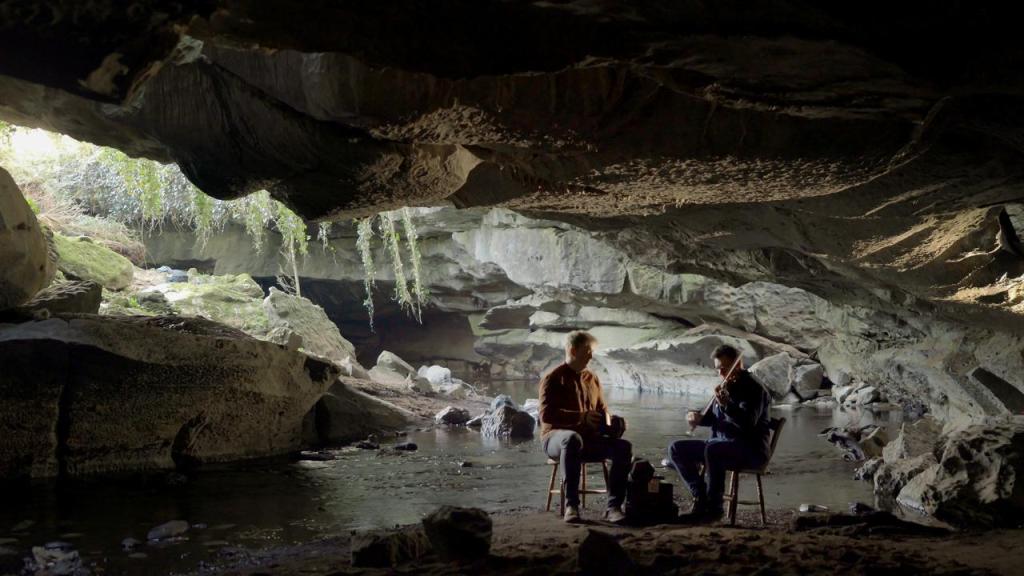
By coincidence (or perhaps not), I was listening to the new recording from Cormac Begley and Liam O’Connor, titled “Into The Loam.” The phrase ‘drawing from the well’ often comes up in discussions of traditional music, but Begley and O’Connor seem to have found one of those mythical places to play and film some of their new music.

This selection is called Bogadh Faoi Shusa. It struck me that it would make a good lament for Magan’s passing, especially the second part where the melody winds down. He would have appreciated the location, a cave of sorts, half underground and half overground, with nearby running water. He was on the verge of much wider recognition for his culture-changing work. If you have not read, seen, or heard him, seek out his work. A number of his films were made for TG4, Ireland’s Irish-speaking TV channel, and may be found on the TG4 Player.

The Old Blog Node Creation Story and some Blog-trotting

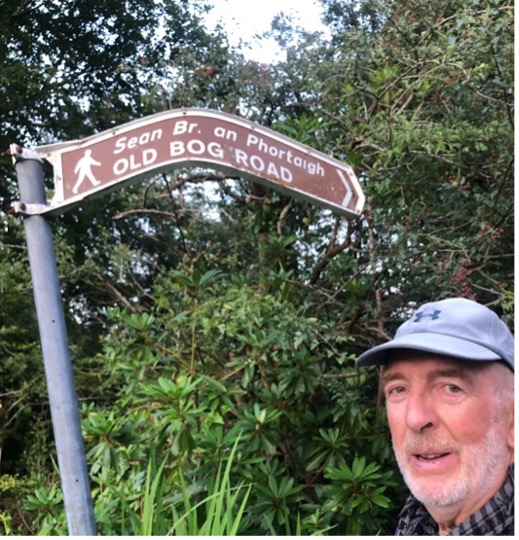
On a visit to Ireland earlier this year, I visited my old childhood summer home-away-from-home in Oughterard, Co. Galway. On an evening walk down the Pier Road, I came upon this sign. This was one of the inspirations for the title of this blog, although I had utterly forgotten the connection. This old road sign points towards Lemonfield, where I had a formative experience listening to two local fiddle players, Matt and Pete Conneely, with my friend John Clancy. You can find that story here, in one of the most widely read posts, “The Power of the Pattern” (in 2 parts), from 2010.

Many of the older posts from my original blog have not been referenced or reprised in the WordPress version, which I started in 2020. It’s about time I cross-posted some of those earlier pieces. All of my recent posts have been published on both sites. I maintain the original Blogger site because I want to keep track of my “readership,” which has now exceeded 120,000. Not bad for a part-time, unpromoted publishing effort focused on Irish music and arts, dating back to 2008, when blogs, depending on your perspective, were either still a big thing or already passé.

One goal was to create a space for informed and insightful writing about Irish culture and arts with a focus on traditional music from an immigrant perspective. The music served as a primary cultural lifeline back to Ireland after I emigrated to the United States in the 1980s. I wanted to share my passion and inspire others to acquire an interest in the country’s music and arts.

Initially, I wanted to have more than my voice on the site. I had hoped to persuade musicians to write about music-making, insights into the creative process, or aspects of performance or stage-craft. That dream remained unrealized. Musicians, I came to understand, place more value on playing and performing over sitting down to write, and who can blame them?  However, my posts contain links to other writers, many of whom are more polished than I, providing additional resources to contextualize my commentary and address the Node mandate in the title.

Writing about music is an odd preoccupation. Listening is always required to get into music, but sometimes the right words can change perceptions of new or old music. I’ve benefited from that exchange more than a few times myself, and I aspire to offer the same opportunity to my readers.

I was fortunate to have a bi-cultural, urban and rural upbringing in Ireland before the effects of television, telephones, and technology began to erode our traditional culture. Radio was the dominant technology, and thanks to Ciarán Mac Mathúna, Séamus Ennis, Seán Ó Riada, and others, I heard some of the best traditional players and singers on RTE Radio. I reveled in the trad and folk revival of the 1960s, tuning in to the Clancy Brothers, the Johnstons, the Dubliners, and the Chieftains. Then, my tastes were further expanded (maybe even exploded) by Planxty, featuring Donal Lunny, Christy Moore, Andy Irvine, and the late Liam O’Flynn—the Holy Trinity Plus One of Irish music.

In California, my writing practice was revived by the encouragement and persistence of Catherine Barry and Elgy Gillespie, who were editing the Irish Herald, a monthly newspaperin San Francisco, until the early 2000s. I had three very prolific years with the Herald, covering CD and concert reviews, as well as interviews with visiting musicians. For example, I was fortunate to talk with Maria and Simon O’Dwyer of Coirn na hÉireann (Horns of Ancient Ireland) on their first trip to San Francisco. Their revival work on early Irish instruments was featured in John Creedon’s excellent 2024 documentary, Creedon’s Musical Atlas of Ireland. I saw and wrote about Tony Mac Mahon playing two extraordinary concerts with the Kronos Quartet in 2002 and 2003.

I wrote regularly for Irish Music Magazine for over ten years, conducting interviews with musicians and writing reviews of performances and recordings. Some of these have been reproduced or referenced on the blog, but I plan to “digitize” a few more in a selective fashion. And, as if that was not enough, when I resumed my sidebar writing activities, it intersected with the stratospheric trajectory of Martin Hayes’ career. I was fortunate to see him play live in San Francisco, Berkeley, and Sebastopol many times. My first piece on Hayes in the Irish Herald in September 2000 was titled Zen and the Art of Fiddle Playing. I heard him play at the San Francisco Celtic Music Festival each spring for ten years from 1991.

I have written about Hayes several times, and it has always been a rewarding experience. The first blog essay, titled Hayes and Cahill: Recalibrating the Tradition,” was published in October 2008. I include it here since the post went up before the counter was initiated, and many readers may never have had the opportunity to read it. It is one of my favorites with extended quotes from an interview with the two masters conducted at the legendary Freight (formerly known as The Freight and Salvage) in Berkeley.

Hayes and Cahill graced the stage and enthralled audiences many times at the Freight, sometimes in their pluperfect partnership, other times with larger musical groupings. There was a riveting evening with The Gloaming in 2014.  Another unforgettable performance I titled Quadruple Delights in 2018, showcased the Blue Room CD and Hayes’ quartet.

One of their most unique duo performances was in 2012 at the Freight, where sound engineer Tesser Call created a magical, intimate evening. Hearing them play in smaller settings, such as churches, in the early days (2011) was always a special pleasure.

A good part of my continuing education in traditional music came from some of the well-known figures I have mentioned and a slew of lesser-known musicians who schooled me in the music. In fact, it is the countless hosts of musicians who play and perform for little or no reward that keep the music alive. Irish roots music is in fine shape, and each new generation of players seems to be more talented and innovative than their forebears.

These time-machine reposts will be continued in the future with other widely read posts on Susan McKeown, Paddy O’Brien, John Doyle, the Black Brothers, the late Mick Fitzgerald, Brendan Begley, Christy Moore, and others.

Fintan Vallely gets down to brass tacks in his new book

Dublin can be heaven if you are seeking cultural stimulation, and the Hodges Figgis’ bookshop is a good place to look. In June, I was fortunate to be there for the book launch of Camarade by my friend, Theo Dorgan. The audience was studded with poets, writers, scholars, musicians, and sundry cognoscenti: I was perhaps the most anonymous attendee. I sat next to a distinguished-looking gentleman with a lilting Northern accent. We chatted amiably, but initially I did not catch his name.

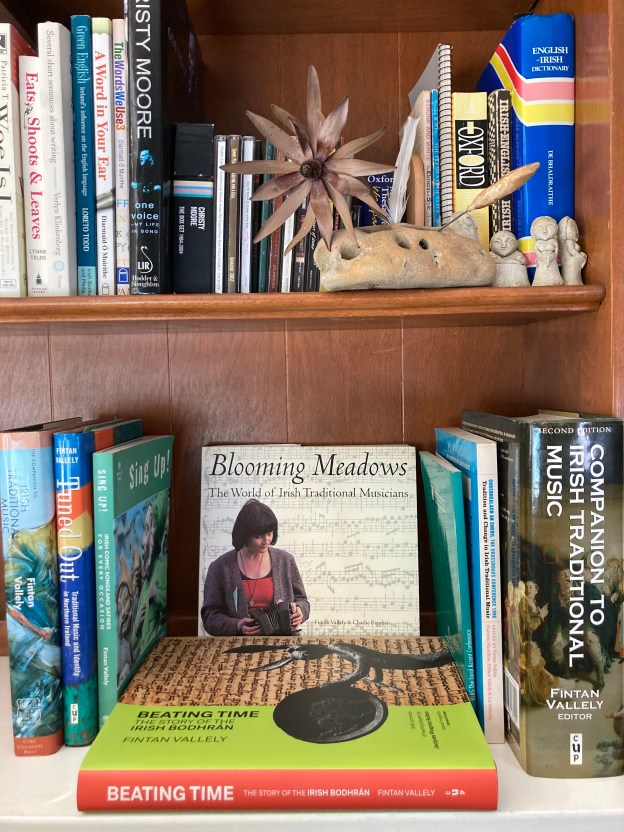
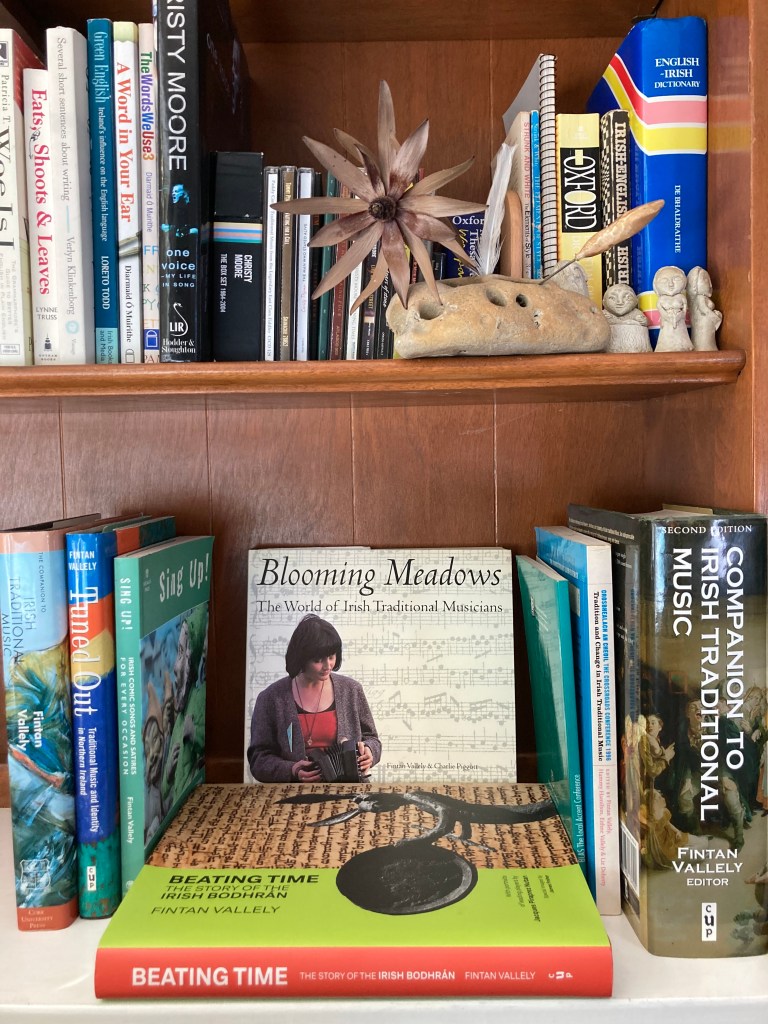
Imagine my astonishment, then, when I realized I was talking with Fintan Vallely, Ireland’s preeminent expert on Irish traditional music and a highly accomplished flute player. He has been writing, speaking, teaching, and advocating for traditional music for over fifty years. I have a decent collection of his writing, suitably curated in the title photograph. I have relied upon his books and articles as sources of sound information (especially the series of Companion Guides), stimulation, and writing inspiration.

His newest book, Beating Time: The Story of the Irish Bodhrán, explores the history of Ireland’s favored percussion instrument. The frame drum is not nearly as old as many people think. Vallely dates its high-profile arrival in Irish music to 1959, when it featured in the music for Sive, John B. Keane’s play, at the Abbey Theater. Sean O’Riada was the Abbey’s music director, and he was drawn to the drum’s possibilities. He made room for a bodhran player, Peadar Mercier, when he created a new ensemble, “ceili” band, Ceoltóirí Chualann  (“The Band that Changed the Course of Irish Music”) in 1961.

The new book features vivid portraits by Jacques Piraprez Nutan and James Fraher and an extraordinary array of archival material, photos, and illustrations. Vallely establishes the tambourine as the origin of the drum. There is little evidence that it was present or necessary historically in the deeply melodic traditions of Irish music, Vallely asserts. However, improvised drums were fashioned from frames used for winnowing and sifting, particularly by Wrenboys on St. Stephen’s Day.

His book is suffused with organic intelligence. There are no artificial ingredients. Every chapter is rigorously researched, carefully arranged and annotated, and beautifully presented. The writing smoothly weaves dazzling details into the larger narrative. He is a Master collaborator. Each edition of the Companion guides involves contributions from dozens of musicians and music scholars. He is generous in his credits and acknowledgements and wears his erudition lightly.

Nicholas Carolan, former Director of the Irish Traditional Music Archive, introduced Vallely’s book at the Willie Clancy Summer School this July. He said Vallely had tirelessly researched the bodhran for many years and drew from a great range of recently digitized information. “He’s produced here both a definitive history of the Irish drum, and also an exemplar, a template for writing the social and musical history of other instruments of Irish traditional music.”  On that last point, the concertina would be an excellent topic.

My favorite among Vallely’s works is Blooming Meadows, The World of Irish Traditional Musicians, a book of 30 interviews and portraits of Irish musicians published in 1998. Co-written with Charlie Piggott and featuring Nutan’s photographs and a “borrowed’ bar stool, the book is a treasure of lore and legends. The timely book offered a wealth of stories on long-established musicians, including Joe Burke, Ann Conroy, Paddy Canny, Joe Cooley, Lucy Farr, and Ben Lennon. It features many others who were on the cusp of greater recognition: Martin Hayes, Sharon Shannon, Liz Carroll, and Brendan Begley, among others. The format of short essays paired with a good image was one inspiration for my blog when I started it in 2008.

His other works in my collection are Tuned Out, a comprehensive and authoritative (like all Vallely’s writing) exploration drawn from interviews with musicians of how Irish traditional music fell out of favor with many Northern Protestants, regrettable collateral damage in the political polarization wrought by The Troubles. Sing Up is a humorous, clever collection of Irish comic and satirical songs. It’s got a whole section called Goatery and Percussion with songs about the bodhran.

Arguing at the Crossroads goes back to 1997 with ten essays on a changing Ireland. Vallely’s essay surveyed the state of Irish music at that point (post-Riverdance) and found it in rude health. The Local Accent, Selected Proceedings from BLAS also dates from 1997, and includes his provocative essay, The Migrant, the Tourist, the Voyeur, the Leprechaun. Vallely edited Crosbhealach An Cheoil (The Crossroads Conference, 1996) with Hammy Hamilton, Eithne Vallely & Liz Doherty.

Vallely is a walking/talking encyclopedia of Irish traditional music. In our brief conversation at the book launch, he summarized the key points of his bodhran research, mentioned his studies of The Princess Grace Song-Sheet Collection in Monaco (an astounding piece of catalogue work), and described the evolution of the Third Companion Guide into recordings on CD and DVD. He also gave me a copy of his 2021 CD, Merrijig Creek, an enchanting album of his compositions and arrangements with a powerhouse set of musical partners: his sister, Sheena, on flute, Caoimhin Vallely, their cousin, on piano, Liz Doherty and Gerry O’Connor on fiddles, Daithi Sproule on guitar, and Brian Morrissey on, you guessed it, the bodhran.

Vallely is an ubiquitous presence in the Irish music literature. I like to think of him as a key “influencer” before it was a popular or profitable role. Beating Time has everything you would want to know about the bodhran (including brass tacks) and much more that you may find intriguing and enlightening.

Links and additional sources:

All of Vallely’s prodigious work, books, recordings, articles, and other musical projects can be found at his website imusic.ie:

https://imusic.ie/

Irish arts suffered a tremendous loss this month with the untimely death of Sean Rocks, the voice of arts coverage on Irish radio for 20 years. Here are two short clips from his RTE programme, Arena:

First, an interview with Fintan Vallely about Beating Time.

https://www.rte.ie/radio/radio1/clips/22533245/

And, second, Sean Rocks interview with Theo Dorgan discussing his new novel, Camarade.

https://www.rte.ie/radio/radio1/clips/22529307/

DakhaBrakha fire up The Freight

DakhaBrakha fires up The Freight

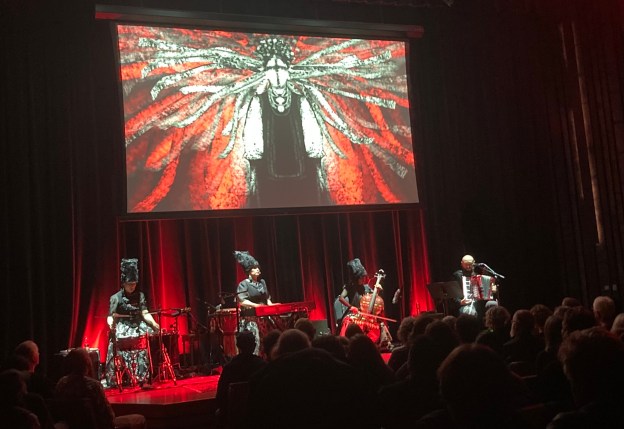
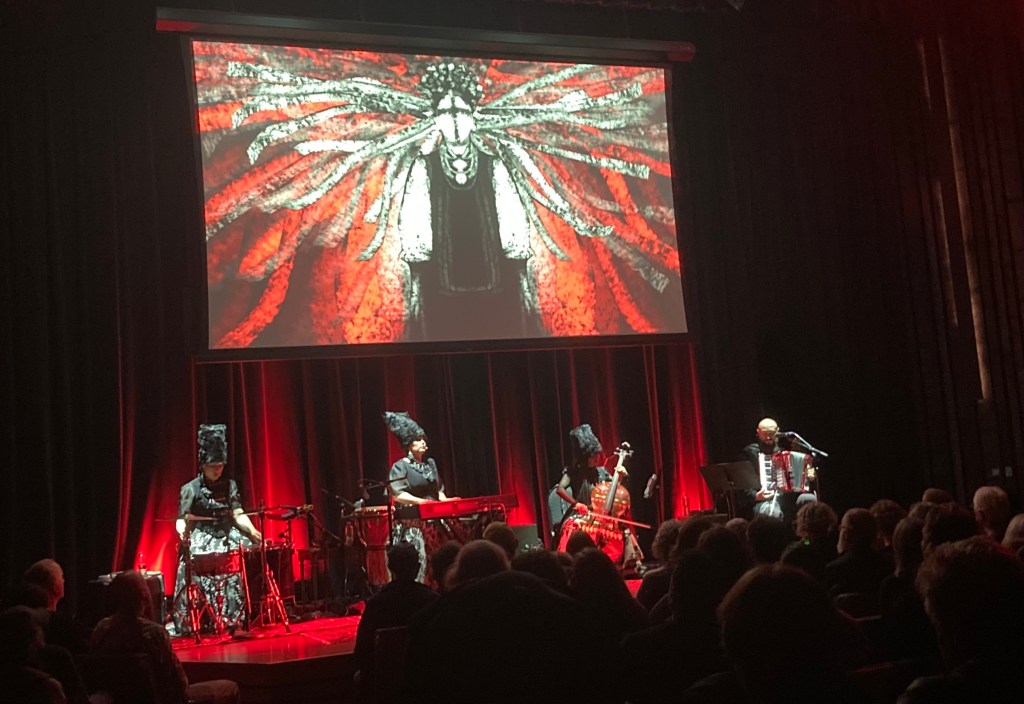
Ukrainian band DakhaBrakha lit up The Freight and Salvage in Berkeley with three sold-out shows last weekend, April 4, 5, and 6. The group’s performances are an audio-visual extravaganza. Their music cuts across a broad spectrum of folk/trad/rock/jazz/techno: ethno/techno, in their words. Think of them as musical anthropologists. They play with passionate intensity and muscular musicality—rigorous and vigorous.  The quartet comprises Marko Halanevych, Iryna Kovalenko, Olena Tsybulska, and Nina Garenetsk.

Every instrument has a percussive role, supplementing the array of drums (Indian, African, and Arabic) on stage. Everyone sings, and the women’s voices meld into soulful, sharply cadenced choruses. The cello brings dark energy to sonic arrangements. The accordion sound is minimal in many songs and often resembles uilleann pipes, organs, or harmonica.

Some of their music was featured as the soundtrack for Porcelain War, a terrible beauty of a documentary, that played earlier this year at the Smith Rafael Film Center. A streaming service has not taken up the powerful anti-war film, but some clips can be seen here: https://www.porcelainwar.com/videos

DakhaBrakha was created in 2004 at the Kyiv Center of Contemporary Art “DAKH” by avant-garde theatre director Vladyslav Troitskyi. Theatre work has left its mark on the band’s performances—their shows are always staged with a strong visual element of projected imagery and animations.

Their U.S. tour ends this month and they have one more Northern California gig in Davis before returning to Ukraine for a series of summer concerts. They are a uniquely powerful ensemble expanding Ukrainian folk and traditional music into a wild world of sonic adventures. And, in the You-know-you’re-in-Berkeley-When category, a Ukrainian immigrant, Igor Tregub, who serves on the Berkeley City Council, introduced the group.

Porcelain War is a perfect anti-war film

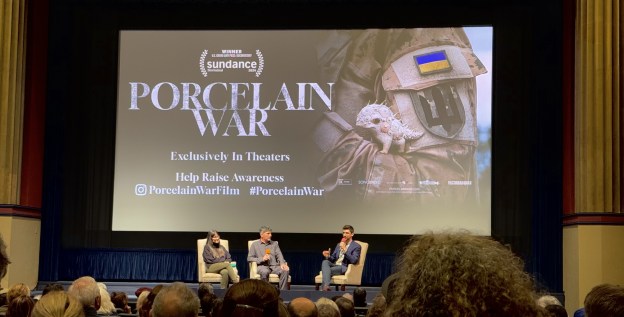
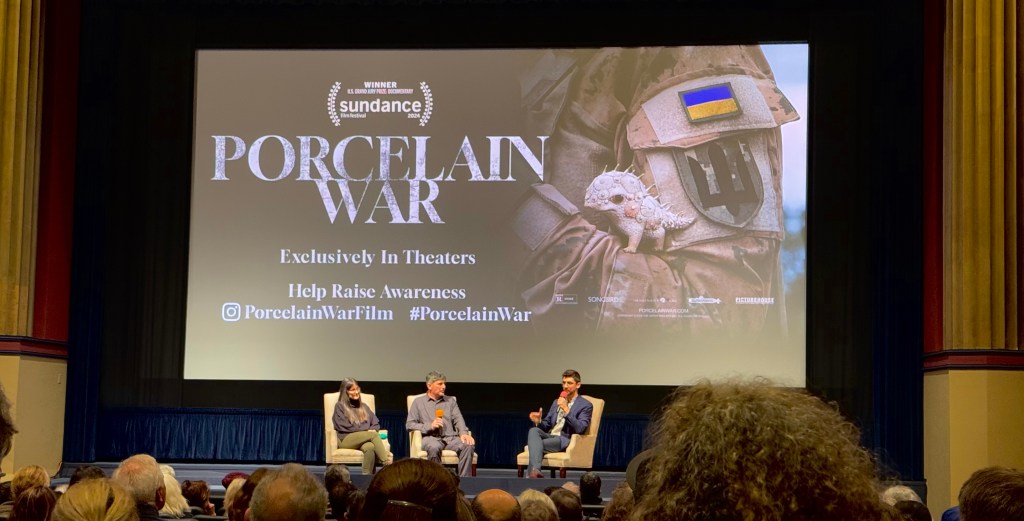
Porcelain War Filmmaker Slava Leontyev and producer Paula Dupre Pesmen were interviewed by the Ukrainian Deputy Consul General Yevgeniy Drobot at the Smith Rafael Film Center on February 4, 2025. (Photo by Dave Mackie)

Porcelain War is a terrible beauty of a documentary, an improbable and almost impossible achievement by a group of Ukrainian artists. Slava Leontyev, Anya Stasenko, and Andrey Stefanov stayed in the war zone around Kharkiv, armed only with their art, cameras, and, for the first time ever, guns. Ordinary extraordinary civilians electing to fight for their lives, culture, freedom, and democracy in a war waged against professional soldiers.

The filmmakers decided not to make a film that presents a balanced narrative of the horrors and successes of war. They wanted to show as much beauty, bravery, grace and decency as possible. There is no fog of war for the Ukrainian resistance. They fight in the most moral way, lamenting the brutal power of the weapons they use while showing compassion and empathy for Russian soldiers being sacrificed for Putin’s delusion of a restored Russian empire.

When I first saw it, I had the revelation that Ukraine’s war is the frontline of the worldwide struggle to save democracy. Many people already understood this, but the film hammered it home for me. That was before President Trump’s inauguration. Now, I see that the frontline has shifted to the United States and that Ukraine may become collateral damage in the worldwide anti-democratic surge.

Another troubling and sobering film is Democracy Noir about the Hungarian struggle against authoritarian forces. This film was shown at The Parkway in Oakland on inauguration day as a counterpoint to the ascension of the “broligarchs” in Washington, D.C.

Both films have useful lessons on resistance. Firstly, everyone who sees the authoritarian dangers must resist in their own way. In Ukraine, two porcelain artists and a painter became movie-makers. Other professionals, teachers, farmers, engineers, human resources specialists, and tech-savvy young people joined the army and put their skills to patriotic use.

In Hungary, three women- a journalist, a politician, and a nurse- led resistance work to counter Viktor Orbán’s corrupt, persistent, and largely successful campaign to undermine democracy. As many commentators have noted, Orban’s playbook is the model for Project 2025 and the barrage of executive orders Trump has signed in the first two weeks of his “reign.” Orbán took carefully crafted, methodical steps to chip away at Hungarian democratic institutions (the media, universities, arts organizations, and Non-Government Organizations) while maintaining popularity with a majority of citizens. His authoritarian project is over fifteen years strong. 

I have already seen Porcelain War twice this year, thanks to the generous and activist programming of the California Film Institute and the Smith Rafael Film Center. The film is on a limited theatrical release and has not secured a streaming arrangement so far. It has been Oscar-nominated for Best Documentary Feature. Don’t miss it if it is showing near you.

The soundtrack features the sweet and startlingly tart music of the Ukrainian band DhakaBrahka. The band is touring the United States in March and April and will play some concerts at the Freight and Salvage in Berkeley at the end of March. Described as being,

“At the crossroads of Ukrainian folklore and theater, their musical spectrum ranges from intimate to riotous, plumbing the depths of contemporary roots and rhythms.”

The film’s focus on people trying to live their best lives in a time of unrelenting war is inspiring and motivational. The scenes of beauty in nature and people are captivating. When the filmmakers were asked how people could help the cause, not once did they ask for money. Their goal was to raise awareness of how people are dealing with the tragedy in their country and raising money would be a crass and useless gesture. The film stands on its own merits.

The struggle for democracy is going on now in the United States and other countries. Very wealthy people are no longer rooting for democracy or for the common good. Towards the end of the film, Anya Stasenko says that she is lucky to have met so many brave people in the resistance and is amazed at how much good work they have accomplished together. Do we need to have wars to see this truth?

It would be easy to lose hope. Perhaps hope has finally risen to the level of strategy, to rework that Obama-era cliché? The lesson from these films is to do whatever you can; every little gesture of resistance is important. Support local arts organizations, especially for music, movies, theater, and visual arts. Stay informed by supporting independent and local media outlets while we still have some. Find community groups doing work for the common good and volunteer to help. Contact your elected representatives at the local and state levels to express your dissatisfaction with the outrageous power grabs underway. Take to the streets, like some Democrat leaders are finally doing. Speak out on behalf of the most vulnerable, demonized people and groups. Try to be as courageous, honorable and resourceful as Ukrainians.

Porcelain War