Lacking any musical talent, I started writing about Irish music and arts more than 20 years ago. My writing has appeared in Irish Music Magazine, the Irish Herald in San Francisco, History Ireland, and several artists' websites. More recently, I have been writing about the Women's World Cup in Australia and New Zealand.
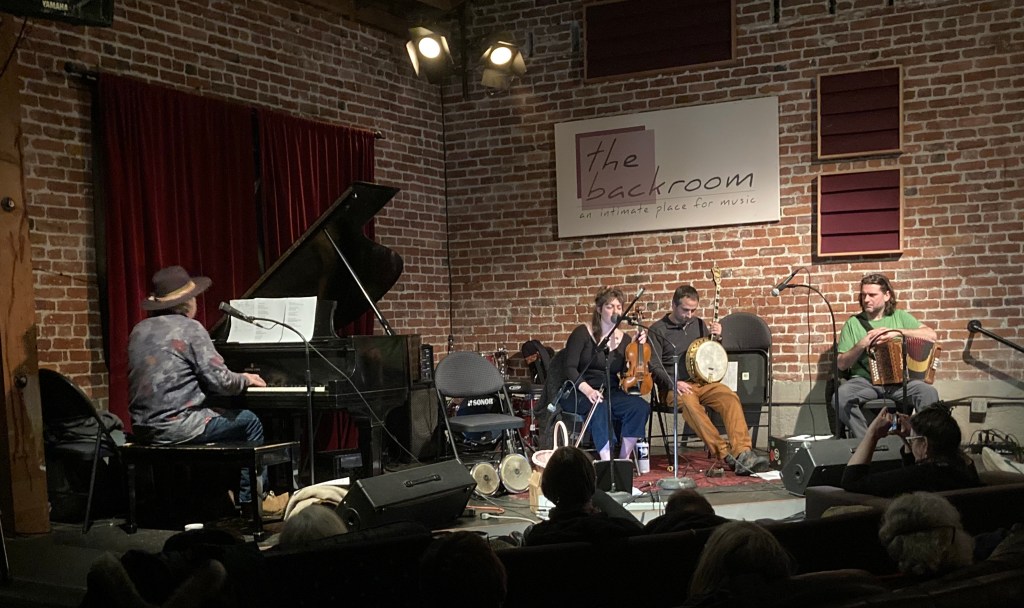
Eamonn Flynn brought his Dublinesque music hall event to the Back Room in Berkeley on February 1, St Brigid’s Day. I’ve seen this show a few times in recent years, and it’s always lively, entertaining, and ever-changing. Led by Flynn on piano and vocals, the ensemble includes Darcy Noonan from Oakland on fiddle, Hector Bragado from Balboa on banjo, and Felim Egan from Offaly on accordion.
As the name suggests, the show focuses on Dublin songs and stories; every song has a story, and vice versa. The show is built around Flynn’s grooving, tuneful Dublin tribute album from 2022, Anywhere But Home. The city has its share of catchy, light-hearted songs: Molly Malone, Dublin Saunter (Dublin Can Be Heaven), Daffodil Mulligan, and Flynn’s own classic, Strollin’ (Baile Atha Cliath).
But there are darker songs, too. Sack ‘Em Ups is a rhythmic riff on the spooky subject of grave robbers in 19th-century Dublin. May Oblong is a tribute to one of Dublin’s most famous Red Light madames. Weela Weela Wayla, a well-known children’s song popularized by The Dubliners, is a gruesome tale wrapped in an infectious tune.
Another grim story is told in Hunting the Wren, written by Ian Lynch of Lankum. Darcy Noonan set down her fiddle to bravely and boldly take the vocals on this dark, intense song. It commemorates The Wrens of the Curragh, a shameful episode in the history of Irish mistreatment of women. Willie O is a lovely old song that many singers have covered (I recommend Niamh Parson’s version.) Flynn paired it with a Dr John instrumental, Cajun Moon.
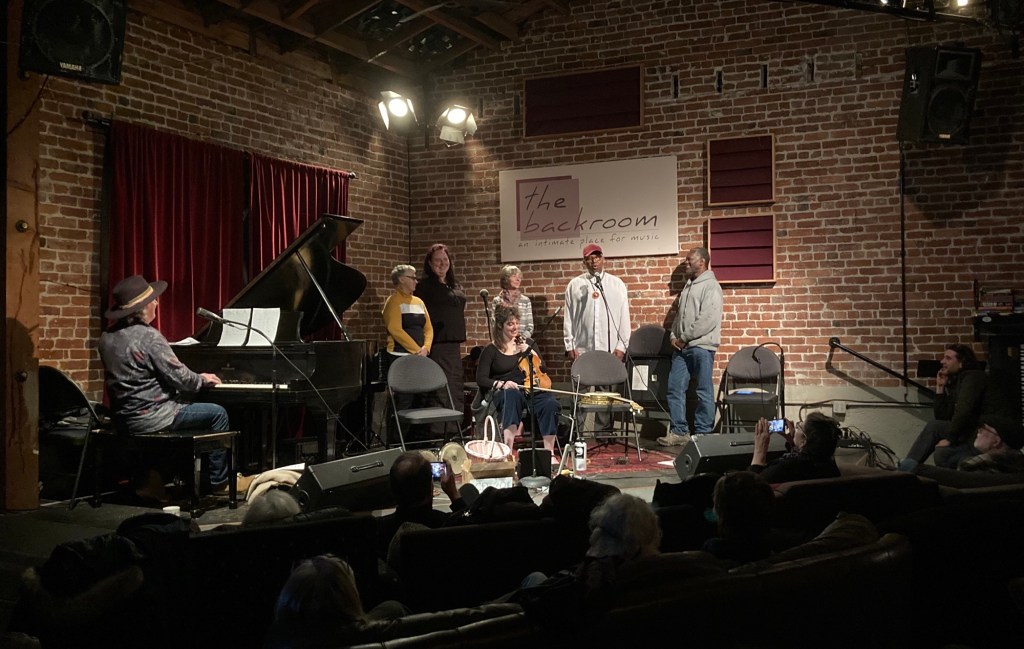
He is part of many wide-ranging musical groupings in the Bay Area. He and Egan play with the Black Brothers, who have some Bay Area shows in March. Check his website for upcoming performances in February and March. He has also been part of the Glide Memorial music program for a couple of years and brought some of the Glide Choir as guests for this show. They provided the highlight of the evening with Dennis Hersey singing Danny Boy. It’s an overused piece, but Hersey sang with it with great heart and reverence.
Dennis Hersey of the Glide Memorial choir brought a deep interpretation of Danny Boy
St Brigid seems to have taken on a new agent in recent times. There were three other musical events in the East Bay on her feast day. The second Bank Holiday created by the Irish government to commemorate her occurs this Monday, February 5. Maybe someday, her life will be as widely celebrated as St Patrick’s. Flynn opened the evening by reading a poem attributed to Brigid known as The Lake of Beer. So, could there be a similar amount of sanctioned drinking on her holiday?
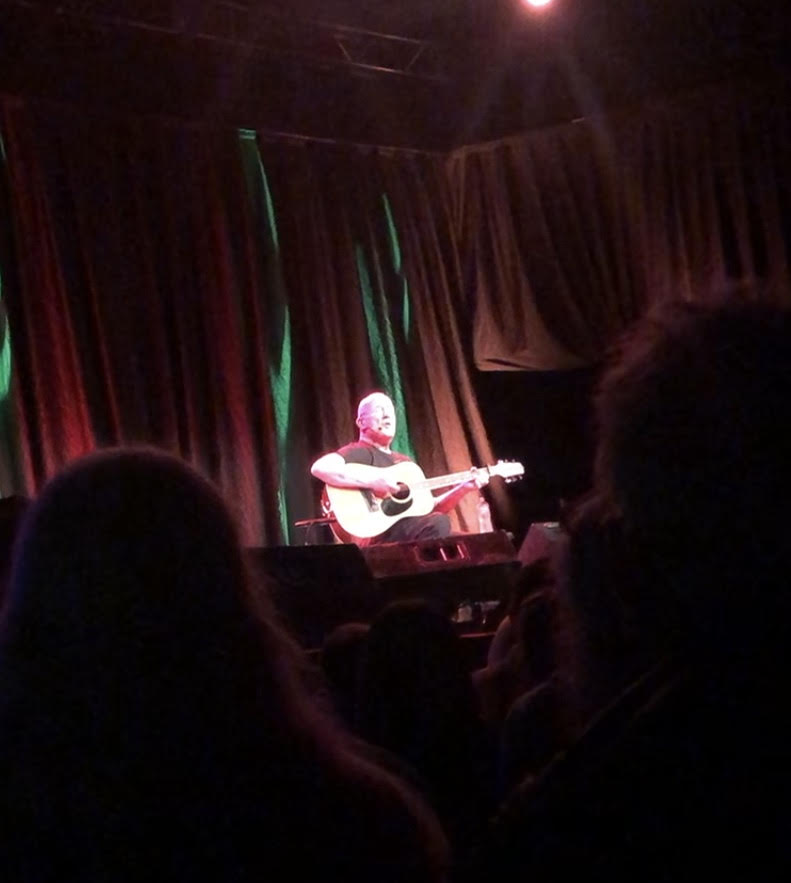
If there is a better way to start the New Year than taking in a Christy Moore concert, I don’t know what that could be. He opened a series of performances on January 2, 2024, at Vicar Street in Dublin. The show reaffirmed that he is a force of nature, propelled by his deep dedication to singing and playing. He is still in powerful form and has many more performances lined up for this year.
At one time, he was a bit grumpy about people singing along at his concerts. At this stage, asking people not to sing the choruses to The City of Chicago, Ride On, or Viva La Quinta Brigada is a fool’s errand. This night, he embraced the communion of voices and the convivial vibes. The energies exchanged at his concerts make for spiritual and even transcendent experiences.
He has a rotating set list of favorites from the hundreds of songs in his repertoire. The Voyage, Lisdoonvarna (now with RTE flip-flops!), Welcome to The Cabaret, Barney Rush’s song Nancy Spain, and Joxer Goes to Stuttgart made welcome appearances. Moving versions of the Bobby Sands’ song Back Home in Derry and Black is the Colour made the list. His take-down of political gobbledygook, Lingo Politico, is another favorite. He is trying out a new song with the tart tagline: When it comes to social media, They’re afraid to use their names.
He interspersed some less performed songs like the one he wrote with the late Wally Page about going to Bob Dylan shows. Lyra, his tribute to the slain Northern Irish writer Lyra McKee, was well received. Barrowland, a song for his favorite Glasgow ballroom, another Page collaboration, popped into the setlist in response to a “noble call” from the floor. Another shout-out prompted the Shane McGowan masterpiece, A Pair of Brown Eyes. A quick chorus of I’ll Tell Me Ma could have been a memento mention for Sinead O’Connor, and if he had launched into “How can I protect you, in this Crazy World” for Christy Dignam we’d have been right there with him.
My evening highlight was his tender rendering of Beeswing, Richard Thompson’s novella of love, loss, and longing. An impressionist song filled with painterly lines: She was a rare thing, fine as a beeswing; Even a gypsy caravan was too much like settling down; and, You might be lord of half the world, You’ll not own me as well. The late Frank Harte proposed this song to Christy, a man who shared his forensic understanding of songs and singing. Moore has said, “It chills me to sing this, makes me happy and sad.”
Those contrasting emotions come in waves at Christy’s shows and never more so in the intimate space at Vicar Street. The modern Moore’s Melodies are memorable, feisty, and evocative songs that inspire and motivate. He has been the beating heart of contemporary Irish folk music since the 1960s. Indeed, seeing him sing in the Liberties brought back happy memories of the first time I saw him play a solo gig in St Catherine’s Church of Ireland up the street at The Liberties Festival in the early 1970s. If memory serves me right, a young Barry Moore before his Luka Bloom incarnation was on the bill that night.
I reviewed his remarkable book, One Voice, My Life in Song, in The Irish Herald, San Francisco, in December 2000 and said this about his status as a living legend:
“.. he is the best kind of legend -one who is still alive and picketing, and singing, writing, doing whatever is necessary to live a full and moral life.”
Today, his music continues to comfort the have-nots and confront the have-yachts.
New CD and DVD
A new CD and DVD called Christy Moore: The Early Years 1969 – 1981 was recently released. Christy’s website has a lovely introduction to the project with his son, Andy, interviewing him and singing along on the Dun Laoghaire pier, a “plein air” performance.
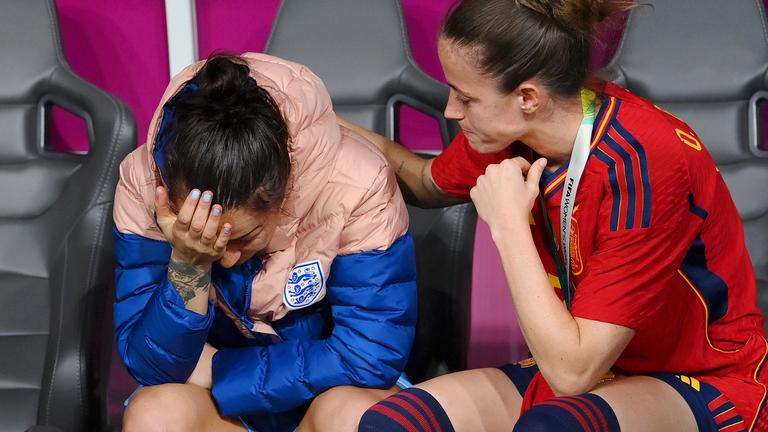
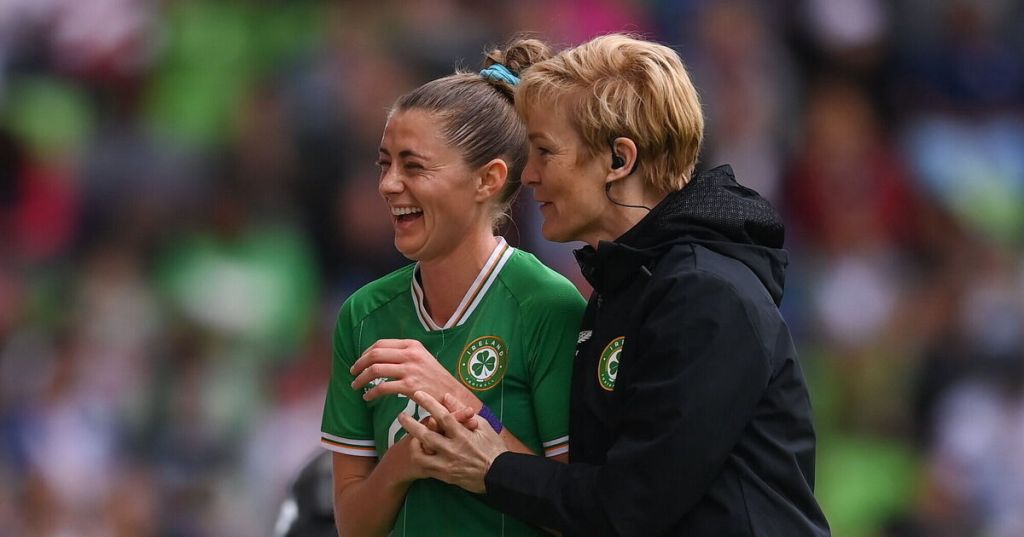
England’s Lucy Bronze is consoled by Spain’s Ona Batlle after the Women’s World Cup final. Photograph: Stephanie Meek/CameraSport via Getty Images
Spain’s victory over England in the Women’s World Cup final was about much more than football. The Spanish women were beautifully ruthless over the ninety-plus minutes. They kept England constantly off balance and frustrated their every attempt to acquire momentum. Twenty days earlier in Wellington, New Zealand, I watched Spain endure their biggest humiliation of the tournament, a 4-0 defeat by Japan. Their pride was stung by the elegant effectiveness of Japan’s press that denied space and time to their best players.
They took on board the hard lessons (suffering was a term many of them used) and grew into a solidified team that would not be denied. The Spanish players had multiple reasons, personal and collective, for winning the final. The sting of the loss to Japan; anger at the inept response of the Spanish Football Federation to a player protest in 2022, and the absence of key players who were frozen out after that protest. The sum total of those motivations always exceeded the English commitment. That old commentary cliche, They wanted it more, applied.
This is a Spanish movie that we have seen before. (Maybe Pedro Almodovar is looking for another script with a group of heroic women?) The backbone of this team are Barcelona players, the current European Champions. They had a variation on the Spanish midfield regulators from the men’s dominant era. You could think of Aitana Bonmati as a Xavi stand-in and Hermoso as a tall Andres Iniesta. The pair controlled the midfield action, creatively improving their performances against Switzerland, Holland, and Sweden. Hermoso has an uncanny facility for short passing that ensures possession and prises open threatening spaces for colleagues.
Spain emulated the Japanese-style press to unsettle England in every section of the field, with one player challenging for the ball while two others cut off the passing options. England’s two Barcelona players, Keira Walsh and Lucy Bronze, had a less happy evening in Sydney. Bronze went walkabout in the packed Spanish midfield, lost the ball, and in a flash, the play was switched to where she should have been. Russo was slow to cover and Carmona raced up to take a Caldentey pass and strike with deadly precision. Spain had been having a lot of success attacking up the left flank, and it finally paid off.
England contributed greatly to the contest. They rolled the tactical dice at halftime, bringing in Lauren James and Chloe Kelly and later pushing Millie Bright up to center forward. Mary Earps saved a penalty after some Bronze gamesmanship rattled Hermoso. It was all to no avail. Spain was not for shifting.
The photos in The Guardian article by Jonathan Liew and the one I used at the top of the blog are iconic and symbolic. The women’s game embodies levels of respect and compassion that are harder to find in men’s international football. For women players, the road to international representation is littered with stones, rocks, blocks, and (sometimes) kisses from the patriarchy. The fine line between victory and defeat may be more permeable for women. And, as noted by Liew, the top women have supportive friendships, alliances, and even rivalries that develop at their clubs.
My Petaluma correspondent, Charles Little, had this revelation after the U.S. exited the tournament. Currently, only one U.S. player, Lindsay Horan, plays for a top European club, Lyon. Maybe, Charlie said, the National Women’s Soccer League is no longer the best high-level, competitive league. The European leagues are the source of the best women’s football now. Three of the four semi-finalists were European, and Australia, the other semifinalist, has the majority of their players earning their living at European clubs.
The NWSL is still an invaluable proving ground for players from outside the U.S. with international aspirations. Ireland, for example, benefitted from the NWSL experience of Denise O’Sullivan, Sinead Farrelly, Kyra Carusa, and Marissa Sheva. How will the U.S. Women’s team be rebuilt, and how long will it take? It’s hard to imagine the program will not bounce back strongly, but the rest of the world has caught up fast. Spain, England, and other nations will not give up their leading roles easily.
The World Cup is reaching a very satisfying ending. It has been brilliant, thrilling, absorbing and hugely entertaining. The level of play has been outstanding and far superior to the patchy quality of the men’s World Cup in Quatar seven months ago or, indeed, many of the recent men’s competitions. And the drama has been over the top. The Australia-France penalty shoot-out? You could not make it up. Columbia putting the wind up England with a rugged and arrogant first half display? Spain finding form at last against the Dutch.
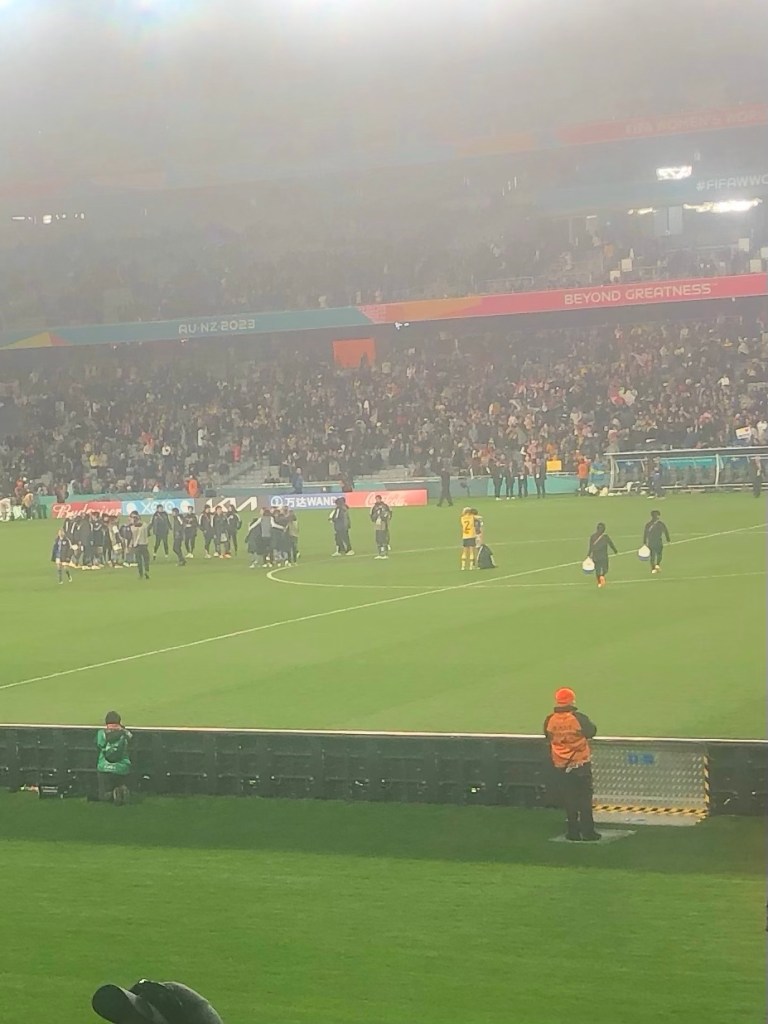
Our last live game was the quarterfinal between Japan and Sweden at Eden Park. A closely-contested game where Sweden blunted the Japanese press with a skillfully executed game plan. Japan missed a penalty at a crucial point and left it too late to pressure the Swedish defense.
We hung out at the stadium for a long time afterwards watching the devastated Japanese players, many prostrate on the field, some being consoled by one or two Swedish players.
Then, amazingly, they huddled and turned as a group bowing respectfully to their opponents, the fans, and to the field. They are a class act and we must wait another year before seeing them again in the Olympics in Paris. Even watching their pre-game warmup drills was a football treat: meticulous touches, rapid and exact passes, intricate patterns, powerful shooting. There is a purity of purpose in Japan’s playing that makes them a joy to watch. The players are always looking for the best choice in passing, patterns, pacing, movement, and speed. They were endlessly creative and dynamic.
Along with Japan, we saw Spain and Sweden live twice which means we have now seen one of the eventual finalists during our New Zealand travels. I started this piece before any of the quarterfinal games were played and was getting ready to predict a France-Japan final. So much for my predictions. Both Spain and Sweden have grown into better versions of themselves during the competition. Sweden has shown great flexibility in its playing formations and each player possesses a complete range of technical skills. Spain learned the hard lessons of that elegant demolition by Japan and came back renewed against Switzerland and Holland.
The Sweden-Spain semifinal on Tuesday is a delightful prospect. It will be the last game at Eden Park and sadly it kicks off just as we board a plane to return to San Francisco. On the Australian side, the home team earned their semifinal spot the hard way. They have major momentum but England will be ready after getting a stern test from Columbia. And my new prediction for the final? Australia versus Spain with Australia to win it, urged on by fanatical home support. It would be a fitting finale to a compelling competition. Whatever happens, we will have a new world champion. This is the last post from on the ground in New Zealand. We’ll have more to say and more considered social and cultural perspectives to offer later.
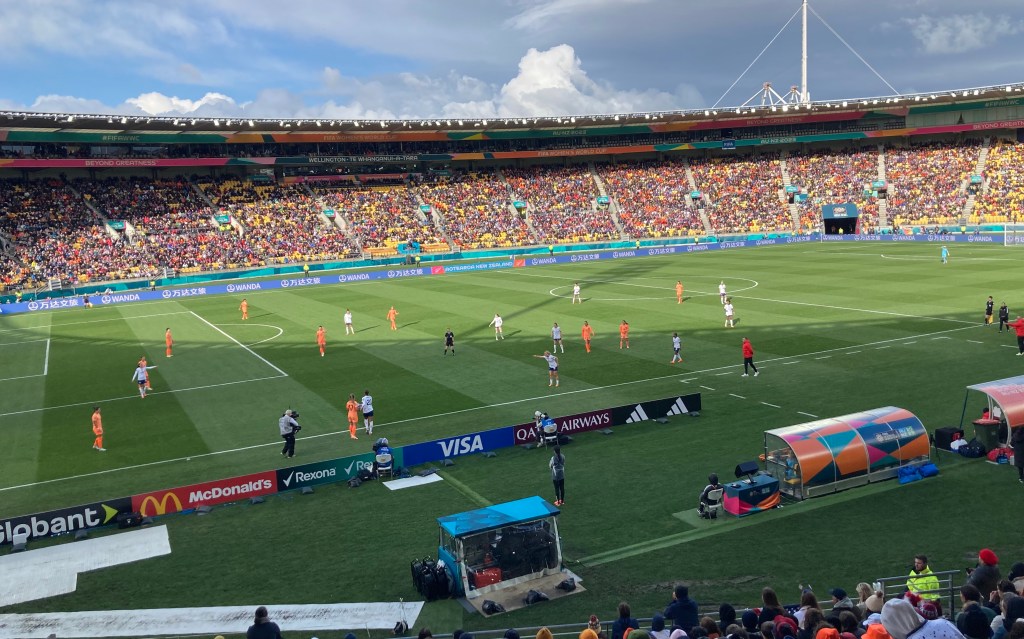
This was a strange game. The Dutch managed the midfield play for much of the first half and scored a fine goal against the run of play. Manchester City’s Jill Roord coordinated the Dutch resistance and scored the goal. Rose Lavelle was introduced at halftime and the US gained more superiority. Horan, in particular, was more effective in this new partnership. We had an excellent perspective on both goals and the other action at that end of the field.
Horan exhorting her teammates. Coach Andonovski spent a lot of time alone in the coaching box.
Horan clashed with her Lyon club teammate, Van de Donk, early in the second half and, with a flash of angry energy, met Lavelle’s corner and flicked a header into the net. There has been much speculation about why the U.S. made no more subs in the second half but no good answers. We noted that the reserves spent much of the game warming up behind the goals, in small groups at first but by the end everyone was out.
Rapinoe’s comment the day after the game about being too narrow are spot on. But also true is that Rodman and Smith got no joy from their encounters with the Dutch fullbacks. The switched sides a few times in the first half to no avail.
Episode 2: Sweden 5 -Italy 0
Italy had a fiery start and were defensively solid until Sweden curled some precise corner kicks into the packed six-yard box. One was a close thing but the next three were scored, two headers and a knee. Italy were dazed and confused to be three behind at halftime. Another headed goal from a corner shortly after the half put the result beyond doubt. A breakaway goal near the end was the icing on the cake. This was a bonus game for us in Wellington, getting tickets just the day before. FIFA’s digital ticket system has worked seamlessly and ticket resale prices are capped at 105% of the original ticket value, a very sensible policy.
New Zealand’s dream comes to an end
The Football Ferns can be proud of their work in their first World Cup. They bravely tried to match their performance in the opening game but came up short. But there have been huge spin-off benefits from the team’s appearance and their spirited approach.
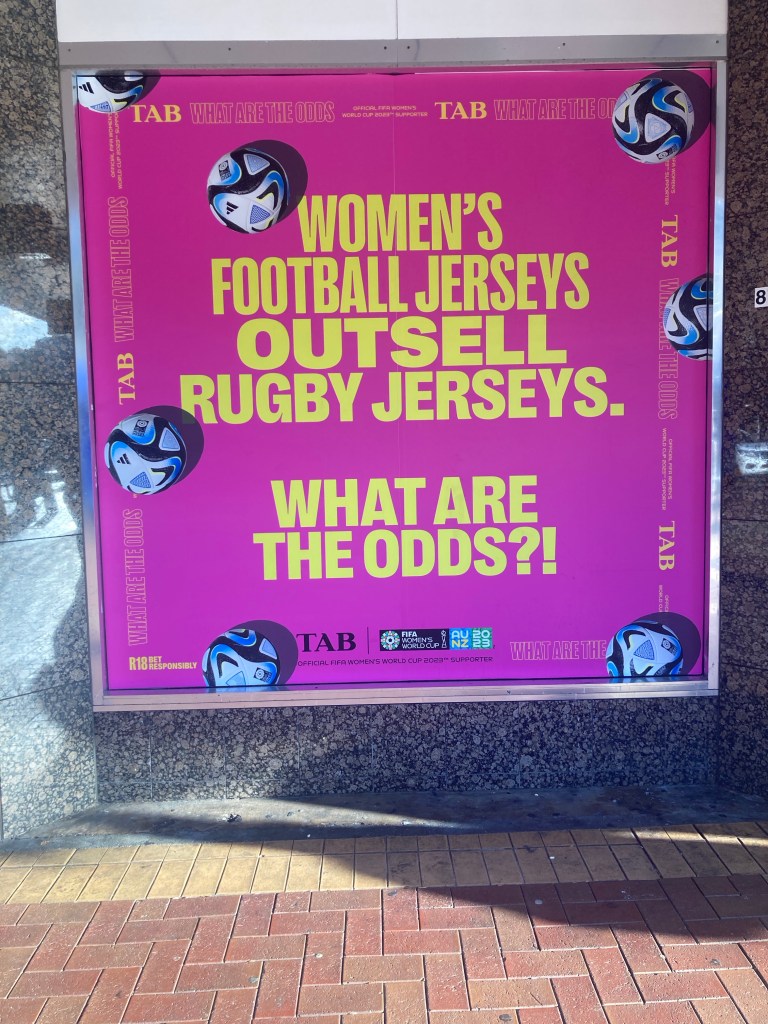
Here’s a poster in a Wellington shop that tells part of the story. In a nation where Rugby is practically a religion, this is a major change.
Episode 3: Japan 4 – Spain 0
Last night in Wellington we were fortunate to be at the best game of the tournament so far, Japan’s powerful and elegant demolishing of Spain. Japan launched an irrepressible press that completely disrupted any rhythm Spain hoped for. The Japanese are relentlessly effective at taking opportunities. Miyazawa raced by the Spanish defense after 12 minutes to score. Ueki cut inside from the left and shot but the defender’s block spun up and over the keeper for the second. Miyazawa struck again before the half, almost a copy of her first strike. Super sub Tanaka added a delightful fourth before the end.
Japan are a consummate team, a natural product of the communal culture of the country. There is a mysterious math to their formation: five at the back; seven or eight in the midfield; and, two or three up front. Spain lost count again and again. Japan are the only team with a perfect record, played three, won three, scored eleven and conceded no goals. Their goalkeeper, Yamashita, was largely untroubled by Spanish attacks but her distribution and goal kicks were exceptional. Japan are a very popular side with vocal supporters, many of whom are not Japanese.
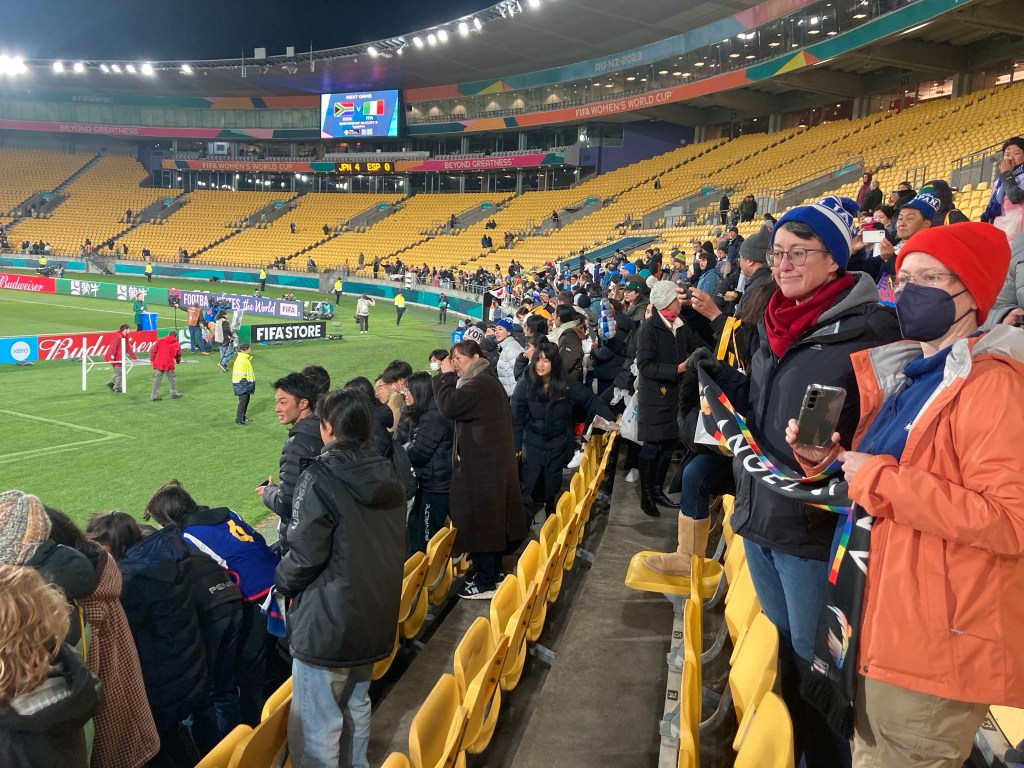
Supporters stayed on to congratulate the Japanese players after the game
This is a re-post from earlier in July contextualizing the Women’s World Cup.
FILE PHOTO: The Sydney Opera House lights up in celebration of Australia and New Zealand’s joint bid to host the FIFA Women’s World Cup 2023, in Sydney, Australia, June 25, 2020. REUTERS/Loren Elliott
The Women’s World Cup hosted by Australia and New Zealand is just a few weeks away, and I will be there. I am opening a new strand on the blog for the next couple of months, shifting to covering the World Cup and women’s football generally. On our first trip to that part of the world, my wife and I will spend a month in Auckland with side trips to Wellington and Queenstown. We will see four games in Auckland and two in Wellington. Auckland’s Eden Park stages the opening game with New Zealand, The Football Ferns, taking on Norway on July 20.
Next up, the opening game for the U.S. women in Group E against Vietnam, first-timers against four-time winners. Two countries with a lot of shared history but not in football. Then, the most competitive game for the U.S. team is when they square off against the Netherlands in Wellington on July 26, a repeat of the 2019 World Cup final. And two days later, two other ambitious contenders, Spain and Japan, go head-to-head for the top spot in group C.
I will be on the ground in Auckland, which is the base for the U.S. team in the group stages. I plan to bring some impressions, insights, and highlights to followers of the blog. More stories and drama are sure to emerge as the World Cup gets going.
Plenty of pre-tournament stones in the road
Just as the hope that the women’s games would bring more moral clarity and less corruption, things went sour early on. The Cup has already weathered a few crises. Many of the women’s teams had issues with their national federations, often male-dominated. The Canadian women threatened to strike and not participate in the She Believes Cup in February. Spain and France had to resolve squabbles between the players, coaches, and administrators. Pia Sundhage, the former U.S. coach who now manages Brazil, has complained about how chaotic the administration of women’s football is below the level of the national team.
The payments for European broadcast rights to the Cup were only recently settled. For a time, FIFA contemplated a toxic intervention into their own tournament: a possible sponsorship deal between FIFA and Saudi Arabia’s tourism authority. The Australian and New Zealand soccer federations were outraged by the proposed deal because of Saudi Arabia’s human rights record, especially regarding women and LGBTQ individuals. USA forward Alex Morgan was forthright: “Pretty much everyone has spoken out against that because morally, it just doesn’t make sense.” Of course, there’s the rub. When was the last time FIFA’s top leaders were in the same room with morality? Money, not morality, is frequently the driving force in world soccer.
According to the global players’ union, Fifpro, footballers were placed “at risk” during qualifying for the Women’s World Cup by a lack of medical support and substandard working conditions. The survey involved responses from hundreds of international players and highlighted how fragmented and badly scheduled the games for qualification were. Some of the world’s leading women’s players will not be playing due to major injuries, notably torn ACLs.
United States: high expectations, but is the mix right?
The United States is the pre-tournament favorite but can expect stiff competition from other nations with high-quality squads. The U.S. roster for the tournament was announced last week. It’s a solid mix of experienced and first-time players. Alex Morgan, Megan Rapinoe, and Kelley O’Hara will be making their fourth appearance in a World Cup, while goalkeeper Alyssa Naeher and midfielder Julie Ertz will be playing in their third. However, the U.S. will be without Becky Sauerbrunn in defense and in-form goal-scorer Mallory Swanson, injured in a friendly game against Ireland in April. Julie Ertz’s return will improve the intimidation factor, along with the spiky presence of Rose Lavelle and Lindsay Horan in the U.S. midfield. Four of the six selected forwards are making their first World Cup appearance: Trinity Rodman, Sophia Smith, Ashley Sanchez, and Lynn Williams. A great deal may hinge on their goal-scoring success. The U.S. team will play a final friendly game against Wales on July 9 in San Jose.
The First-Timers
The Irish Women’s team join seven others, Haiti, Morocco, Panama, Philippines, Portugal, Vietnam, and Zambia, in making a first appearance at the World Cup. The famous luck of the Irish deserted them with the group C draw, which has to be considered “the group of death.” To add to the pressures, Ireland opens against Australia in Sydney and then crosses the country to Perth five days later to play Canada. Ireland’s second to last game before the big tournament was against Zambia last week in Dublin. The Irish women (minus two of their stars, Katie McCabe and Denise O’Sullivan) won 3-2, recovering from a poor first half to a victory against an African team below Nigeria in the FIFA rankings.
Irish coach Vera Pauw is under no illusions. She says that if people expect the team to win the World Cup, they will be disappointed, but they intend to make the Irish fans proud. She makes many good points in this Irish Times Women’s Podcast. Vietnam played Germany, a pre-tournament favorite, in a friendly game this week and lost 2-1. Morocco may have the best chance of advancing to the second round, but all the debutants will face stiff competition and little mercy from their group rivals.
Australia looks strong and ready, New Zealand less so
Host nation Australia has high hopes, and their top-class players, Chelsea’s Sam Kerr and Arsenal’s Caitlin Foord, are in fine form. Canada, the 2019 Olympic Champions in Tokyo, is the other force in that group and will fancy their chances of advancing. Underappreciated Nigeria, who have played in every women’s World Cup since 1991, round out the group. They have won their last three friendly games this year and will be looking to advance further than before in the competition. New Zealand lost two games in Auckland to the U.S. in February and don’t look ready for prime time.
Happy and unhappy squads
Some nations have had relatively drama-free build-ups to the World Cup, others not so much. The U.S., England, Germany, Sweden, Denmark, and Norway have been preparing diligently. The English women have some significant advantages: reigning European Champions, a settled camp, and longer prep time than other countries. But key players are injured: Captain Leah Williamson and Beth Mead, leading scorer in Euro 2022.
France had lots of off-field drama, firing manager Corinne Diacre after falling out with some of the star players, Wendie Renard, Eugénie Le Sommer, and Amandine Henry. All the players have since resumed their French careers. The team is now managed by Herve Renard, an experienced World Cup specialist who has managed the men’s teams of Morocco, Zambia, and Angola.
Spain had similar problems going back to the Euros in 2022 when the coach, Jorge Vilda, refused to pick some key players due to disagreements about preparation and attitudes. A few players have since returned to the fold, especially the Barcelona (European Champions League winners) stars Irene Paredes, Aitana Bonmati, Alexia Putellas, and Mariona Caldentey.
The Big Picture on Women’s Rights
The global showcase of women’s sports is happening in a socio-cultural context that continues to be challenging and depressing for women’s rights. A recent United Nations Development Programme report concluded that nine out of ten people (of all genders) have a bias against women. This figure is the same as a similar study from ten years ago. You can be sure that this misogynistic bias has been operating in the build-up to the competition and will be reflected in the coverage and viewership of the Cup.
I have been lucky enough to see men’s World Cup games during the 1994 competition held in the U.S., and I hope to see some more in 2026 when the competition returns to these shores. My best years playing soccer were in the San Francisco Co-ed league with the character-laden, ironically named MUD team. Most of the women players (let’s hear it for Title IX) were better than the men, myself included. It was the most engaging, satisfying, and sporting experience in my many years of team play.
I am conscious of the dangers of men writing about women’s soccer. I hope to judge the games on their own terms and limit over-simplified comparisons with the men’s game. I enjoy women’s soccer because teamwork and cooperative patterns of play are more visible. The team’s the thing in women’s football. There is significantly less ego, grandstanding, and “diving” to draw foul calls. Games are competitive, particularly on the World Cup stage, but also more sporting and compassionate. There is more respect for match officials. I plan to use no disrespectful terminology, like “girls” or the patronizing “ladies.”
My Early Group predictions: Winners, Second
Group A: Norway, Switzerland (Sorry, New Zealand)
Group B: Australia, Canada (Sorry, Ireland)
Group C: Spain, Japan
Group D: England, Denmark
Group E: U.S.A, Netherlands
Group F: France, Brazil
Group G: Sweden, Italy
Group H: Germany, Morocco
I use a variety of sources for football news and updates: The Irish Times, ESPN, San Francisco Chronicle. And the Guardian, especially the weekly newsletter, Moving the Goalposts covering women’s soccer:
This is my second World Cup post and the last before leaving for Auckland later this week. I will be posting football news and views, impressions of New Zealand, photos, and whatever else takes my fancy in the build-up to the opening games on July 20. Stay tuned.
Sinead Farrelly and Vera Pauw
Sinead Farrelly -Overcoming Injury Time
Sinead Farrelly’s road to representing Ireland in the World Cup was more rocky than most. She had not played professionally for seven years, a lifetime for a professional footballer, more than the career of many players. Farrelly’s long break was prompted initially by the abusive actions of one man, a coach named Paul Riley. She represented the United States at every level up to Under-23 until his harassment forced her out of the game in despair. In 2021, she went public with her allegations about Riley which in turn sparked an investigation into abusive behavior by coaches in the US women’s league. Riley was banned for life from any involvement in U.S. soccer in January of this year.
Then, to compound her suffering, she was injured in a car accident and required years of treatment for concussion and whiplash. She only returned to play professionally this year, signing for Gotham FC in the NWSL and making a solid debut for Ireland in a friendly game against the U.S. Farrelly qualifies to play for Ireland through her Cavan-born father. Irish coach, Vera Pauw, encouraged Farrelly to resume playing and picked her for the Irish squad.“We were waiting on a player like Sinead,” said Pauw after her debut when she showed what a composed and skilled midfielder she is. There is more detail in this Irish Times story on Farrelly’s brave choices for herself and for women’s football.
Pauw herself has become collateral damage in the fallout from the NWSL investigation into abuse and misconduct by coaches. She was the manager of the Houston Dash for one season in 2018. Some players and staff at the club have accused her (anonymously) of belittling players and being overly controlling. Her situation is complicated and fraught, and I have included a link for those who have not followed the story. She has the support of the Football Association of Ireland (FAI) and the team, but it must be an unwelcome distraction for Ireland’s preparation for the competition.
The Irish women got a reality check last week when they played France in a friendly before the World Cup. The team looked solid for 45 minutes, giving the French a scare but lapses in concentration presented two goals to France in added time before halftime. One goal was a gift, the other was well taken by the deadly Eugenie Le Sommer. A third goal from a corner on the hour was even more of a gift. Ireland hung on doggedly but heads were down long before the game ended. Captain Katie McCabe was injured and replaced at 30 minutes. Her combative presence was missed and France took full advantage of her absence. There were bright spots. Sinead Farrelly brought crafty skills and guile in the midfield. Denise O’Sullivan was energetic and influential throughout. Kyra Carusa led the line impressively, earning the MVP award, no mean feat when you are being marked by Wendie Renard.
Marta, Brazil’s football Queen
Brazil’s enduring and exceptional star, Marta Vieira da Silva, makes her sixth World Cup appearance, her last outing at the highest level. (She shares this honor with Canada’s evergreen Christine Sinclair.) Marta has been a shining and assiduous presence for over twenty years in international football. She is not likely to start for Brazil as she recovers from a knee injury (on her magical left leg), but her inspiration is vital to her country’s hopes. “Marta is the queen, the icon, and just to be around her is contagious,” Pia Sundhage told reporters as she announced the Brazilian squad. Marta has won six FIFA World Player of the Year awards, more than any other player.
I asked my 11-year-old granddaughter, Olivia, to watch this short film on Marta’s career:
Coming from a difficult past, Marta managed to put it behind her and start her dream of becoming a football player. I’m glad she made it into the squad of Brazil’s women for the World Cup. She is an amazing player with so much passion and courage.
Getting the balance right
One of the challenges faced by World Cup teams is how to strike a good balance between experience and freshness. Players who starred previously in the competition (four years earlier) may have lost form or enthusiasm or be missing entirely due to injury. New, often younger players may be overawed, overeager, outclassed, or not sure of their role in the team. Chemistry and camaraderie are essential qualities to which everyone must contribute. This can be especially vexing for teams that are expected to do well, like the United States, England, France, Germany, and Spain, all of whom will be hoping that new players settle quickly into the team culture.
The U.S. farewell game against Wales this weekend was a case in point. Seven of the starting team are heading for their first World Cup, and it showed. The wise heads kept the team bonded: Crystal Dunn, Lindsay Horan, Alex Morgan, and later Lynn Williams. The wise ones on the bench, Rose Lavelle, Megan Rapinoe, and Julie Ertz, were sorely missed. The newcomers played well but the blend was off for large parts of the game. Passing was erratic and slow, and chances in the final third were scarce. Until star-in-waiting Trinity Rodman, who replaced Morgan at halftime, took hold of the game with two well-finished goals late in the second half.
Rapinoe announced her retirement from club and country this year. She has already transitioned to a hybrid role with the U.S. as a part-time player and full-time motivator and leader off the field. She has forthright views on the larger significance of this, the ninth Women’s World Cup and the first to include 32 teams.
“It is actually terrible business if you are not tuning in. You are missing out on a large cultural moment. I think we know that bottom line, equality is actually good for business, that is something special that the women’s game has and this is the premier women’s sporting event in the world, bar none, and this is a paradigm shift globally, not just in the U.S.”
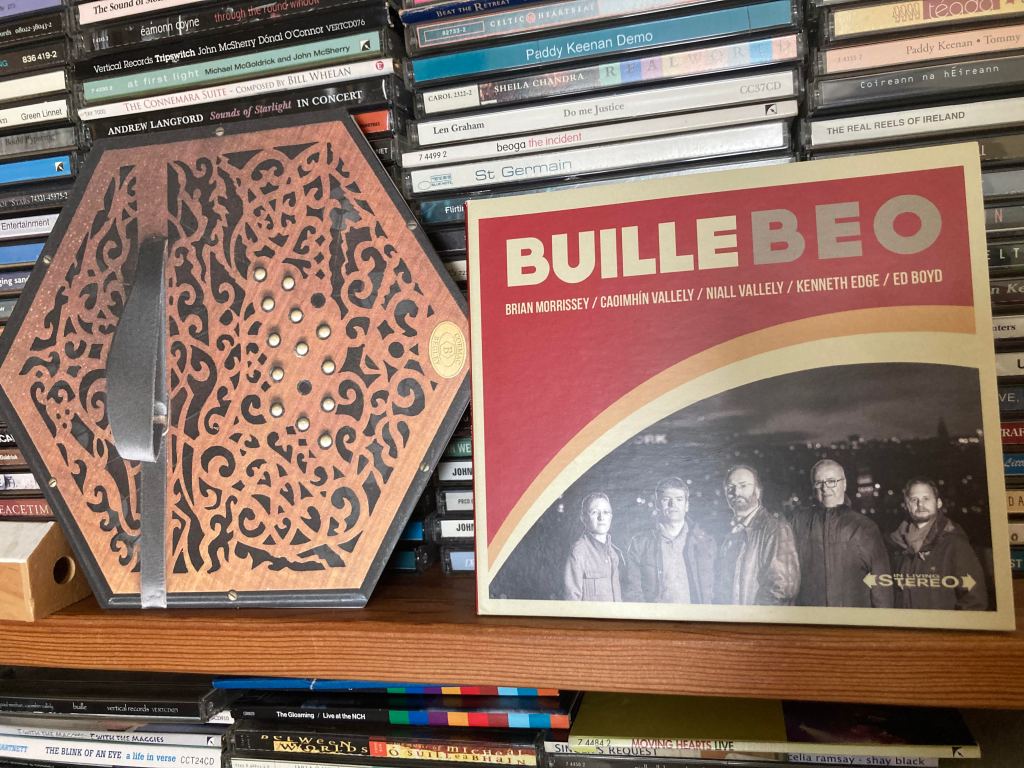
My post on Cormac Begley’s Vicar Street concert was out in the web world before I got a copy of his album, B. It arrived this week, and it’s a thing of beauty. The playing, the music, the design, and the dedication to delivering a concertina concept album. That’s the beauty on the left of the photograph.
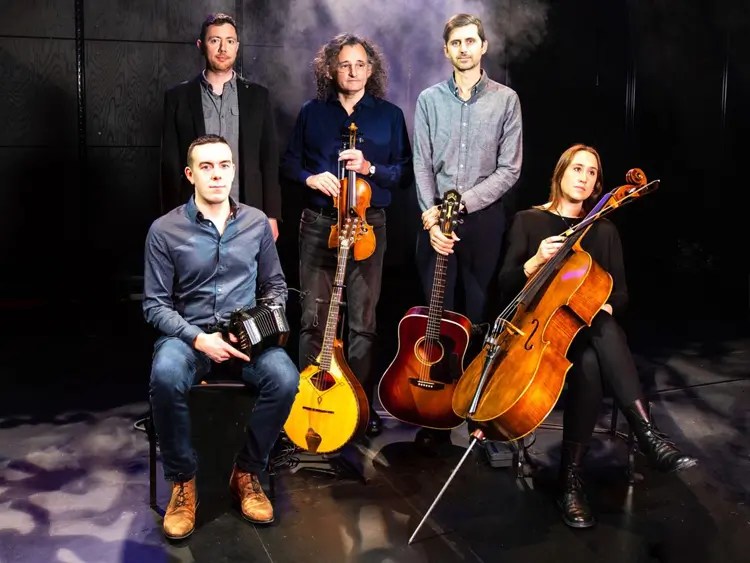
I also recently received a “hard copy” of another album I recommended in that post, Niall Vallely’s Buille Beo. It, too, is an exceptional musical achievement, a live album recorded in Ballyvourney, Co Cork. Vallely is partnered with his brother Caoimhin on piano, Ed Boyd on guitar, Brian Morrissey on percussion, and Kenneth Edge playing some gorgeous soprano saxophone. Almost all the tantalizing tunes are composed by Niall and Caoimhin. The one that isn’t, In A Silent Way, is a Joe Zawinul composition immortalized by Miles Davis in an album of the same name. The version here is simply delightful, paired with an Indian-influenced tune written by Niall Vallely.
New music from Martin Hayes is always worth the wait. He is primarily a live performer but his recordings are unique, accomplished, and accessible. Peggy’s Dream is a graceful and adventurous album, building afresh on his other ensembles: The Gloaming, The Blue Room Quartet, Brooklyn Rider, and his long, profound partnership with the late Dennis Cahill. The album is dedicated to and inspired by Cahill and Hayes’ mother, Peggy.
Hayes brings a high degree of artistic, intellectual, and cultural credibility to Irish music, universally defined. He takes traditional music to the most prestigious arenas where it meets many other music genres as an equal and a willing partner. He has expanded and enriched Ireland’s cultural capital as a musician himself and as a facilitator of imaginative combinations. His partners on this new album are luminaries in their own right, selected for their musicianship and mutuality.
Cellist Kate Ellis is a prolific performer and musical leader. She is the artistic director of Ireland’s leading contemporary music group, Crash Ensemble. Her folk and traditional interests are well established, having played and recorded with Iarla Ó Lionáird, Gavin Friday, and Karan Casey. Guitarist Kyle Sanna has worked with Seamus Egan and Dana Lyn. Cormac McCarthy is a pianist, composer, arranger, and conductor from Cork. He is primarily a jazz and contemporary music artist with an album/band called Cottage Evolution. Brian Donnellan is the most mainstream traditional member of the group playing bouzouki, concertina and harmonium. Like Hayes, he is from an East Clare family and is a member of the legendary Tulla Céilí Band.
I have long thought that there is a case for the cello in the Irish tradition. The seminal Hidden Ground recording in 1980 from Paddy Glackin and the late Jolyon Jackson was a major influence on my thinking in this respect. I described it previously as the most artful deconstruction of Irish traditional music up to that point. Jackson played cello and a multitude of other instruments on the album, and his playing was also featured on The Chieftains Boil the Breakfast Early the previous year. More recently, Iarla Ó Lionáird’s thrilling and brilliant 2011 album, Foxlight, had two cello players, a viola, and Caoimhín Ó Raghallaigh! It sets a new bar for the integration of cello into traditional arrangements. It could well be an inspiration for Peggy’s Dream and this grouping. The hidden ground is now part of the commons.
The cello brings other dimensions and flow to the slower, more contemplative tunes. The Boyne Water opens with a jaunty melody from the fiddle and piano, then darkens with the cello’s arrival and a set of low, deep chords on the piano. Cá Bhfuil An Solas is a Peadar Ó Riada composition first recorded on the Triúr Arís (Three Again) album. The piano lays down a lively backing. Garrett Barry’s Jig has a moody, dissonant start with somber cello and harmonium throughout. It’s a mesmerizing piece with a perfect tonal balance of low and high. The Glen of Aherlow was written by Tipperary fiddler the late Seán Ryan, a prolific composer. Here it gets the “high lonesome” treatment from Hayes with a tight bit of ensemble playing, Sanna channeling Dennis Cahill on guitar. The piano and cello colorations are delightful. Aisling Gheal is a “goltrai” (an old Irish term for a lament) classic where the fiddle gets pride of place with empathetic piano.
The title track, Peggy’s Dream, was sourced by Steve Cooney from the Goodman Collection, like the Fainne Geal An Lae track on Foxlight. Plucked strings (is it piano or cello?) give a percussive base to the tune that is picked up by the concertina and fiddle. Like a few other tracks, this has a gentle, fade-out ending, perhaps dictated by the limitations of making a record. Live performances of these tunes may be very different.
The more up-tempo tracks contain the bones of Hayes’ trademark long sets. Toss The Feathers/The Magerabaun Reel opens with fiddle and guitar before McCarthy embarks on a jazzy piano section with shades of The Gloaming and Thomas Bartlett. Hayes soars to a big flourishing finish spurred on by the company. Johnny Cope, an old hornpipe I first heard on a Planxty album, is paired with the vivacious Hughie Travers’ Reel. The Longford Tinker has the rhythm of a joyful train journey.
Hayes worked with McCarthy and Donnellan on a gorgeous EP recording, Live at the NCH 2020. Like any creative person, Hayes does not like to repeat himself. Even with tunes he’s played hundreds of times, he is always looking for another angle, a deeper emotional realm to explore. In his musical memoir, Shared Notes, Hayes describes it like this:
I must go to the space that I want others to enter, go as deep as possible and trust that the invitation is powerful enough for others to come along.
Some of Hayes’ favorite melodies get beautifully reconsidered on this album: Lucy Farr’s Barndance and, one of my all-time favorites, The Wind Swept Hill of Tulla.
Hayes is a vivid expression of the history of Irish music, a procession of musicians, composers, and listeners that stretches back many hundreds of years. His playing was so rooted in the best of the past that, in his early years, older musicians called him a ghost. Martin Hayes’ ensembles seem to be almost covenants. They are a set of intentional relationships intended to advance the tradition and enhance the Irish musical legacy. The Common Ground Ensemble enriches the musical identity of high-level players like Ellis, Sanna, McCarthy, and Donnellan. This is a beautiful recording brimming with inventiveness, intelligence, and integrity.
Sources, Resources, and links to the artists:
The next opportunity to see Hayes perform with some of his many musical partners will be August 23-27, 2023, at the West Cork Music venue in Bantry.
Mrs. Elizabeth Crotty must have been dancing with delight in the afterlife. The legendary concertina player would be astounded that one man playing that iconic instrument could fill a large hall and be so rapturously received. It was a memorable concert in Dublin’s most eclectic venue with excellent sound quality and a deeply appreciative audience. The opening performer, singer-songwriter Niamh Regan from Galway, set the stage beautifully.
Begley began by strapping on wrist supports for each hand. His playing of the larger bass concertina requires strong and forceful actions. The instrument is extremely versatile, with built-in plaintive tones for slow airs and laments and powerful, percussive sounds (enhanced by rods attached to one of the concertinas) for marches, polkas, and slides. He brought a collection of instruments: bass, baritone, anglo, piccolo, and a baby concertina. And took the time to educate us about the origins of the instrument with short demonstrations on the “Jew’s Harp” and the harmonica, precursors of the concertina.
The range of ethereal tonalities and deep sighs he draws from the “breathing” box is extraordinary. I hear echoes of Doug Weiselman’s bass clarinet on Martin Hayes’ The Blue Room Album or, from an earlier era, Steve Cooney’s didgeridoo playing on the album, Meitheal, with Begley’s late uncle Séamus. The late Tony Mac Mahon is another clearly audible influence, and Begley played a set he put together for Tony’s 80th birthday concert.
Begley is a beguiling and brilliant figure among younger traditional players. From a famous West Kerry musical family, he has blazed a unique path playing solo and in various fruitful combinations with musicians such as Caoimhín O Raghallaigh, Martin Hayes, Liam Ó Maonlaí, Liam O Connor, Lankum and Lisa O Neill. Ye Vagabonds are frequent partners, and Brían Mac Gloinn from the duo was a guest at this concert, singing and playing mandolin. Begley first came up on my radar in a Myles O’Reilly film where he sits beside the Shannon playing the bass concertina. The sound was loud and loamy, like uilleann pipes from another dimension.
During his wry and funny interstitial comments, Begley noted that Kerry people don’t come to Dublin to take part: they come to take over. Which he did, as storyteller Eamon Kelly used to say, with a group of West Kerry set dancers, two cousins on accordions and concertinas, and Stephanie Keane, a loose-limbed traditional dancer from Limerick. His mother was in the audience too but with his vigorous, virtuoso playing gave her no opportunity to use any of the cryptic put-downs he ascribed to her on the night.
The concert was the musical highlight of my Spring visit to Ireland. I went with my son, Bryan, who heard plenty of Irish music growing up in our family, but Begley upended his perceptions of traditional music. He was deeply impressed. “I was blown away by his interaction with the crowd and the enormous energy it took to captivate the audience with the squeezing of a small musical box. A powerful performance of incredible music by one of Ireland’s future greats.”
Additional Resources on Cormac Begley and other concertina players
Myles O’Reilly’s film, Backwards to go Forwards, was the one that introduced me to Cormac Begley and other cutting-edge Irish artists. There’s more of him on YouTube
A (very) partial list of concertina players and recordings:
There are a number of women concertina players who continue the Mrs. Crotty line. Mary McNamara is a concertina master from the Clare tradition. Caitlín Nic Gabhann and Edel Fox are two well-known musicians who feature in The Irish Concertina Ensemble alongside Mícheál Ó Raghallaigh, Pádraig Rynne, and Tim Collins.
Noel Hill was the trailblazer who drew from a rich Clare traditional background but expanded it exponentially. He is a noted concertina teacher who gives classes in the United States.
Niall Vallely has been one of my favorite concertina players for years. He composes a lot of his own music, and his playing has a “blues harp” and jazz feel to it. His three albums are Buille and Buille 2 and, the most recent, BuilleBeo.




 The Old Blog Node