Author Archives: An Fear Blog Eireannach

Unknown's avatar

About An Fear Blog Eireannach

Lacking any musical talent, I started writing about Irish music and arts more than 20 years ago. My writing has appeared in Irish Music Magazine, the Irish Herald in San Francisco, History Ireland, and several artists' websites. More recently, I have been writing about the Women's World Cup in Australia and New Zealand.

Secret Superstars: The Hidden History of the Kennedy Cup

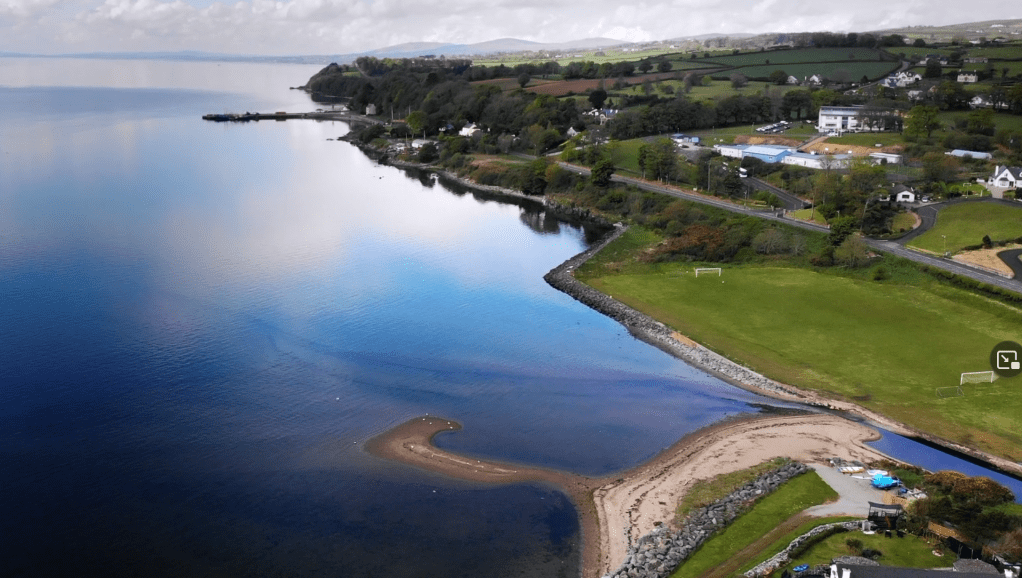
The field in Moville where the Kennedy Cup was played

For fans of Donegal, football, and quirky stories that had almost slipped away, Secret Superstars: The Hidden History of the Kennedy Cup is a real treat. A summer tournament that was played in Moville, Co Donegal featured teams that combined junior (non-professional) players and big-name players from clubs in Scotland, England, Northern Ireland, and the Republic. The catch was that the professionals were not supposed to play during the summer months but they found various ways to play incognito. The Cup was played from the mid-1950s up to the start of “The Troubles” in 1970.

A labor of love produced and directed by Tom O’Flaherty, the film explores how some of the best professional footballers of the 1950s and 1960s came to the picturesque little shoreside pitch in Moville to play in the Kennedy Cup. The prize money of two thousand pounds sterling was the big draw but the camaraderie and hospitality of the town were equally attractive. This was long before professional soccer players were paid daft sums of money for signing or transferring from club to club. The local volunteers fund-raised year round to get that prize money, almost 60,000 pounds in today’s money.

O’Flaherty found some fine eye-witnesses to interview. Paddy Crerand, of Scotland and Manchester United, was more of an ear-witness (he never played in that Cup) but he heard the unlikely stories and fills in some of his own footballing history. Johnny “Jobby” Crossan from Derry was someone who did feature in the Cup throughout his extensive professional career with clubs in England, Northern Ireland, Holland, and Belgium.

The archival football footage is remarkable and three of the men who filmed get mentioned in the credits. And there are classic scenes from the famous European Cup finals of 1967 and 1968 won by Glasgow Celtic and Manchester United. Celtic’s wing wizard, Jimmy Johnstone, did play in the Kennedy Cup but watch him dancing by defenders in the European highlights. Donegal produced two legendary Irish football goalkeepers, Packie Bonner, and Shay Given, but this film includes a surprising revelation about the great Irish actor, Ray McAnally, who grew up in Moville.

I can testify that Moville is and was passionate about football and Glasgow Celtic in particular. I stayed one night in Moville during a driving holiday in the late 1990s through Antrim, Derry, and Donegal with my son, sister, and brother-in-law. We went to a small pub for dinner and were ushered into a side room with a cosy fire. Over the fire, where many houses would have had a Sacred Heart picture, there was a large painting of Henrik Larsson, the Swedish international star who was then playing and scoring goals for fun at Celtic. The picture of him with his glorious dreadlocks dominated the room. The film was screened at the San Francisco Irish Doc Fest on Saturday, March 4, along with some other intriguing films: Violet Gibson: The Irish Woman Who Shot Mussolini; North Circular; and, The Man With The Moving House, Brendan Begley’s saga about getting permission to build on his ancestral land near Dingle.

The Team’s the Thing: Reflections on the 2022 World Cup

Morocco player Sofiane Boufal dancing with his mother

Watching the games of the 2023 World Cup in Qatar was, in equal measure, uncomfortable and compelling. How do we assess the moral balance sheet of this tournament? Is the notion of morality even applicable with FIFA? Can moments of footballing loveliness ever be considered more valuable than the lives lost, the obscene spending on transitory stadiums, and the astounding, continuing carbon footprint? But the football and Messi were exciting, often beautiful and highly competitive. It was a humbling experience for some of the big football nations: take your pick from Germany, Holland, Spain, Belgium, Brazil, Portugal or England.

Morocco were the feel-good story of the tournament and the images of Moroccan players dancing with their mothers are unforgettable. But there were many admirable teams who played their hearts out. Neutral fans like myself found it hard to pick a side in the third-place game where Croatia’s compact, creative midfield finally ended Morocco’s dream. Then, there was the speedy, purposeful football from Japan; the valiant South Koreans, and the rugged play of Australia and Switzerland.

Messi showed up with his magic feet and a renewed commitment to winning. I have written about him glowingly before and his influence on the time-space continuum. And more critically, the team around him were deeply invested in giving him a fitting farewell to his international career. Argentina’s victory was like the second coming of Diego Maradona who brought the Cup home in 1986. Messi is a more complete player but less charismatic person than Maradona, as my former East Bay United teammate and Argentinian, Andy Connell notes.

Maybe lifting the World Cup will correct that charisma deficit. Messi has always been easy to admire and love, unlike Ronaldo, who is an equally graceful player, but rarely gracious. Teammates seldom wax eloquent about Ronaldo but nobody has a bad word to say about Messi. Ronaldo’s egotism often got the better of him in team dynamics. He seemed to spend more time sulking on the sideline than playing in this competition, an inelegant finale to his international career.

It was not a happy tournament for those who fixate on star individual players like Neymar, De Bruyne, Van Dijk, or Lewandowski. None were able to bring their team beyond the quarter-finals. The two best individuals, Mbappe and Messi, were integrated into solid teams and showed their class in the exhilarating finish to the Final with the two best goals of the tournament. And then, there were other stars in waiting who stepped out of the shadows here: Brighton man Mac Allister for Argentina, Chelsea player Ziyech for Morocco and Gvardiol for Croatia. 

Argentina had hundreds of “brujas” casting spells to protect Lionel Messi and the team. England, on the other hand, were undone by a kind of karmic deficit (Brexit?) against France. Olivier Giroud, who is so familiar to English Premier players, slipped between Stones and Maguire to head home the decisive goal and then, almost unbelievably, Harry Kane misses the second penalty kick. It was disappointing for Gareth Southgate who has shown leadership qualities that are sadly lacking elsewhere in the English political sphere. And ironic because the quality of football in the Premier League (itself an anti-Brexit project before that nightmare was foisted on English people in 2016) is a big reason for the renewed credibility of the English team.

During the competition, I watched the Netflix series, FIFA Uncovered. It made for sobering viewing exposing the full stories behind the disgraceful shenanigans that brought the World Cup to Russia and Qatar and cast some shade on the decision to award a World Cup to South Africa. The revelations about behind-the-scenes bribery, corruption and sports-washing that went into the decisions to hold the World Cup in two totally unsuited locations were distressing and depressing.

Of course, there is a long history of politically ambitious, power-hungry administrators with a purely transactional attitude to football. In Ireland, we had John Delaney running the Football Association of Ireland as his personal fiefdom for years and the 2002 debacle of Roy Keane’s abrupt departure from the Irish squad’s preparations in Saipan.

Sepp Blatter, who is banned from participating in the game until 2024, had no regrets and claimed he was not responsible for the actions of representatives from other countries or cultures. The U.S. representative on the North American federation (CONCACAF), the late Chuck Blazer, was finally forced by the FBI investigators to spill the beans on all the illegal wheeling and dealing. Two notable and timely tidbits about him from the documentary: he lived in Trump Tower and had not paid any taxes for 15 years -is it something in the water there?

I have written about the FIFA scandals previously in 2015, when the s-word hit the fan, a piece called Bye, Bye Blatter.  

“There has always been a certain type of narcissistic, immature -invariably male- character attracted to administrative roles in soccer. In my experience, it can happen even in youth leagues. The opportunity to exercise power and authority is irresistible for some who are patently ill-suited to the responsibility. They are generally disinterested in the more beautiful elements of the game which don’t readily translate into bottom-line or status considerations. FIFA is a graphic, global example of this phenomenon and maybe the worst offenders will finally be held accountable.”

But don’t take my word for it. The late Eduardo Galeano, in his extended love poem to the game, Soccer in Sun and Shadow, has plenty to say about administrative ineptitude and the stench of corruption which has hung over FIFA for years. His pithy indictment of FIFA: “Like everything else, professional soccer seems to be run by the almighty, even if non-existent, UEB (Union of the Enemies of Beauty).

Or Phillip Lahm, the German international and Bayern star, who Pep Guardiola called “the most intelligent footballer I have ever coached.”

“There is nothing wrong with football itself. But the people who govern, manage and market it are squandering the unrestricted joy of it. They forget that they are merely service providers for a common good.”

It is time for FIFA to start making reparations for past and current sins. The decision for where the 2030 World Cup will be played has not been made. Let’s cut through the crap and award it to Morocco, who has tried five times unsuccessfully to host the Cup. Saudi Arabia is said to be interested, but please?

One other annoyance in the World Cup coverage in the United States is the unevenness of Fox Sports coverage. It leans towards jingoistic, lowest common denominator commentary and analysis. Yes, I am talking mainly about Alexie Lalas who dug a fine hole for himself by admitting early on, that he had never warmed to Messi.  Fox Sports is stuck in a kind of early 90s time-warp where U.S. audiences needed spoon-feeding about tactical approaches, styles of play, and the rules of the game. They don’t seem to realize that almost ten years of continuing soccer education from NBC Sports sophisticated coverage of the Premier League has greatly expanded knowledge and appreciation for the game. The coverage on the Spanish channel Telemundo was often more enjoyable to watch.

****

Commonwealth Closing

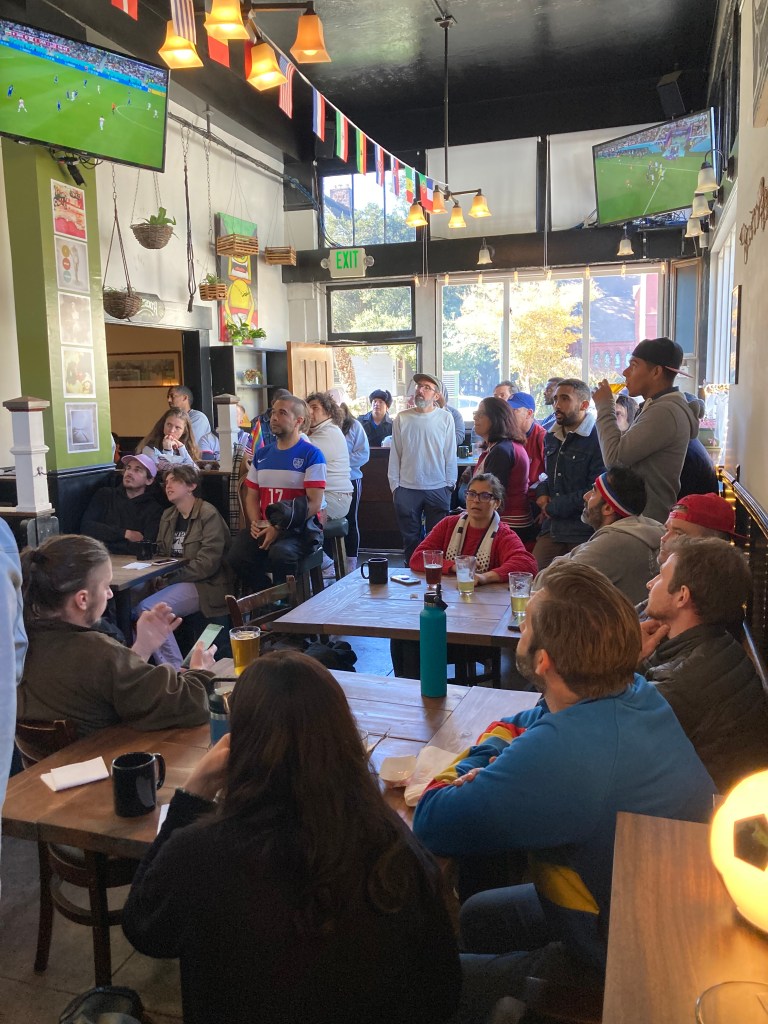
A sad note for East Bay soccer fans was the closing of Commonwealth Pub in Oakland at the end of the World Cup. It was a fine, friendly location with good food and drink that drew a diverse crowd. I went to the US-Iran final group game. The place was packed. Brian Watt from KQED radio was working the room, interviewing fans. I have always enjoyed his work, so it was a fun sidebar seeing him in action.

*****

Women’s World Cup 2023

I plan to write more about football in a sub-section of the blog titled Foot Notes. I will be in New Zealand next summer for the Women’s World Cup and I plan to offer a series of pieces about the teams and the players before and during the competition. I have tickets for six games, four in Auckland and two in Wellington. The competition opens in Auckland with New Zealand against Norway followed by the United States versus Vietnam, a meeting with a big historical shadow. Can the women’s game transcend the misogynistic FIFA culture? We shall see. If you come for the football, please stay for the music.

Songs of the Road by Vincey Keehan

Vincey Keehan was sidelined by the Covid lockdown but it gave him time to write some new songs and pull some old ones from the bottom drawer. Before he knew it, he had a fine album on his hands, Great Highway. Galwayman Keehan is a vital, long-time node in the San Francisco Bay Area music community. He gathered the village luminaries to produce this lively, lyrical collection of songs, a piece of high-level, homemade art honed over years of playing with like-minded working musicians.

My first impression of these songs with the traveling themes was that Mayo Troubadour, John Hoban, might have a hand in the work. And, sure enough, Hoban gets credited with inspiring Keehan years ago to begin writing songs that were personal and dealt with everyday life. Blended in with memories of childhood and life in Ireland it makes for a memorable mix. Keehan composed all the songs and does most of the singing with help from his son, Michael, and daughter Rosie. The liner notes include a number of beautiful historical family photos.

The album is filled with sturdy, tuneful songs. Any worthy singer-songwriter would be proud to have songs like Working the Streets, Rosmuc Hero, Going Down the Road, The Classic, Argentina or Georges Street.  Working the Streets has a measured pathos with Rosie on vocals. Eamonn Flynn on piano, Kyle Alden on guitar, and Dana Lyn on fiddle provide a lovely setting for a sad story. Going Down the Road is a fine country anthem with the pointed refrain,

You call me anytime you’re thinking about the road.

The Classic is a honky-tonk opener inspired by nights at the Classic Ballroom in Gort, Co Galway, Keehan’s home territory. It’s a sketch of his journey from the showbands to traditional music and later emigration to the U.S.  The band are firing on all cylinders: the ubiquitous pair of Flynn and Alden; Gas Men regulars Kenny Somerville and Cormac Gannon; and backing vocals from Michael Keehan and Susan Spurlock

Argentina was my favorite song on The Gas Men’s Clement Street album with the touching lines, Although we speak in Spanish now, in Gaelic we sing our songs. Here Mary Noonan takes the lead vocals.  It’s a lovely lean arrangement with Colie Moran on acoustic guitar and Paddy Egan on concertina. Another uncluttered song is the ballad, The Lovely Woodlands of Clare, a tribute to Keehan’s niece, who died tragically at a young age. 

Rosmuc Hero honors the boxer Sean Mannion. The song tells the poignant, painful portrait of a man’s rise, fall, and redemption. It has a layered lonesome sound with sax, guitar and harmonica. Make It Back is sung vigorously by Michael Keehan, giving Van Morrison a run for his money. Along with Morning, this is a new song developed in street sessions during the Covid lockdown. This song and Pride Comes Before the Fall are wonderfully embroidered by Bill Sparks saxophone playing.

Many of these songs will have longevity and be carried on down the highway by other singers. Kyle Alden shows the way with Georges Street on the album with a solo performance. He applies the style from his W. B. Yeats albums Songs From the Bee-Loud Glade (2011)and Down in the West, Volume I (2013). Yeats might relish lines like, 

My mother said my neck would break,

Staring at the Gateaux cakes.

Alden contributes some musical adornment on almost every track and co-produced the album with Keehan.

Another delightful ballad is I Got to Dance with the Rose of Tralee. Rosie Keehan’s other claim to fame was representing San Francisco at the Rose of Tralee Festival in 2014. She also gets her own song Rosie is Going to School, one of Keehan’s early songs. The Blackbird Set is a fine string adventure with the band showing their traditional chops on two mandolins, a fiddle, a concertina, and guitar.

Keehan has been singing trad and folk songs for many years. There are songwriting lessons to be learned from the old songs and Keehan has absorbed them well. He continues his journey down the Great Highway, making all the stops along the way. Like many of us, Keehan found the San Francisco Bay Area is just like the Hotel California: you can check out any time you want, but you can never leave.

The CD launch party has been rescheduled to October 7 at 7:00 pm at The Balboa Theater, 3630 Balboa Street, San Francisco.

Selected Blogiography

For more information on Keehan’s music and performances visit:

http://www.vkmusic.net/

The album is available from Bandcamp and will be on sale more generally after the album launch on October 6.

https://vinceykeehan.bandcamp.com/album/great-highway

The definitive Gas Men album, Clement Street, was released in 2008. My review is here:

https://theoldblognode.blogspot.com/2009/01/playing-in-street-with-gasmen.html

Keehan made a lovely album about 10 years ago, Nights in Shanaglish, with Paddy Egan and many of his cohort from this album. My review is here:

https://theoldblognode.blogspot.com/2013/04/nights-in-shanaglish.html

Paddy Egan -Pádraig Mac Aodhgáin has a splendid solo concertina album, Tobar Gan Tra.

https://www.tobargantra.com/

Kyle Alden’s Yeats album, Songs from the Bee-loud Glade, is reviewed here:

https://theoldblognode.blogspot.com/2011/11/songs-from-bee-loud-glade.html

For news and updates on the inspirational John Hoban:

http://www.johnhoban.net/

Sean Mannion, Rocky Rosmuc, is interviewed here:

Mick Moloney, another good ancestor passes

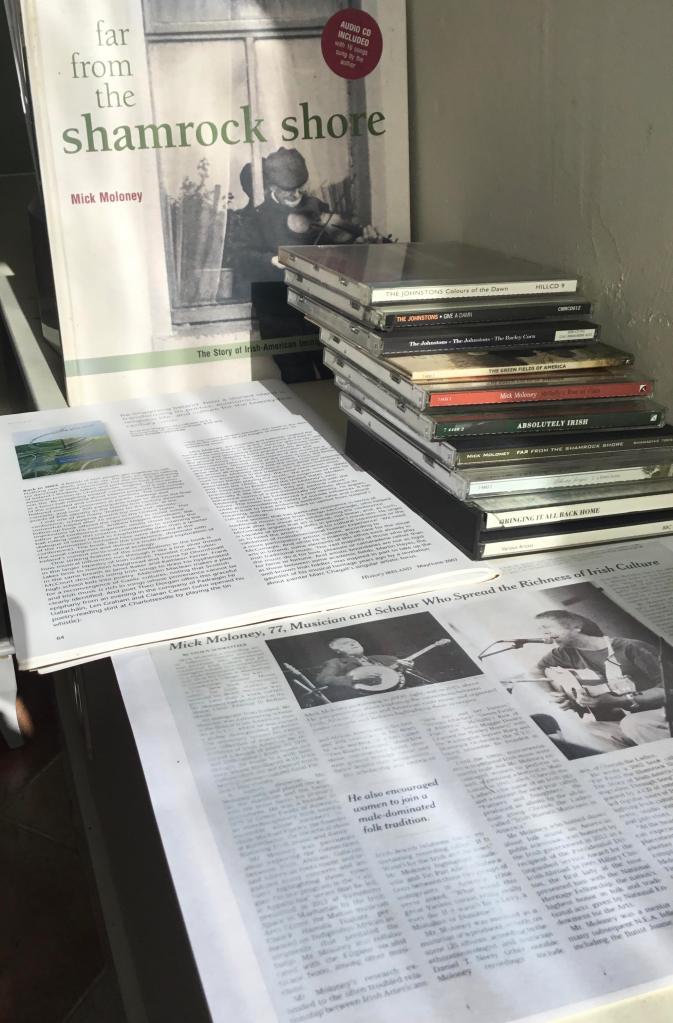
A selection of Mick Moloney’s albums and writing

Mick Moloney is a giant figure in the Irish music universe. His sudden passing last week at age 77 has left musicians and music lovers all over the world reeling with grief. Coming so quickly on the heels of other major departures, Dennis Cahill, Tony Mac Mahon, and Paddy Moloney, makes this a sad season of mortality. Each represents an enormous loss to the diverse rainforest of Irish music and Moloney is another huge tree whose fall echoes throughout the ecosystem. However, the roots he put down in Ireland and the United States, and the seeds he has sown in many other corners of the world will nourish new growth for years to come. Even his shade will be fertile.

Mick Moloney could be described as a universal unitarian since he did not recognize clear-cut musical borders between Irish, Irish American, folk, and other cultural traditions. The outpouring of eloquent, dignified, and heartfelt tributes on social media has been overwhelming. Many are from musicians who knew him, were mentored or taught by him, had their first performances engineered by him, or were touched by him at critical moments in their development. Many are well-known names, others less so. What is crystal clear, is that every encounter with him was enlightening and uplifting, sometimes life-changing, and often memorable.

He was a brilliantly accomplished musician but his modesty meant that he rarely hogged the limelight, preferring to praise and honor other musicians. He loved ensemble playing and the list of his collaborators is extensive. His style was composed and cool but he wanted always to be known as a banjo-driver.

I met him through his music, initially with The Johnstons whose Colours of the Dawn album was a mind-blowing experience that still has resonance fifty years later. It was one of an early series of ear-opening Irish music performances that stretched from Sean O’Riada, the Clancy Brothers, and The Dubliners to Planxty and Horslips. For many years, my go-to party piece song was The Old Man’s Tale (by Ian Campbell) appropriated from Mick’s rendition on that album. And, I can still sing a couple of verses of The Fields of Vietnam (by Ewan MacColl) from his 1973 solo album, We Have Met Together.

Then there is the song, Kilkelly, composed by Peter Jones from letters sent to his great, great grandfather by his father back in Ireland. I first heard this on the compilation album, Bringing It All Back Home in 1991, played by Moloney, Jimmy Keane and Robbie O’Connell. This poignant song became emotionally powerful for me in 1994 when my father died in Dublin and I did not get home in time to say a last goodbye.

He is an archetypal Good Ancestor who landed in a nurturing family in Limerick and spent summers with his grandparents in Sliabh Luachra, that mysterious space that borders Cork and Kerry whose music belongs to neither county. Heeding the biological imperative to bloom where you are planted, Moloney absorbed the cultural and musical riches around him. When he moved to Pennsylvania in 1973 to study ethnomusicology at the University of Pennsylvania, he sought out, acknowledged, and proclaimed some of the Irish musicians who had toiled in the U.S. for years, notably Ed Reavy, Mike Flanagan, Eugene O’Donnell, and Sean McGlynn.  He was determined to honor these living ancestors who kept the music alive in often inhospitable circumstances.   

Our paths crossed a few times, most memorably at Charlottesville, Virginia, in 2003 when a Who’s Who of Irish artistic, literary, musical, political, and cultural characters participated in the Reimagining Ireland Conference. Moloney was a compelling, lively, and witty talker and he was in his element at this extraordinary gathering. When he chaired the panel on Irish Music in Charlottesville (an occasion when there really were “good people on both sides” in that gracious city) he opened the session by commenting on the “almost frightening display of punctuality” he was witnessing at an Irish event.

I had some informal interviews with him when he played in the Bay Area. You always knew a little more about music, culture, or social history after a conversation with him. He oozed erudition. In 2016, he performed a program of song, dance, and poetry at the Freight in Berkeley for the centenary of the Irish Rebellion, a pivotal and cathartic moment in modern Irish history. In typical fashion, he was more keen to sing the praises of his fellow musicians that night: Billy McComiskey on button accordion, dance champion Niall O’Leary, and Athena Tergis on fiddle.

I was a very minor figure in his Irish music universe but nevertheless, he generously responded to my requests and messages. We remained in contact via email for many years and I was surprised to find how many messages I had received from Moloney, oftentimes from his adopted home in Bangkok.

Moloney was an unabashed liberal with a life-long passion for social justice. He was woke before it was popular or profitable inspiring Joanie Madden to form the all-women group Cherish The Ladies, still going strong after almost 40 years. He was, as the Irish Times obituary described him, a renaissance man with many strings to his bow. He also received a half-page obituary in The New York Times. His capacity for positive and progressive work in and around the music was immense and he was playing right up to his final days.

In the follow-up publication from the Reimagining Ireland conference, Moloney contributed an insightful and incisive essay on Irish music. He was fundamentally optimistic about its future. The music has preserved a core identity, he argued, while accommodating a variety of outside influences. It has shown itself to have enduring aesthetic value and cultural meaning and thus may be hard to uproot from Ireland’s cultural ecology. Moloney deserves a big share of the credit for that rootedness.

Additional Resources

By Memory Inspired, Mick Moloney Songbook is a riveting series created during the Covid era and available on YouTube. Each episode features a song or tune around which Moloney weaves a tapestry of social, cultural, and historical context. Start with this one but take the time to view them all: you will be enriched and uplifted.

The book on the Charlottesville Conference is:

Re-Imagining Ireland: How a storied island is transforming its politics, economics, religious life, and culture for the twenty-first century. Book and DVD, Edited by Andrew Higgins Wyndham, University of Virginia Press, Virginia & London, 2006. 288 pages.

https://www.upress.virginia.edu/title/2357

My review of The Johnstons Reunion concert in 2011 can be read here:

https://theoldblognode.blogspot.com/2011/07/johnstons-reunion-concert.html

And I recently found an excellent recording of highlights from that concert posted on YouTube. It’s nicely organized into segments, so you can easily find your favorite Johnstons song.

https://www.youtube.com/watch?v=GMNqH8MLVAw

Eamonn Flynn’s Dublinesque at The Freight

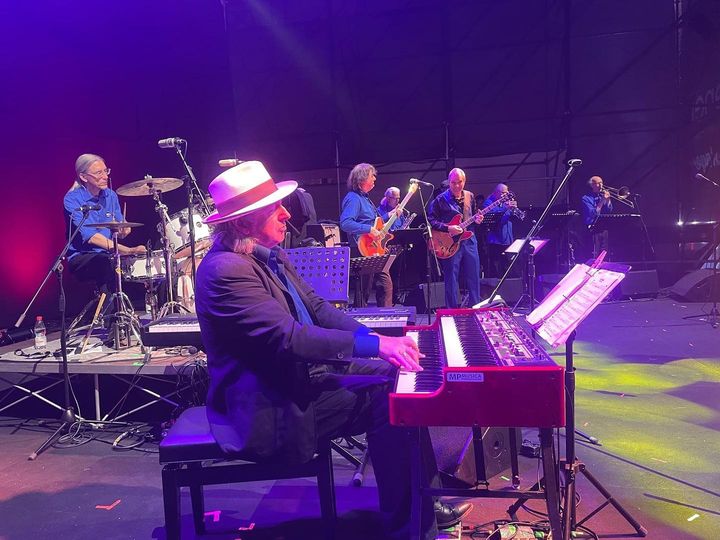
Eamonn Flynn playing at the Poretta Soul Festival in Italy

Irish singer-songwriter/pianist Eamonn Flynn is making up for pandemic lost time with his recent performance schedule. He has crafted a show titled Dublinesque from his grooving, moving, tuneful Dublin tribute album, Anywhere But Home. I saw this lively, lovely and engaging performance in May at the Back Room in Berkeley with his musical partners Darcy Noonan, Autumn Rhodes, and Hector Brogado.

Now he is bringing an online, solo version to the Freight and Salvage on August 13. Flynn is no stranger to the Freight stage. He’s played there many times over the years with the Black Brothers, Elvin Bishop, and under his own name. The show is online because Flynn is playing and traveling in Europe this summer. Last week, he was in the house band for the 34th annual Poretta Soul Festival in Italy. From San Francisco, the Anthony Paule Soul Orchestra contained, according to Flynn, “an embarrassment of singing riches we are backing up: Omega Rae, Nona Brown, Larry Batiste, Salassie Burke, John Ellison, Mitch Woods, and Chick Rodgers.”

Flynn also spent time teaching kids at the 2nd annual United Irish Cultural Center Summer Camp in June. The wide-ranging program included hip hop dance, drama, coding, sport, improv, and lots of music. And he played music for the Bloomsday Celebration on June 16 at the Mechanics Institute in San Francisco.

Dublinesque is a soulful celebration of Dublin, its music, stories, and history. As Sean Laffey put it in his Irish Music Magazine review of Anywhere But Home: “Dubliners need have no fear. The well is not dry; Flynn is the bard to continue the canon of songs for Dublin because every generation needs its memories and melodies.”

The Quiet Man of Irish music has left the stage

Portrait by Nutan Jaques Piraprez
(from his Facebook post at Nutan Jacques Piraprez’s )

Dennis Cahill died this week at his home in Chicago. His low-key style, superb guitar playing and authoritative musical presence expanded and enriched Irish music. His relationship with Martin Hayes is one of the most enduring and inspiring musical achievements of the past 30 years, one that extended into two other influential groups, The Gloaming and The Martin Hayes Quartet. Accompaniment always seemed like a pale descriptor for his beautiful work.

Dennis Cahill was the quiet man in the Hayes-Cahill partnership. But his silence was studied, voluminous and eloquent. In other settings like workshops or classes, he had plenty to say, much of it pointed, precise and passionate. And, he had a good ear for humor and jokes.

He embodied the traditional value of modesty which takes a particular variation in Irish culture. He never flaunted his universal musical wisdom and experience. It was this very global reach which drew Hayes to him, first as a friend, and later as a harmonic partner. In his recent biography, Hayes describes their second round of playing together on tour in Norway. (There was some serendipity around them becoming a pair.) Instead of becoming a traditional guitarist in a generic sense, he encouraged him, “…to look at these tunes in the way one might imagine a Bach partita or a Beatles song.” The harmonic and chordal side of traditional music is not so clearly defined and Hayes felt that together they could find some unexplored territory.

I had the great privilege, with a cohort of other Bay Area admirers, of seeing their partnership grow and flower over almost thirty years. I saw them play many times in San Francisco and Berkeley before I ever tried to write about their music. One element of their performances I always enjoyed watching was their on-stage communication. Traditional music is full turns, repetitions, not-quite-repetitions, and shifts in cyclical patterns. Rabbit holes of a sort. Someone has to call the changes even in a duo. Early on, Hayes’ signals were broadly visible: the headshake, the direct stare or the half-turn. Over time, though, this communication became subtle, almost imperceptible. Hayes says in his Facebook tribute to Cahill: “There were so many times on stage when you were simply able to read my mind…”

One of my favorite passages in Martin Hayes’ book describes their routine when they drove to gigs, Martin behind the wheel and Dennis on the maps:

We were both OK with long stretches of silence where an hour or two would pass by without either of us saying a word.

This was easy to imagine since in any long-term relationship there is a plateau where people are content to say only what needs saying.

One reality that is painfully illustrated in Martin Hayes’ biography is how precarious a pursuit of artistic integrity can be. There are many years spent playing to small audiences, in cramped venues with relentless travelling and very limited income. There is no guarantee of a safe and successful passage from the noisy stage in the cavernous Fort Mason or the tent in Sebastopol or the old Freight and Salvage in Berkeley.

The last time I saw Cahill play live was in 2018 when Hayes and his Blue Room Quartet were featured at the Freight. I noted that Hayes was, “Doubling down fruitfully on his long association with guitarist Dennis Cahill, Hayes has now created a Quartet..” The full review is found here. One of the duos most memorable shows at the Freight was 10 years ago when sound engineer Tesser Call created a sonic wonder for the enraptured audience.

Interviews with Hayes and Cahill were always enlightening, a colloquium in the finer points of playing music and the creative process. One of my most memorable interviews with the pair also took place at the Freight in 2008. When I asked about how they prepare for concerts, Hayes explained their shows this way:

Our live performance is sort of its own thing. Whatever happens, happens. They go a certain way. The live show doesn’t vary hugely from night to night, it kind of gradually changes. No two nights are the same –I might like it to be- but some tune will fly and another one won’t. There’s not much you can do about that. You have to feel it out every time.”

Dennis weighed in with this observation:

“And you have to do it that way for two reasons. One, there’s only two of us up there, so you’re very exposed. And if you don’t let it flow, and get in the habit of doing that, you run the risk of becoming your own tribute band –sounding like somebody doing a version of you.”

You could tell from his expression that this was the worst fate he could envisage for them.

Then, he added this acute analogy:

“You have to have a framework and you have to keep it in your head. I think of it as being like one of those chairs you need to assemble –you can put the screws in place but don’t tighten them. Because if you do, it may not fit and you’ll end up with one leg hanging too high in the air. Each piece, each performance has to work like that.”

With exquisite communication and profound intuition, Hayes and Cahill assembled many magical musical chairs over their years together. Hayes says Cahill was one of a kind, a very special blend of talent, humility, grace and good humor. He will be deeply missed by the music, the musicians, the audiences, his family and friends.

Dublin Can Be Heaven, songs of longing and love from Eamonn Flynn

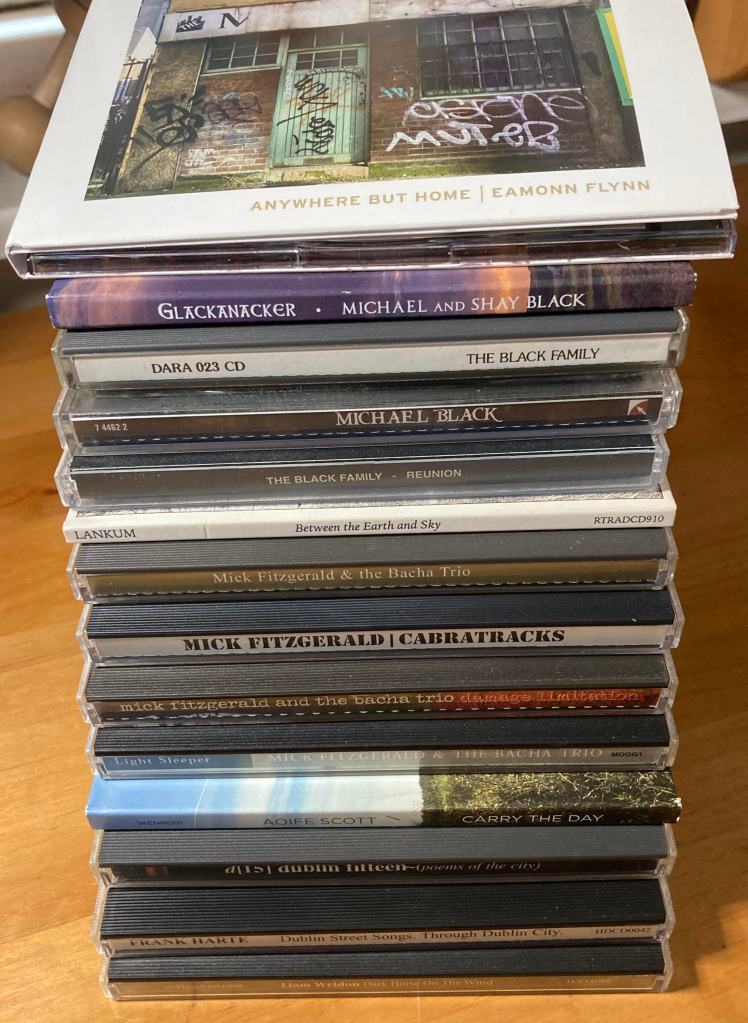
Anywhere But Home sits atop my collection of albums with Dublin singers and songs

Anywhere But Home is a grooving, moving, tuneful tribute to Dublin by Eamonn Flynn, a proud Northsider, who swapped the docks for the Dock of the Bay some years ago. He plays piano and sings in various genres and with a wide range of musical combinations. He is currently heading out for a West Coast tour with Maria Muldaur and her Bluesiana band. Flynn first came to my attention some years ago when he joined the Black Brothers band bringing new dimensions to their shows. He was a key contributor to their brilliant 2020 album Glackanacker.

Like many people, Flynn was “working from home” these past two years. His usual offices in clubs, pubs and halls were closed and he had to get by on his Spotify earnings! However, he was very productive with regular online performances and two “studio” albums, this one and an excellent instrumental album The King of the Cats. While the album’s tone is nostalgic it surges musically past any cheap sentimentality. Flynn’s experience shows in the way he blends the building blocks of notes and lyrics into a set of songs that will quickly take up residence in your head. 

Flynn builds on a long tradition of catchy songs inspired by Dublin: Molly Malone, Dublin Saunter, The Foggy Dew, The Rare Old Times, and Remember that Summer in Dublin, just to mention a few. Non-Dubliners may be unaware of the (mostly) friendly cross-river rivalries that animate Dublin’s culture. The Southside, for example, gets a lot of airtime in the songs: Grafton Street, St Stephen’s Green, the Coombe, Raglan Road and the Grand Canal. Flynn’s album brings some limelight to the neglected Northside with songs about the Bull Wall, the Docks and St Anne’s Park. He follows the tracks laid down by the late singer-songwriter Mick Fitzgerald, a Cabra man, who also showcased the Northside in his songs.

St Anne’s recalls the childhood joys of playing in a large park in Raheny, a Guinness family property with follies and sculptures that became a public park in the 1930s. The park is home to a modern sculpture carved into an old tree by Tommy Craggs which is featured in a short film Building the Ark by Pat Boran, himself a Northside resident. Boran has created a whole new accessible genre of short poetry films mostly shot on the Northside.

Ringsend Balcony Bingo is a crafty, clever tribute to one of Dublin’s most creative pandemic lockdown responses. In Italy they sang opera from their apartment balconies but in working class Ringsend, community bingo was the favored activity. In other parts of Dublin, local musicians gave impromptu concerts in front of their house while the neighbors came out to watch and listen.

Sack ‘Em Ups is rhythmic opener on the spooky subject of grave-robbers in the 19th Century Dublin.  Bull Wall is an R&B tribute to a Dublin Bay landmark sung with bluesy style. Baile Atha Cliath is a dynamic song with a samba beat and classic potential. The indelible “Strolling” chorus dissolves into a crescendo of pipes and whistles.

Penalty Shootout in the Dockers echoes Christy Moore’s Joxer Goes to Stuttgart in reminiscing about the days when Ireland had international soccer success thanks to Jack Charlton’s management. Flynn wrote this song after Charlton’s death in 2019. It hits all the right notes: Put ‘Em Under Pressure and Oh, Ah, Paul McGrath. He has a funny line, “When Republic had four syllables,” as he squeezes an extra syllable into “television.”

He makes only two trips out of Dublin. An tOilean Tiar honors the people and culture of the Great Blasket Island off the Kerry coast. The now deserted island is “moving through the mist like a dream,” where “We’d a name for everything that we had.” The Meeting of the Waters is from Thomas Moore, a Dubliner, who, as Flynn notes, was a bit of a rock star in his day (1779-1852) and wrote many classic songs. This is Flynn solo giving this old standard a fresh sonic coat. The song is dedicated to his mother who was a Wicklow woman.

Every good album has a song that works in mysterious ways. Sorry for your Trouble is that song, for me. Flynn, solo again, weaves a lovely litany from the phrases and clichés employed to comfort others after a death. It’s a ritual where, as Flynn says, “We all improvise from a well-rehearsed script.” It’s one of the songs that is smoothly bi-lingual with lines in Irish.

I doubt that Flynn was ever in the same room as his Who’s Who of musical collaborators but you would never know it from the seamless, rounded sound with stand-out contributions from Mike McGoldrick and Todd Denman on pipes and whistles; Athena Tergis on violins; James Blennerhasset on bass; Mick McAuley on accordion; Brian Collier and James Macintosh on percussion; and, permeating the entire musical enterprise, John Doyle (another Northsider) on guitar, vocals and mixing. 

I’ve had my own Dublin memories activated by the centenary events marking the first public housing development in the Free State in the Tenters on the edge of the Liberties where I grew up. And this bright and beautiful album is good company for reminiscing. It is a fine addition to his excellent collection of recent albums: The Irish Channel (2017) and Black Coddle (2019.) Seek them out and buy them from Flynn, an independent artist who, like many others, could use the support. All are available on Bandcamp in various formats, https://eamonnflynn.bandcamp.com/album/anywhere-but-home

I suggest that you listen to it in the order laid down. Don’t second-guess the creative choices by hitting that shuffle button. And listen a few times before settling on favorites or playing just one song repeatedly. So, there you have it. Flynn takes us down the less rocky road to Dublin’s fair city where you can still have a rare old time on a sunny summer morning as long as you’re alive, alive-o.

Northern Protestants: On Shifting Ground, a book of revelations

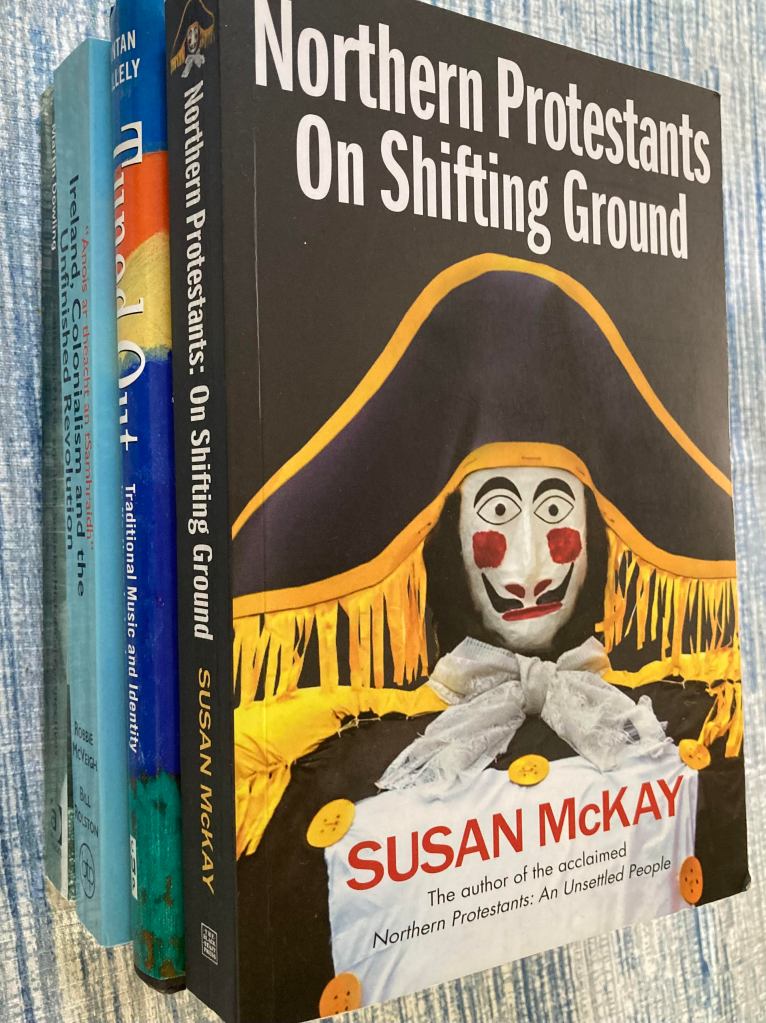
In Nostalgia for the Light, the powerful meditation on memory and trauma by Chilean film maker, Patricio Guzman, an astronomer states that the present is, at best, a fleeting entity. Everything comes with a delay, however minute. We are always dealing with the past and in some places, like Chile and Northern Ireland, this struggle is very visible and often confounding. One book that has clarified some questions for me is Northern Protestants On Shifting Ground by Susan McKay. I have not read a more eye-opening and heart-wrenching book in a long time.

This book is required reading for all, at home or abroad, who espouse romantic wishes for Irish unity. I count myself among them. And while distance makes the heart grow fonder, it can and should, also bring a more critical and comparative perspective. (Every Irish immigrant has been asked more than once to explain the “Troubles” in Northern Ireland: it is usually an unsatisfactory experience all round.)

McKay cuts right through the rigid politics and blustering binaries that often infest policy discussions about Northern Ireland. The major myth the book explores is that there are two monolithic, irreconcilable sides in the Northern Irish story, one Protestant, loyalist and unionist and the other Catholic, republican and nationalist. A careful look at the history of the Northern statelet would indicate that it was never so but the ruling Protestant majority nurtured that supremacist illusion for almost 50 years in Northern Ireland.

The revelations come thick and fast. Prepare to be schooled on the wide range of perspectives, values and opinions held by people who embrace the term unionist, often without the big U. McKay seeks out people from Protestant backgrounds, like herself. We hear from many women, feminists and otherwise. From a range of LGBTQ Protestants. From Unionists who fear any form of United Ireland and unionists who, surprisingly, would accept that outcome if that was how a referendum played out.

There are socialists, activists, community organizers, and local elected representatives. A revealing number of her interviewees come from mixed backgrounds, are married to Catholics, or have Catholics in their extended families. Kenneth Branagh’s heartfelt film, Belfast, is set in a mixed residential neighborhood before the violence drove everyone back into sectarian enclaves.

McKay speaks with a number of artists who offer wide-ranging, open-minded and hopeful perspectives on the way forward. Colin Davidson is a painter who created an exhibit called Silent Testimony that was widely seen in the North. He speaks about people’s reaction to his paintings of survivors of the violence: 

People went in and were struck by the fact they weren’t told who the Protestants and Catholics were, and some of them said to me they were ashamed at themselves for even thinking they needed to know. That actually goes to the very heart of what the enduring problem in this place is. We still haven’t got over the “them and us.” In fact, I wonder if we’ve even scratched the surface.

Stacy Gregg is a playwright and filmmaker who says, “a lot of my identity has straddled binaries: gender, nationality, class.” She attended Cambridge where she became painfully aware of her working class status.

You can’t grow up here and not be political. I’m very aware that Protestants don’t get a good rap. I feel uneasy when people mock working-class Protestants -it shows a poverty of empathy.

But she also comments on the waning of Protestant privilege:

I think most of that protestant privilege is essentially gone or going, but the residual entitlement remains, and can become brittle or defensive. So this bizarre Protestant entitlement helps me understand why some behave as they do.

An Irish language revival has been underway in the North for some years primarily in nationalist areas. The official use of the Irish language has been championed by Sinn Fein and is bitterly opposed by many Unionists. The real story is more nuanced. The fastest-growing group of Irish language learners in the North are Protestants. Linda Ervine runs an Irish language school, Turas (Journey), in East Belfast and speaks about the long history of Irish-speaking Protestants, something which I was sadly ignorant about:

We are steeped in this language. Protestants who reject it don’t know their history. Catholics who claim it as their own don’t know it either. Language doesn’t vote, doesn’t sectarianise, doesn’t fly a flag.

And, with a nod to the book’s cover image of the effigy of “Traitor” Robert Lundy that is burned annually in Derry, scholar Sophie Long says she accomplished a Full Lundy by learning Irish in England.

Jan Carson, author of the acclaimed novel The Fire Starters, is grateful for her upbringing enriched with biblical language and stories. But she is critical of how reductionist the church teachings have become.

I’m interested in an inscrutable God. That’s how the church has failed artists over and over again, because it’s not about the unknown and it should be. Instead the model of the church is corporate worship, for we all sing the same thing at the same time. Artists want to play and think and work outside the box.

And Pamela Denison, a Protestant businesswoman from Antrim, believes the churches were to blame for their decline.

I think religion can be dangerous, very dangerous. I’m not anti-Protestant. I’m just anti-religion.That is how they were reared, a lot of people can’t see past the end of their own lanes. They haven’t opened their minds to other cultures and ideas.

The paucity of politics among loyalists is highlighted. One interviewee calls it geriatric politics, with its singular focus on slogans like No Surrender and What We Have We Hold. Dawn Purvis, from the progressive Unionist party, pinpoints the barrenness:

Northern Ireland for the British. What does it mean? What does it mean when that happens for people who hold onto this notion of identity that they can’t explain, but it is something that they hold onto, like somebody’s trying to steal it from them.

The book also explores the differences between Protestants and Catholics in higher education and career pursuits. Queens University in Belfast is described as a “cold house for Unionists” since Catholic students are the majority and exhibit a stronger drive for educational advancement. Younger Protestants often leave to study in British universities and don’t return. This is considered a grievous generational loss.

History gets a nationalistic spin in most countries. I was taught Irish history by a rabidly republican Kerryman: Britain never did anything right in 700 years of occupying Ireland and propped up the sectarian statelet in the North. The Irish, heroically, never did any wrong. It’s an old story. Even Theobald Wolfe Tone, a hero and martyr of the 1798 rebellion, admitted that hatred of England was always “an instinct rather than a principle.” It’s still being taught with a slant. My 10-year old granddaughter completed a class assignment on The Troubles at her parochial school in South Dublin last year. She came home with this revelation: Protestants were the bad guys here.

The book is a set of interviews with a wide range of Northern Irish unionists and Protestants conducted between 2019 and 2021 and a sequel to her earlier book, Northern Protestants: An Unsettled People. It’s an ethnographic tour-de-force with journalistic flourishes. Many of the segments, pithily headlined, open with the words of the interviewee, some are almost entirely quotes from the person’s testimony. McKay only intervenes to contextualize key events or provide some history for violence or atrocities from the “Troubles” for general readers.

The place of Unionists in some form of a United Ireland (United Island? New Ireland?) has been front and center in the public conversation especially since the passage of Brexit. Andrew Trimble, a retired Irish rugby star, offered his argument in a recent interview in the Irish Times. Rugby people should be heard since it is the one major sports that resisted division after partition and always fielded an All-Ireland team.

Any talk of uniting Ireland must explore this set of fundamental questions. How are the Unionist Protestants accommodated? How do you learn to accept a somewhat unlovable crowd, people who are not just British or Irish but their own awkward selves as Michael Longley put it? What kind of neighbors would they be? How do you avoid creating a “cold house” for them in the new arrangement? And, for some Sinn Fein supporters, how do you resist the temptation to include payback for years of running a vicious, sectarian statelet?

The book offers satisfying answers to those questions. Many of the interviewees come across as sound, thoughtful, and reliable persons. They would be good neighbors, resourceful in an emergency, and respecters of boundaries. The politics and religious attitudes of some would be hard to live with but the present-day Republic is a more diverse, multicultural and tolerant community. The Reverend Ian Paisley’s old jibe about the South being ruled by Rome seems utterly outdated now. One interviewee notes that a unified Ireland would work out all right in the end but the 10-20 years it took to get there could be hellish.

One way or another, Catholics, Protestants and Dissenters (largely from the Presbyterian tradition) have been interacting and cohabiting in those six counties for hundreds of years. Now a critical point has been reached where the dissenters of various persuasions are edging out the unionist and republican extremes, as Emma de Souza argues recently in the Irish Times. Young people have moved away from traditional religious affiliations making the Catholic-Protestant binary more irrelevant than ever.  The elections coming up in May will reveal the strength of the center and how likely it is to hold.

It’s time to stop the “Othering” of groups of people that has plagued Northern Ireland and many places in the world. The present is fleeting but also immensely fragile. Politics everywhere cannot be simply local when the effects of climate change are omnipresent and poised over our future like a tsunami. Fighting over power and control in a small corner of the world is futile, foolish, feeble and wasteful.


Martin Hayes, the good ancestor.

A review of Shared Notes: A musical journey by Martin Hayes

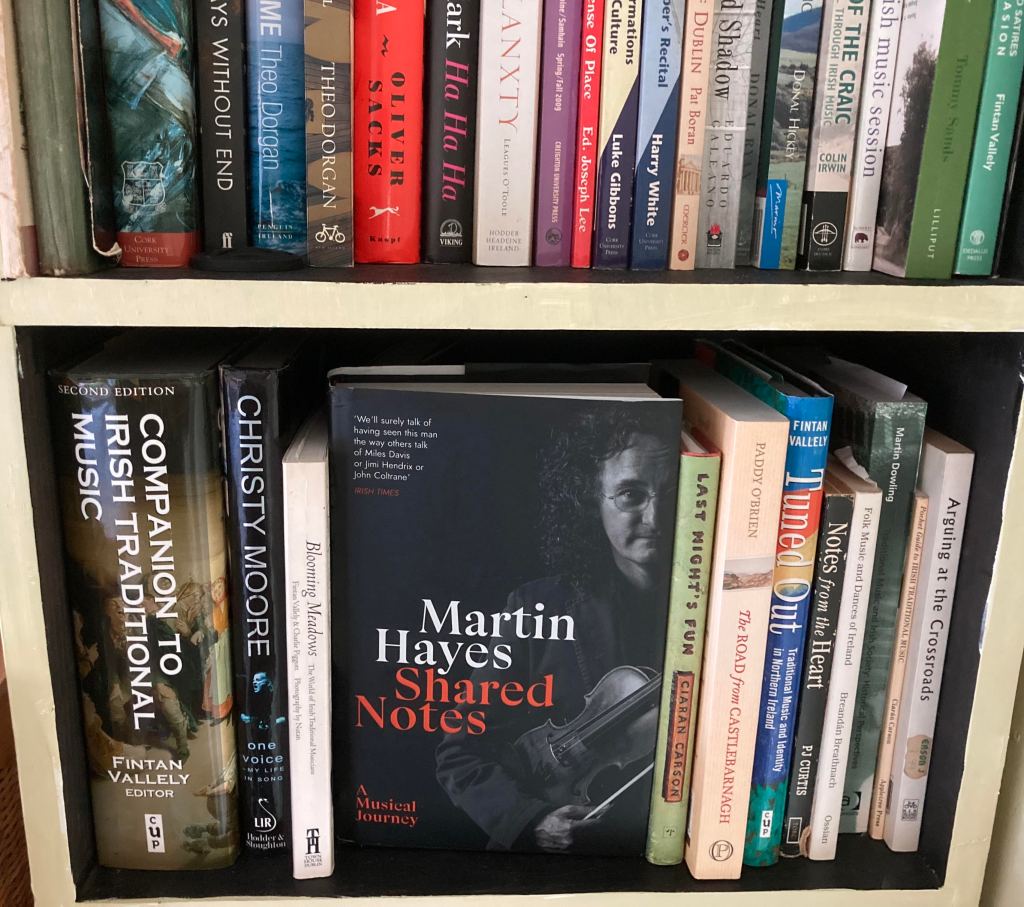
Martin Hayes has written a memoir that’s every bit as brilliant, engaging and moving as one of his famous extended performance sets. The Irish fiddle player was forced onto the sidelines by the Covid epidemic in 2020 but that gave him the time and space to complete the book. In his music, he’s a master of time and space and those skills transfer to the flow, structure, and measured pace of the narrative. It’s a substantial and welcome addition to the meager store of good books on Irish music. The photograph shows a selection from my own modest collection with Hayes’ book in pride of place.

His story starts in the heart of a hotbed of traditional music in East Clare. He grew up immersed in that culture working on the family farm, walking to and from school, and absorbing the music organically along with its “doctrine of soulfulness.” Hayes opens with a lovely portrait of his mother who was “an independent-minded, free-thinking spirit.” She had worked as a nurse in the psychiatric hospital in Ennis and as a waitress in an upscale restaurant in London. She had also spent a year training to become a nun, something Hayes did not learn about until his father’s death in 2001. Irish mothers can diligently secure their secrets. She only lasted a year in the convent, emerging with a lifelong suspicion of authority and a watchful eye for hypocrisy.

Like mothers in many traditional cultures, she gave up her ambitions and dreams to nurture and tend to her husband and family. Not to mention feeding the steady stream of musical visitors who came to commune with Martin’s father, PJ Hayes, leader of the famed Tulla Céilí Band. His father was a huge influence on him but he had other sound ancestors like his uncle, Paddy Canny and local fiddler and piper Martin Rochford. Other early musical influences included Tommy Potts, Joe Cooley, Tommy Peoples, Peadar O’Loughlin, Junior Crehan and Tony Mac Mahon.

Hayes has a number of aphorisms that he regularly delivers with style and precision. One of them is, “… the 1970s were the 60s in Ireland.” More sociologically sound than it seems on the surface, Hayes was a teenager in the late 70s so he knows whereof he speaks. Early on, he was a conforming non-conformist, a position that many young Irish people began to adopt in that era. He worried that he was, “… a socially compliant cultural manikin at the cost of a normal teenage life.”

But, wanted or not, social change was coming to rural Ireland in the 1970-80s and Hayes, like many others, took off for elsewhere. He is unsparing in describing the ups and downs of his life journey. He was enamored of the drink for a few years but giving it up brought more clarity and focus to his search for meaning. He ended up for a time living illegally under the radar in Chicago on an expired tourist visa, suffering the embarrassment of being ripped off by a shyster immigration attorney when he tried to become a legal resident. He had his fallings-out with fellow musicians and once smashed his fiddle on the head of band member.

His detailed and loving memories of childhood and adolescence are extraordinary. The book covers the paths not taken. At various points Hayes could have been lost to music by becoming a Fianna Fail political figure or a frozen food salesman or, briefly, a stock market trader in Chicago, or even a college graduate with a business degree (he dropped out after a year.) And his musical journey had some unproductive byways. Like playing banjo for a time in the Tulla Céilí Band, or playing an electric fiddle in a Chicago folk-rock band, Midnight Court, or accompanying ballad singers in a bar band.

At one concert, Hayes has had enough of the audience members who talk and drink noisily during the show. He asks them to leave, offers a refund, and they reluctantly depart. It’s an empowering moment when he exercises his right, with righteous anger, as a performer to play in conditions that suit his musical goals and ambitions.

Hayes has done the work to arrive at an authentic self and a workable philosophy of life. He came through a tough period when he felt he was losing his past, was disengaged from the present, and not creating a future. His personal spiritual search brought him back to the music. Integrity for any musician or artist is complicated, Hayes says, and “Sometimes, we’re just not ready to handle our own gifts.” He writes eloquently about his experiences teaching music where he revels in the mutual learning possibilities in that creative exchange.

He is deeply committed to making his music “invitational,” drawing the audience into emotional participation, a reciprocity that can be transcendent. Many older musicians frowned upon stage craft but Hayes found that he had to grapple with the dynamics of performance to bring his playing up to the highest possible levels.

Hayes is the preeminent exponent of Irish traditional music in the world. He has transcended his status as an Irish fiddler to achieve parity with other artists, classical and otherwise, in concert halls far beyond Ireland’s borders. He plays, “Music in the universal sense first, and Irish music second.” And performing in more formal settings brings its share of stress. Since traditional musicians don’t usually read music, playing extended pieces with an orchestra can produce a unique kind of terror and sense of inadequacy. Hayes describes this clearly in the book and it matches the experience that Tony Mac Mahon endured in his first performance with the Kronos Quartet.

He brings a high degree of artistic, intellectual and cultural credibility to Irish music, universally defined. Hayes was fortunate to have a long line of ancestors, many with musical abilities. In turn, he has become a good ancestor, taking the long view back and into the future. He is a master practitioner with the right blend of character, charisma and modesty for younger players to emulate. He has done a great deal to expand and enrich Ireland’s cultural capital as a musician himself and as a facilitator of combinations that have led Irish music into new pastures.

In the first post on this blog in 2008, Hayes and Cahill: Recalibrating the tradition, I concluded: “This is quantum music played with a bonsai sensibility, centrifugal explorations of notes and the spaces in between, pulsing with possibility.” Hayes observes that particular notes in tunes carry more weight than others. In Shared Notes, he weighs his words and deploys them as artfully as he draws out the ancient melodies.

Martin Hayes annotated Blogiography

I was fortunate to hear and see and, in time, talk with Hayes as his playing career ascended the heights. Here’s a collection of blog posts on Martin Hayes. He has been a source of great inspiration for my writing over the years. My first piece on Hayes in the San Francisco Irish Herald in September, 2000, was titled Zen and the Art of Fiddle Playing. I first heard him at the San Francisco Celtic Music Festival held each spring for ten years from 1991 under the watchful eye and ear of the late Eddie Stack.

https://theoldblognode.blogspot.com/2018/08/fiddling-on-dock-of-bay-review-from.html

Later, in that same timeframe, I heard him play in various combinations at the Sebastopol Celtic Music which was guided by Cloud Moss. His book honors the memory of those festivals as seminal influences in his playing career. In the 1990s and early 2000s, Hayes made regular appearances in the San Francisco Bay Area. He savored the spaciousness and freedom he experienced in the city and felt that the spirit of Joe Cooley was still in residence.  

https://theoldblognode.blogspot.com/2008/10/hayes-and-cahill-recalibrating.html

There was something very fitting about seeing Hayes and Cahill play in church buildings around the area. Apart from the acoustics, the settings induced a certain reverential expectation that was often fulfilled.

https://theoldblognode.blogspot.com/2011/10/hayes-and-cahill-at-skyland-church.html

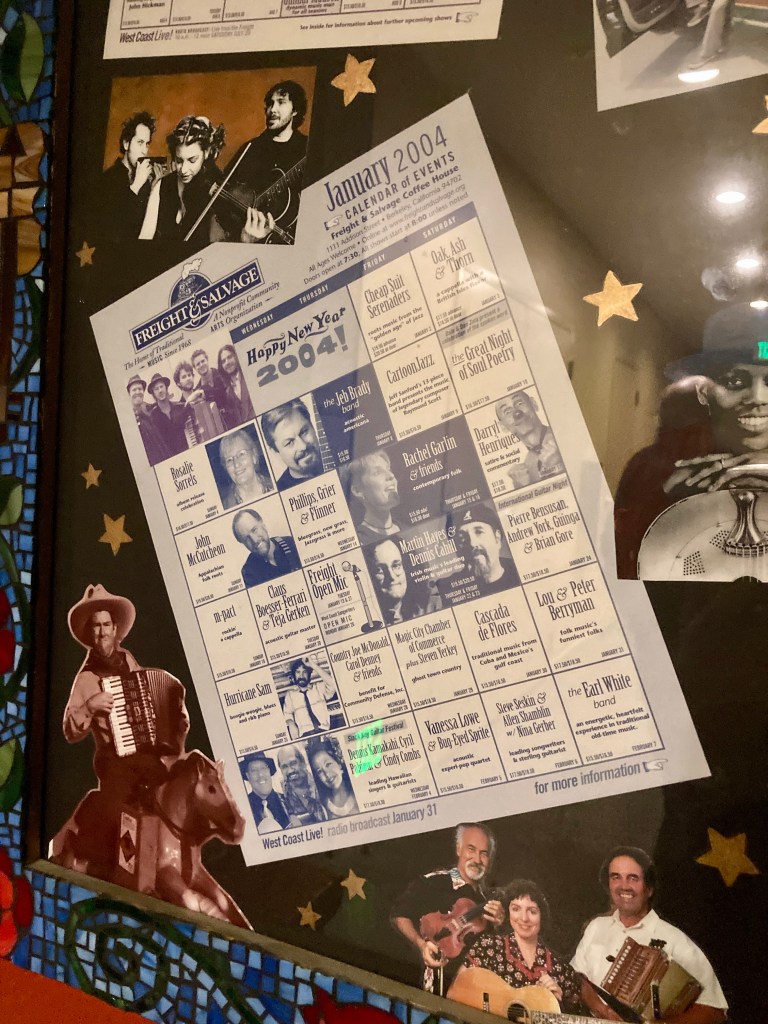
Hayes played many times at the legendary Berkeley concert venue, the Freight and Salvage. One of his appearances with Dennis Cahill from 2004 is recorded on the venue’s calendar wall.

One unique evening is recorded here when sound engineer Tesser Call facilitated an acoustic miracle.

https://theoldblognode.blogspot.com/2012/03/hayes-and-cahill-break-sound-barrier-at.html

Hayes brought every one of his musical groups to Berkeley: twice with The Gloaming, once with his Blue Room Quartet, and once with Masters of the Tradition. Every show was memorable and magical. The two Gloaming concerts are reviewed here:

https://theoldblognode.blogspot.com/2014/12/roaming-with-gloaming-in-berkeley.html

https://theoldblognode.blogspot.com/2017/10/the-gloaming-returns-to-berkeley.html

And the mesmerizing evening with Hayes’ Quartet playing their Blue Room album is reviewed here:

https://theoldblognode.blogspot.com/2018/10/quadruple-delights-from-martin-hayes.html

And here are two insightful reviews of Hayes’ memoir by fellow-fiddle players, Niamh Ni Charra in the Irish Times and Toner Quinn in the Journal of Music.

https://www.irishtimes.com/culture/books/shared-notes-by-martin-hayes-personal-poignant-and-immensely-profound-1.4706747

https://journalofmusic.com/opinion/persist-other-side

Mac Mahon and Moloney: Two Irish music titans leave the scene

Two Irish music giants died last month. Tony Mac Mahon was a fervent guardian of the music traditions, an accordion maestro, a folklorist, and communicator par excellence. He lovingly championed the cultural riches of Irish music for his fellow citizens and shared that huge heritage with the world. Paddy Moloney was a genius and a musical entrepreneur, taking the ensemble structure initiated by Seán Ó Riada with Ceoltóirí Chualann to glorious and enduring heights with The Chieftains. With that ebullient band, he passionately presented the cornucopia of Irish music to the world, taking the music out of the pubs and into concert halls.

Both men leave behind immense cultural legacies, preserving and renewing melodic masterpieces and rare tunes, and seeding the revival of Irish traditional music. Mac Mahon was a collector, curator, broadcaster and often provocative commentator. Moloney was a brilliant band leader, a fine composer, and a generous musical partner.

Moloney was a master of the notoriously temperamental uilleann pipes, a skill characterized by the late Mícheál Ó Súilleabháin as akin to wrestling with an octopus. It’s fair to say he popularized octopus wrestling in many surprising corners of the world. Mac Mahon had a famously ambivalent relationship with the accordion and occasionally wished that he could have played the pipes, a more authentic traditional instrument, in his view.

Paddy Moloney’s life was celebrated recently on the RTE radio Rolling Wave show. One of his early achievements (sometimes forgotten with all his subsequent accomplished) was as CEO and producer for Claddagh Records. These included classic records like The Liffey Banks by Tommy Potts and The Star Above the Garter by Dennis Murphy and Julia Clifford. The role Moloney played in expanding Claddagh Records and the work of reinventing the label are described by Siobhán Long in a recent piece in the Irish Times. The Chieftains played regularly in the Bay Area and they were the last live concert I attended before the Covid lockdown in February 2020.

Moloney was often described as an ambassador for Irish music and culture but Mac Mahon had the equally vital role as emissary from the recent and not-so-recent past. He spoke for the vernacular Irish artists who kept the music alive during the worst of times, before and after the state achieved a measure of independence.

The Rolling Wave (another tune Mac Mahon favored) radio show also memorialized his contributions with praise and recollections from Liam O’Connor of the Irish Traditional Music Archive, Noel Hill, a musical partner and soul-mate, and Caoimhín Ó Raghallaigh who persuaded Tony to record Farewell to Music, his last album released on Raelach Records in 2016.

Mac Mahon, like Martin Hayes and Iarla Ó Lionáird, served as messengers from our traditional musical history, loyal spokesmen for the ancestors. His message was directed at Ireland and the Irish, his plea echoing Breandán Breathnach, that we love and respect the music because it is our own. Mac Mahon’s lifework may be viewed as a Tabharthas, an offering to the artists who preceded him and his peers. According to Manchán Magan’s fascinating book, Thirty-Two Words for Field, the term also means sacrifice. And there is little doubt that Mac Mahon sacrificed some parts of his life for his work. One of his favorite pieces was the lament The Wounded Huzzar and the title may have resonated with his experience.

O’Connor describes Mac Mahon as a force of nature, a sweet and forceful player who did not value technique but had tons of it. Noel Hill, who played with Tony on the classic recording, I gCnoc na Graí/Knocknagree, noted that their way of thinking about the music was very much aligned. They shared a sadness about what had gone before and the loss of the Irish language. And it could be heard in his playing. Caoimhin O’Raghalaigh said that Mac Mahon felt the real music is in the slow airs. He loved the sean-nós singers. His playing was like brushstrokes bringing out the dramatic depths and spaces in the tunes.

I never had the opportunity to meet Moloney in person, other than the time a few years back I saw him in his favorite Indian restaurant in Glasthule but chose not to intrude on him. I did have a phone interview with him once for a San Francisco Irish Herald article during one of the Chieftain’s almost annual U.S. tours. His “people” offered me ten minutes but Paddy was happy to talk for longer as he bemoaned the lack of proper tea in his Denver hotel room. He was naturally gracious and generous.

I had more time and interactions with Mac Mahon and count myself fortunate to have crossed paths with him as an aspiring music writer. I saw him play two extraordinary concerts with the Kronos Quartet at Stanford University in 2002 and at a Napa winery in 2003. David Harrington of the Kronos Quartet told me, “…when I hear something as remarkable and rare as Tony, I believe it. His playing has an extraordinary singing quality in the way he molds and shapes every note.” He was gracious and eloquent, eager to share his insights about the rich store of traditional music. He had an edge to him but his curmudgeon persona could be brilliant and funny.

He played a number of other concerts at smaller Bay Area venues during his 2002 visit. One was at the Resource Center for Non-Violence in Santa Cruz, hosted by Bob Breheny of the Celtic Music Society of Monterey and recorded by Pete Haworth of Molly’s Revenge fame. Tony was in fine form and partnered up with Japanese guitarist Junji Shirota, who has a refined ear for Irish traditional music. It was a magical evening and Tony responded wholeheartedly to the energy generated by an audience of aficionados who were very familiar with his oeuvre.

I was in attendance and later received the recording from Haworth. I treasure it and listen back frequently. And since it is better to listen to Mac Mahon play than read about him, here’s a rare live recording from that house concert in Santa Cruz. It’s the mournful air Amhrán na Leabhar

One track only whets the appetite so here’s another from the superb album, Mac Mahon from Clare from 2000. This old march, The Haughs of Cromdale, was recorded at Mac Mahon’s house in the Liberties with Barney McKenna, John Sheehan and Liam Ó Maonlaí. This is one of the tracks flagged by Paul O’Connor in his mind-blowing survey of Irish music available on Soundcloud, 200 tracks to mess with your idea of trad

Mac Mahon and Moloney had the benefit of growing up marinating in complete universes of traditional Irish culture, one rural and one urban, with music at the heart of it. Both men were strongly committed to uncovering and displaying the shapeliness of the harp tunes, the song-airs, and the music of great, largely unrecorded, older players. They worked at mastering the technical elements of their art and willingly absorbed the codes, customs, and wisdom embedded in that life. That’s what made them such credible messengers and advocates for the tradition. They will live long in our hearts and ears.

Richmond, California
U.S.A.