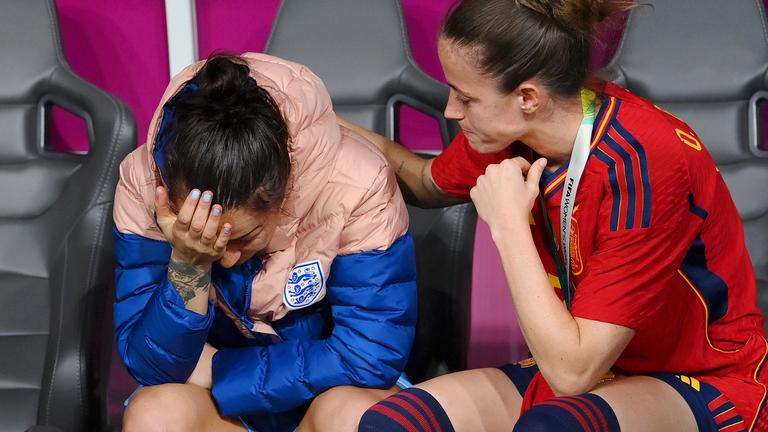
England’s Lucy Bronze is consoled by Spain’s Ona Batlle after the Women’s World Cup final. Photograph: Stephanie Meek/CameraSport via Getty Images
Spain’s victory over England in the Women’s World Cup final was about much more than football. The Spanish women were beautifully ruthless over the ninety-plus minutes. They kept England constantly off balance and frustrated their every attempt to acquire momentum. Twenty days earlier in Wellington, New Zealand, I watched Spain endure their biggest humiliation of the tournament, a 4-0 defeat by Japan. Their pride was stung by the elegant effectiveness of Japan’s press that denied space and time to their best players.
They took on board the hard lessons (suffering was a term many of them used) and grew into a solidified team that would not be denied. The Spanish players had multiple reasons, personal and collective, for winning the final. The sting of the loss to Japan; anger at the inept response of the Spanish Football Federation to a player protest in 2022, and the absence of key players who were frozen out after that protest. The sum total of those motivations always exceeded the English commitment. That old commentary cliche, They wanted it more, applied.
This is a Spanish movie that we have seen before. (Maybe Pedro Almodovar is looking for another script with a group of heroic women?) The backbone of this team are Barcelona players, the current European Champions. They had a variation on the Spanish midfield regulators from the men’s dominant era. You could think of Aitana Bonmati as a Xavi stand-in and Hermoso as a tall Andres Iniesta. The pair controlled the midfield action, creatively improving their performances against Switzerland, Holland, and Sweden. Hermoso has an uncanny facility for short passing that ensures possession and prises open threatening spaces for colleagues.
Spain emulated the Japanese-style press to unsettle England in every section of the field, with one player challenging for the ball while two others cut off the passing options. England’s two Barcelona players, Keira Walsh and Lucy Bronze, had a less happy evening in Sydney. Bronze went walkabout in the packed Spanish midfield, lost the ball, and in a flash, the play was switched to where she should have been. Russo was slow to cover and Carmona raced up to take a Caldentey pass and strike with deadly precision. Spain had been having a lot of success attacking up the left flank, and it finally paid off.
England contributed greatly to the contest. They rolled the tactical dice at halftime, bringing in Lauren James and Chloe Kelly and later pushing Millie Bright up to center forward. Mary Earps saved a penalty after some Bronze gamesmanship rattled Hermoso. It was all to no avail. Spain was not for shifting.
The photos in The Guardian article by Jonathan Liew and the one I used at the top of the blog are iconic and symbolic. The women’s game embodies levels of respect and compassion that are harder to find in men’s international football. For women players, the road to international representation is littered with stones, rocks, blocks, and (sometimes) kisses from the patriarchy. The fine line between victory and defeat may be more permeable for women. And, as noted by Liew, the top women have supportive friendships, alliances, and even rivalries that develop at their clubs.
My Petaluma correspondent, Charles Little, had this revelation after the U.S. exited the tournament. Currently, only one U.S. player, Lindsay Horan, plays for a top European club, Lyon. Maybe, Charlie said, the National Women’s Soccer League is no longer the best high-level, competitive league. The European leagues are the source of the best women’s football now. Three of the four semi-finalists were European, and Australia, the other semifinalist, has the majority of their players earning their living at European clubs.
The NWSL is still an invaluable proving ground for players from outside the U.S. with international aspirations. Ireland, for example, benefitted from the NWSL experience of Denise O’Sullivan, Sinead Farrelly, Kyra Carusa, and Marissa Sheva. How will the U.S. Women’s team be rebuilt, and how long will it take? It’s hard to imagine the program will not bounce back strongly, but the rest of the world has caught up fast. Spain, England, and other nations will not give up their leading roles easily.
The World Cup is reaching a very satisfying ending. It has been brilliant, thrilling, absorbing and hugely entertaining. The level of play has been outstanding and far superior to the patchy quality of the men’s World Cup in Quatar seven months ago or, indeed, many of the recent men’s competitions. And the drama has been over the top. The Australia-France penalty shoot-out? You could not make it up. Columbia putting the wind up England with a rugged and arrogant first half display? Spain finding form at last against the Dutch.
Our last live game was the quarterfinal between Japan and Sweden at Eden Park. A closely-contested game where Sweden blunted the Japanese press with a skillfully executed game plan. Japan missed a penalty at a crucial point and left it too late to pressure the Swedish defense.
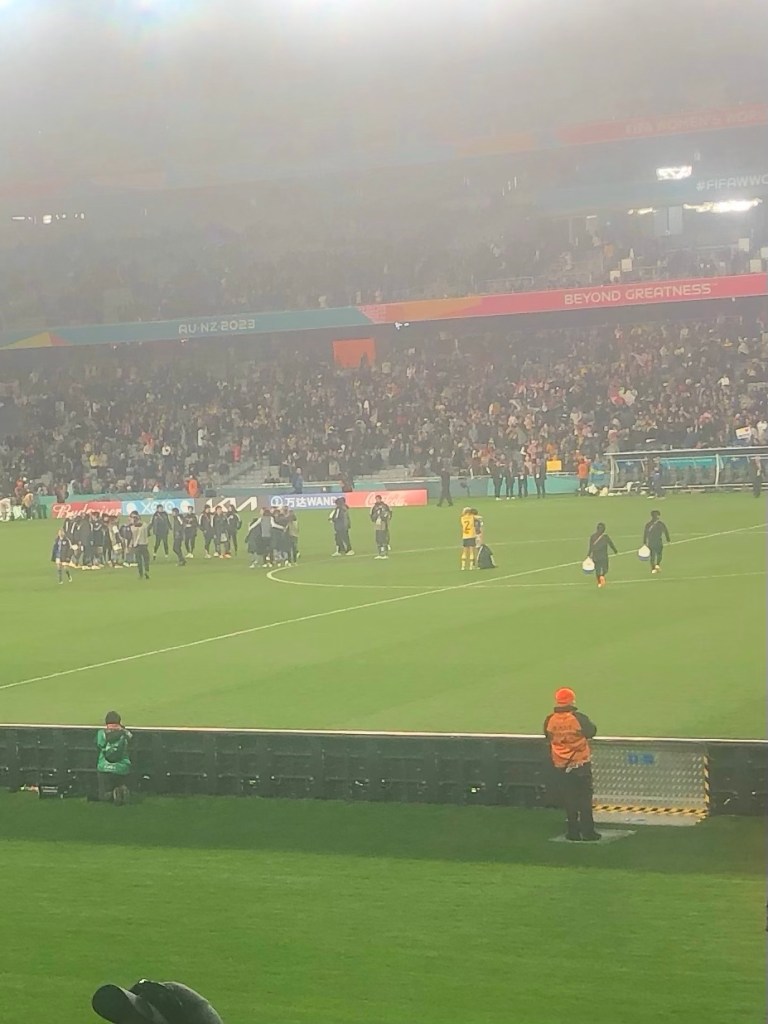
We hung out at the stadium for a long time afterwards watching the devastated Japanese players, many prostrate on the field, some being consoled by one or two Swedish players.
Then, amazingly, they huddled and turned as a group bowing respectfully to their opponents, the fans, and to the field. They are a class act and we must wait another year before seeing them again in the Olympics in Paris. Even watching their pre-game warmup drills was a football treat: meticulous touches, rapid and exact passes, intricate patterns, powerful shooting. There is a purity of purpose in Japan’s playing that makes them a joy to watch. The players are always looking for the best choice in passing, patterns, pacing, movement, and speed. They were endlessly creative and dynamic.
Along with Japan, we saw Spain and Sweden live twice which means we have now seen one of the eventual finalists during our New Zealand travels. I started this piece before any of the quarterfinal games were played and was getting ready to predict a France-Japan final. So much for my predictions. Both Spain and Sweden have grown into better versions of themselves during the competition. Sweden has shown great flexibility in its playing formations and each player possesses a complete range of technical skills. Spain learned the hard lessons of that elegant demolition by Japan and came back renewed against Switzerland and Holland.
The Sweden-Spain semifinal on Tuesday is a delightful prospect. It will be the last game at Eden Park and sadly it kicks off just as we board a plane to return to San Francisco. On the Australian side, the home team earned their semifinal spot the hard way. They have major momentum but England will be ready after getting a stern test from Columbia. And my new prediction for the final? Australia versus Spain with Australia to win it, urged on by fanatical home support. It would be a fitting finale to a compelling competition. Whatever happens, we will have a new world champion. This is the last post from on the ground in New Zealand. We’ll have more to say and more considered social and cultural perspectives to offer later.
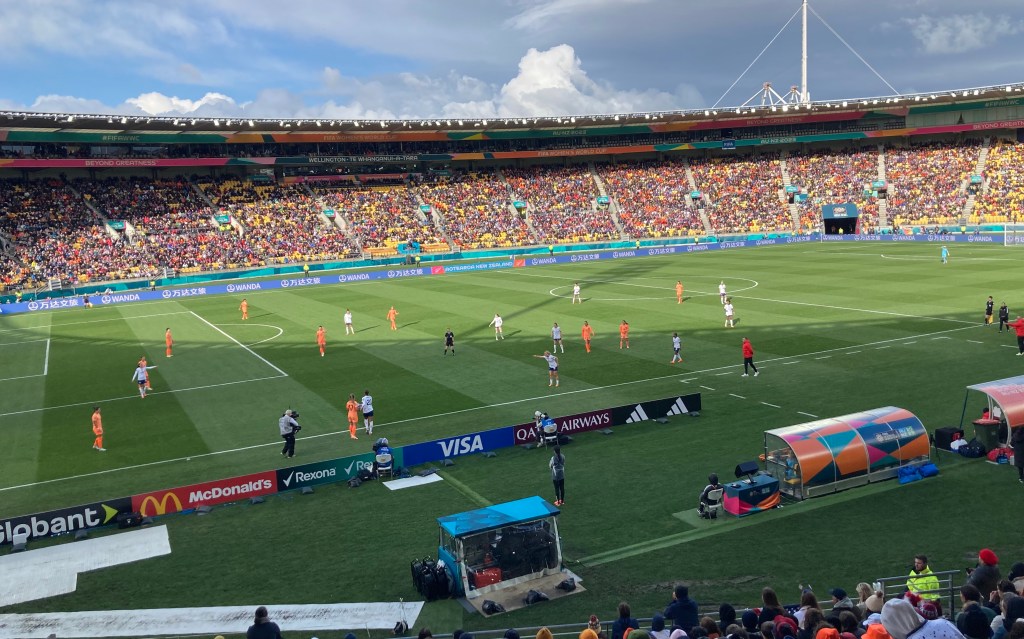
This was a strange game. The Dutch managed the midfield play for much of the first half and scored a fine goal against the run of play. Manchester City’s Jill Roord coordinated the Dutch resistance and scored the goal. Rose Lavelle was introduced at halftime and the US gained more superiority. Horan, in particular, was more effective in this new partnership. We had an excellent perspective on both goals and the other action at that end of the field.
Horan exhorting her teammates. Coach Andonovski spent a lot of time alone in the coaching box.
Horan clashed with her Lyon club teammate, Van de Donk, early in the second half and, with a flash of angry energy, met Lavelle’s corner and flicked a header into the net. There has been much speculation about why the U.S. made no more subs in the second half but no good answers. We noted that the reserves spent much of the game warming up behind the goals, in small groups at first but by the end everyone was out.
Rapinoe’s comment the day after the game about being too narrow are spot on. But also true is that Rodman and Smith got no joy from their encounters with the Dutch fullbacks. The switched sides a few times in the first half to no avail.
Episode 2: Sweden 5 -Italy 0
Italy had a fiery start and were defensively solid until Sweden curled some precise corner kicks into the packed six-yard box. One was a close thing but the next three were scored, two headers and a knee. Italy were dazed and confused to be three behind at halftime. Another headed goal from a corner shortly after the half put the result beyond doubt. A breakaway goal near the end was the icing on the cake. This was a bonus game for us in Wellington, getting tickets just the day before. FIFA’s digital ticket system has worked seamlessly and ticket resale prices are capped at 105% of the original ticket value, a very sensible policy.
New Zealand’s dream comes to an end
The Football Ferns can be proud of their work in their first World Cup. They bravely tried to match their performance in the opening game but came up short. But there have been huge spin-off benefits from the team’s appearance and their spirited approach.
Here’s a poster in a Wellington shop that tells part of the story. In a nation where Rugby is practically a religion, this is a major change.
Episode 3: Japan 4 – Spain 0
Last night in Wellington we were fortunate to be at the best game of the tournament so far, Japan’s powerful and elegant demolishing of Spain. Japan launched an irrepressible press that completely disrupted any rhythm Spain hoped for. The Japanese are relentlessly effective at taking opportunities. Miyazawa raced by the Spanish defense after 12 minutes to score. Ueki cut inside from the left and shot but the defender’s block spun up and over the keeper for the second. Miyazawa struck again before the half, almost a copy of her first strike. Super sub Tanaka added a delightful fourth before the end.
Japan are a consummate team, a natural product of the communal culture of the country. There is a mysterious math to their formation: five at the back; seven or eight in the midfield; and, two or three up front. Spain lost count again and again. Japan are the only team with a perfect record, played three, won three, scored eleven and conceded no goals. Their goalkeeper, Yamashita, was largely untroubled by Spanish attacks but her distribution and goal kicks were exceptional. Japan are a very popular side with vocal supporters, many of whom are not Japanese.
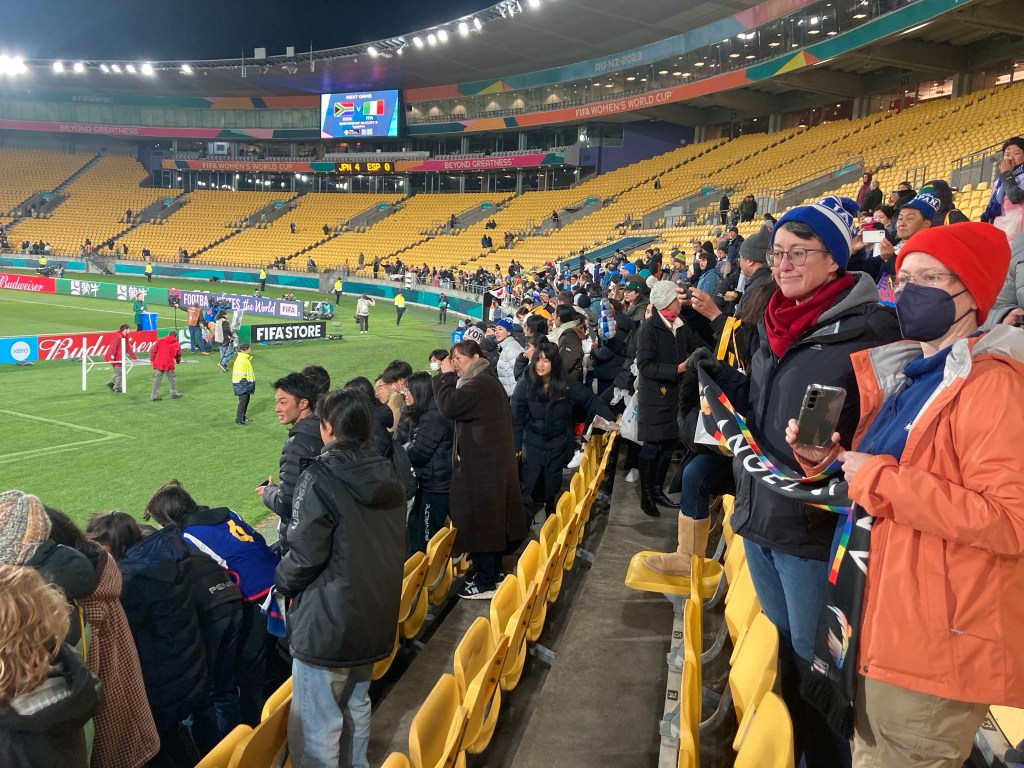
Supporters stayed on to congratulate the Japanese players after the game
This is a re-post from earlier in July contextualizing the Women’s World Cup.
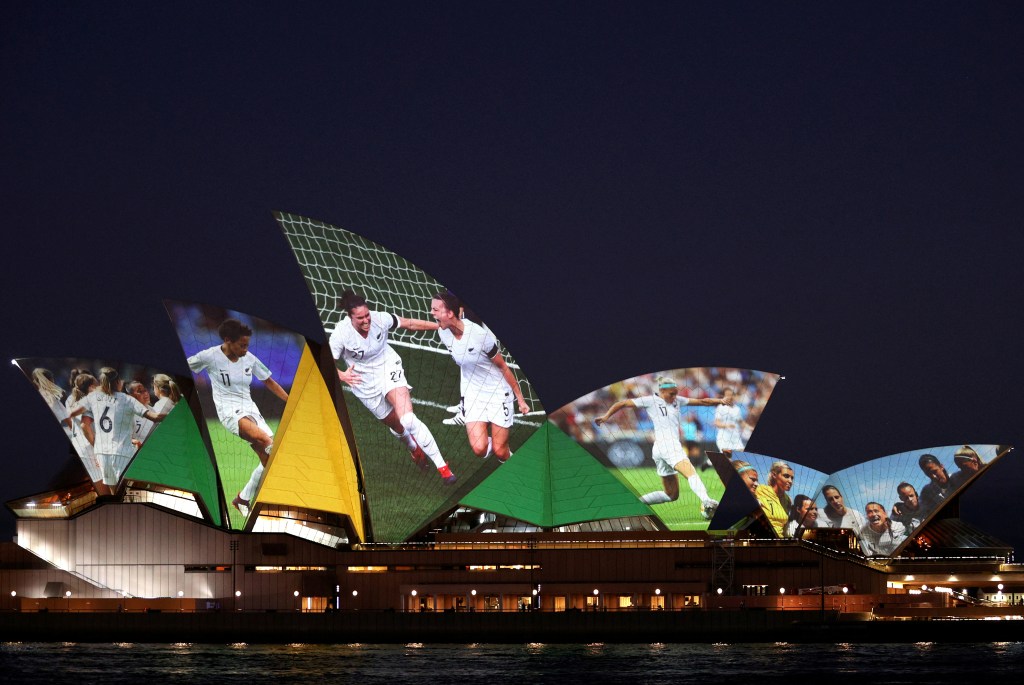
FILE PHOTO: The Sydney Opera House lights up in celebration of Australia and New Zealand’s joint bid to host the FIFA Women’s World Cup 2023, in Sydney, Australia, June 25, 2020. REUTERS/Loren Elliott
The Women’s World Cup hosted by Australia and New Zealand is just a few weeks away, and I will be there. I am opening a new strand on the blog for the next couple of months, shifting to covering the World Cup and women’s football generally. On our first trip to that part of the world, my wife and I will spend a month in Auckland with side trips to Wellington and Queenstown. We will see four games in Auckland and two in Wellington. Auckland’s Eden Park stages the opening game with New Zealand, The Football Ferns, taking on Norway on July 20.
Next up, the opening game for the U.S. women in Group E against Vietnam, first-timers against four-time winners. Two countries with a lot of shared history but not in football. Then, the most competitive game for the U.S. team is when they square off against the Netherlands in Wellington on July 26, a repeat of the 2019 World Cup final. And two days later, two other ambitious contenders, Spain and Japan, go head-to-head for the top spot in group C.
I will be on the ground in Auckland, which is the base for the U.S. team in the group stages. I plan to bring some impressions, insights, and highlights to followers of the blog. More stories and drama are sure to emerge as the World Cup gets going.
Plenty of pre-tournament stones in the road
Just as the hope that the women’s games would bring more moral clarity and less corruption, things went sour early on. The Cup has already weathered a few crises. Many of the women’s teams had issues with their national federations, often male-dominated. The Canadian women threatened to strike and not participate in the She Believes Cup in February. Spain and France had to resolve squabbles between the players, coaches, and administrators. Pia Sundhage, the former U.S. coach who now manages Brazil, has complained about how chaotic the administration of women’s football is below the level of the national team.
The payments for European broadcast rights to the Cup were only recently settled. For a time, FIFA contemplated a toxic intervention into their own tournament: a possible sponsorship deal between FIFA and Saudi Arabia’s tourism authority. The Australian and New Zealand soccer federations were outraged by the proposed deal because of Saudi Arabia’s human rights record, especially regarding women and LGBTQ individuals. USA forward Alex Morgan was forthright: “Pretty much everyone has spoken out against that because morally, it just doesn’t make sense.” Of course, there’s the rub. When was the last time FIFA’s top leaders were in the same room with morality? Money, not morality, is frequently the driving force in world soccer.
According to the global players’ union, Fifpro, footballers were placed “at risk” during qualifying for the Women’s World Cup by a lack of medical support and substandard working conditions. The survey involved responses from hundreds of international players and highlighted how fragmented and badly scheduled the games for qualification were. Some of the world’s leading women’s players will not be playing due to major injuries, notably torn ACLs.
United States: high expectations, but is the mix right?
The United States is the pre-tournament favorite but can expect stiff competition from other nations with high-quality squads. The U.S. roster for the tournament was announced last week. It’s a solid mix of experienced and first-time players. Alex Morgan, Megan Rapinoe, and Kelley O’Hara will be making their fourth appearance in a World Cup, while goalkeeper Alyssa Naeher and midfielder Julie Ertz will be playing in their third. However, the U.S. will be without Becky Sauerbrunn in defense and in-form goal-scorer Mallory Swanson, injured in a friendly game against Ireland in April. Julie Ertz’s return will improve the intimidation factor, along with the spiky presence of Rose Lavelle and Lindsay Horan in the U.S. midfield. Four of the six selected forwards are making their first World Cup appearance: Trinity Rodman, Sophia Smith, Ashley Sanchez, and Lynn Williams. A great deal may hinge on their goal-scoring success. The U.S. team will play a final friendly game against Wales on July 9 in San Jose.
The First-Timers
The Irish Women’s team join seven others, Haiti, Morocco, Panama, Philippines, Portugal, Vietnam, and Zambia, in making a first appearance at the World Cup. The famous luck of the Irish deserted them with the group C draw, which has to be considered “the group of death.” To add to the pressures, Ireland opens against Australia in Sydney and then crosses the country to Perth five days later to play Canada. Ireland’s second to last game before the big tournament was against Zambia last week in Dublin. The Irish women (minus two of their stars, Katie McCabe and Denise O’Sullivan) won 3-2, recovering from a poor first half to a victory against an African team below Nigeria in the FIFA rankings.
Irish coach Vera Pauw is under no illusions. She says that if people expect the team to win the World Cup, they will be disappointed, but they intend to make the Irish fans proud. She makes many good points in this Irish Times Women’s Podcast. Vietnam played Germany, a pre-tournament favorite, in a friendly game this week and lost 2-1. Morocco may have the best chance of advancing to the second round, but all the debutants will face stiff competition and little mercy from their group rivals.
Australia looks strong and ready, New Zealand less so
Host nation Australia has high hopes, and their top-class players, Chelsea’s Sam Kerr and Arsenal’s Caitlin Foord, are in fine form. Canada, the 2019 Olympic Champions in Tokyo, is the other force in that group and will fancy their chances of advancing. Underappreciated Nigeria, who have played in every women’s World Cup since 1991, round out the group. They have won their last three friendly games this year and will be looking to advance further than before in the competition. New Zealand lost two games in Auckland to the U.S. in February and don’t look ready for prime time.
Happy and unhappy squads
Some nations have had relatively drama-free build-ups to the World Cup, others not so much. The U.S., England, Germany, Sweden, Denmark, and Norway have been preparing diligently. The English women have some significant advantages: reigning European Champions, a settled camp, and longer prep time than other countries. But key players are injured: Captain Leah Williamson and Beth Mead, leading scorer in Euro 2022.
France had lots of off-field drama, firing manager Corinne Diacre after falling out with some of the star players, Wendie Renard, Eugénie Le Sommer, and Amandine Henry. All the players have since resumed their French careers. The team is now managed by Herve Renard, an experienced World Cup specialist who has managed the men’s teams of Morocco, Zambia, and Angola.
Spain had similar problems going back to the Euros in 2022 when the coach, Jorge Vilda, refused to pick some key players due to disagreements about preparation and attitudes. A few players have since returned to the fold, especially the Barcelona (European Champions League winners) stars Irene Paredes, Aitana Bonmati, Alexia Putellas, and Mariona Caldentey.
The Big Picture on Women’s Rights
The global showcase of women’s sports is happening in a socio-cultural context that continues to be challenging and depressing for women’s rights. A recent United Nations Development Programme report concluded that nine out of ten people (of all genders) have a bias against women. This figure is the same as a similar study from ten years ago. You can be sure that this misogynistic bias has been operating in the build-up to the competition and will be reflected in the coverage and viewership of the Cup.
I have been lucky enough to see men’s World Cup games during the 1994 competition held in the U.S., and I hope to see some more in 2026 when the competition returns to these shores. My best years playing soccer were in the San Francisco Co-ed league with the character-laden, ironically named MUD team. Most of the women players (let’s hear it for Title IX) were better than the men, myself included. It was the most engaging, satisfying, and sporting experience in my many years of team play.
I am conscious of the dangers of men writing about women’s soccer. I hope to judge the games on their own terms and limit over-simplified comparisons with the men’s game. I enjoy women’s soccer because teamwork and cooperative patterns of play are more visible. The team’s the thing in women’s football. There is significantly less ego, grandstanding, and “diving” to draw foul calls. Games are competitive, particularly on the World Cup stage, but also more sporting and compassionate. There is more respect for match officials. I plan to use no disrespectful terminology, like “girls” or the patronizing “ladies.”
My Early Group predictions: Winners, Second
Group A: Norway, Switzerland (Sorry, New Zealand)
Group B: Australia, Canada (Sorry, Ireland)
Group C: Spain, Japan
Group D: England, Denmark
Group E: U.S.A, Netherlands
Group F: France, Brazil
Group G: Sweden, Italy
Group H: Germany, Morocco
I use a variety of sources for football news and updates: The Irish Times, ESPN, San Francisco Chronicle. And the Guardian, especially the weekly newsletter, Moving the Goalposts covering women’s soccer:
This is my second World Cup post and the last before leaving for Auckland later this week. I will be posting football news and views, impressions of New Zealand, photos, and whatever else takes my fancy in the build-up to the opening games on July 20. Stay tuned.
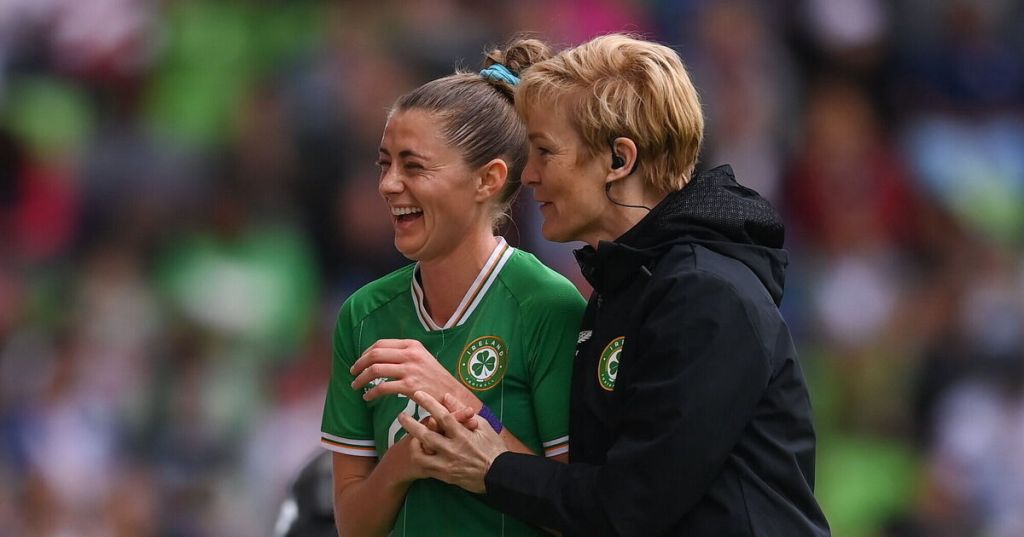
Sinead Farrelly and Vera Pauw
Sinead Farrelly -Overcoming Injury Time
Sinead Farrelly’s road to representing Ireland in the World Cup was more rocky than most. She had not played professionally for seven years, a lifetime for a professional footballer, more than the career of many players. Farrelly’s long break was prompted initially by the abusive actions of one man, a coach named Paul Riley. She represented the United States at every level up to Under-23 until his harassment forced her out of the game in despair. In 2021, she went public with her allegations about Riley which in turn sparked an investigation into abusive behavior by coaches in the US women’s league. Riley was banned for life from any involvement in U.S. soccer in January of this year.
Then, to compound her suffering, she was injured in a car accident and required years of treatment for concussion and whiplash. She only returned to play professionally this year, signing for Gotham FC in the NWSL and making a solid debut for Ireland in a friendly game against the U.S. Farrelly qualifies to play for Ireland through her Cavan-born father. Irish coach, Vera Pauw, encouraged Farrelly to resume playing and picked her for the Irish squad.“We were waiting on a player like Sinead,” said Pauw after her debut when she showed what a composed and skilled midfielder she is. There is more detail in this Irish Times story on Farrelly’s brave choices for herself and for women’s football.
Pauw herself has become collateral damage in the fallout from the NWSL investigation into abuse and misconduct by coaches. She was the manager of the Houston Dash for one season in 2018. Some players and staff at the club have accused her (anonymously) of belittling players and being overly controlling. Her situation is complicated and fraught, and I have included a link for those who have not followed the story. She has the support of the Football Association of Ireland (FAI) and the team, but it must be an unwelcome distraction for Ireland’s preparation for the competition.
The Irish women got a reality check last week when they played France in a friendly before the World Cup. The team looked solid for 45 minutes, giving the French a scare but lapses in concentration presented two goals to France in added time before halftime. One goal was a gift, the other was well taken by the deadly Eugenie Le Sommer. A third goal from a corner on the hour was even more of a gift. Ireland hung on doggedly but heads were down long before the game ended. Captain Katie McCabe was injured and replaced at 30 minutes. Her combative presence was missed and France took full advantage of her absence. There were bright spots. Sinead Farrelly brought crafty skills and guile in the midfield. Denise O’Sullivan was energetic and influential throughout. Kyra Carusa led the line impressively, earning the MVP award, no mean feat when you are being marked by Wendie Renard.
Marta, Brazil’s football Queen
Brazil’s enduring and exceptional star, Marta Vieira da Silva, makes her sixth World Cup appearance, her last outing at the highest level. (She shares this honor with Canada’s evergreen Christine Sinclair.) Marta has been a shining and assiduous presence for over twenty years in international football. She is not likely to start for Brazil as she recovers from a knee injury (on her magical left leg), but her inspiration is vital to her country’s hopes. “Marta is the queen, the icon, and just to be around her is contagious,” Pia Sundhage told reporters as she announced the Brazilian squad. Marta has won six FIFA World Player of the Year awards, more than any other player.
I asked my 11-year-old granddaughter, Olivia, to watch this short film on Marta’s career:
Coming from a difficult past, Marta managed to put it behind her and start her dream of becoming a football player. I’m glad she made it into the squad of Brazil’s women for the World Cup. She is an amazing player with so much passion and courage.
Getting the balance right
One of the challenges faced by World Cup teams is how to strike a good balance between experience and freshness. Players who starred previously in the competition (four years earlier) may have lost form or enthusiasm or be missing entirely due to injury. New, often younger players may be overawed, overeager, outclassed, or not sure of their role in the team. Chemistry and camaraderie are essential qualities to which everyone must contribute. This can be especially vexing for teams that are expected to do well, like the United States, England, France, Germany, and Spain, all of whom will be hoping that new players settle quickly into the team culture.
The U.S. farewell game against Wales this weekend was a case in point. Seven of the starting team are heading for their first World Cup, and it showed. The wise heads kept the team bonded: Crystal Dunn, Lindsay Horan, Alex Morgan, and later Lynn Williams. The wise ones on the bench, Rose Lavelle, Megan Rapinoe, and Julie Ertz, were sorely missed. The newcomers played well but the blend was off for large parts of the game. Passing was erratic and slow, and chances in the final third were scarce. Until star-in-waiting Trinity Rodman, who replaced Morgan at halftime, took hold of the game with two well-finished goals late in the second half.
Rapinoe announced her retirement from club and country this year. She has already transitioned to a hybrid role with the U.S. as a part-time player and full-time motivator and leader off the field. She has forthright views on the larger significance of this, the ninth Women’s World Cup and the first to include 32 teams.
“It is actually terrible business if you are not tuning in. You are missing out on a large cultural moment. I think we know that bottom line, equality is actually good for business, that is something special that the women’s game has and this is the premier women’s sporting event in the world, bar none, and this is a paradigm shift globally, not just in the U.S.”
The field in Moville where the Kennedy Cup was played
For fans of Donegal, football, and quirky stories that had almost slipped away, Secret Superstars: The Hidden History of the Kennedy Cup is a real treat. A summer tournament that was played in Moville, Co Donegal featured teams that combined junior (non-professional) players and big-name players from clubs in Scotland, England, Northern Ireland, and the Republic. The catch was that the professionals were not supposed to play during the summer months but they found various ways to play incognito. The Cup was played from the mid-1950s up to the start of “The Troubles” in 1970.
A labor of love produced and directed by Tom O’Flaherty, the film explores how some of the best professional footballers of the 1950s and 1960s came to the picturesque little shoreside pitch in Moville to play in the Kennedy Cup. The prize money of two thousand pounds sterling was the big draw but the camaraderie and hospitality of the town were equally attractive. This was long before professional soccer players were paid daft sums of money for signing or transferring from club to club. The local volunteers fund-raised year round to get that prize money, almost 60,000 pounds in today’s money.
O’Flaherty found some fine eye-witnesses to interview. Paddy Crerand, of Scotland and Manchester United, was more of an ear-witness (he never played in that Cup) but he heard the unlikely stories and fills in some of his own footballing history. Johnny “Jobby” Crossan from Derry was someone who did feature in the Cup throughout his extensive professional career with clubs in England, Northern Ireland, Holland, and Belgium.
The archival football footage is remarkable and three of the men who filmed get mentioned in the credits. And there are classic scenes from the famous European Cup finals of 1967 and 1968 won by Glasgow Celtic and Manchester United. Celtic’s wing wizard, Jimmy Johnstone, did play in the Kennedy Cup but watch him dancing by defenders in the European highlights. Donegal produced two legendary Irish football goalkeepers, Packie Bonner, and Shay Given, but this film includes a surprising revelation about the great Irish actor, Ray McAnally, who grew up in Moville.
I can testify that Moville is and was passionate about football and Glasgow Celtic in particular. I stayed one night in Moville during a driving holiday in the late 1990s through Antrim, Derry, and Donegal with my son, sister, and brother-in-law. We went to a small pub for dinner and were ushered into a side room with a cosy fire. Over the fire, where many houses would have had a Sacred Heart picture, there was a large painting of Henrik Larsson, the Swedish international star who was then playing and scoring goals for fun at Celtic. The picture of him with his glorious dreadlocks dominated the room. The film was screened at theSan Francisco Irish Doc Fest on Saturday, March 4, along with some other intriguing films: Violet Gibson: The Irish Woman Who Shot Mussolini; North Circular; and, The Man With The Moving House, Brendan Begley’s saga about getting permission to build on his ancestral land near Dingle.
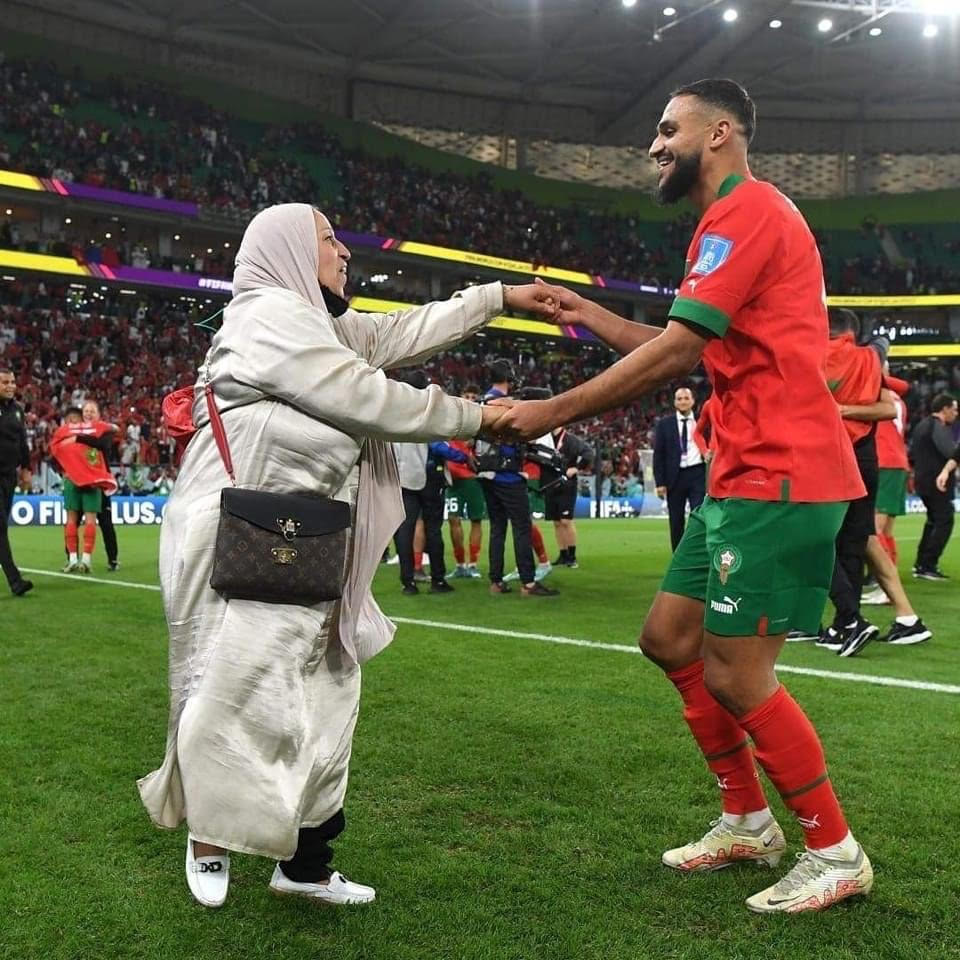
Morocco player Sofiane Boufal dancing with his mother
Watching the games of the 2023 World Cup in Qatar was, in equal measure, uncomfortable and compelling. How do we assess the moral balance sheet of this tournament? Is the notion of morality even applicable with FIFA? Can moments of footballing loveliness ever be considered more valuable than the lives lost, the obscene spending on transitory stadiums, and the astounding, continuing carbon footprint? But the football and Messi were exciting, often beautiful and highly competitive. It was a humbling experience for some of the big football nations: take your pick from Germany, Holland, Spain, Belgium, Brazil, Portugal or England.
Morocco were the feel-good story of the tournament and the images of Moroccan players dancing with their mothers are unforgettable. But there were many admirable teams who played their hearts out. Neutral fans like myself found it hard to pick a side in the third-place game where Croatia’s compact, creative midfield finally ended Morocco’s dream. Then, there was the speedy, purposeful football from Japan; the valiant South Koreans, and the rugged play of Australia and Switzerland.
Messi showed up with his magic feet and a renewed commitment to winning. I have written about him glowingly before and his influence on the time-space continuum. And more critically, the team around him were deeply invested in giving him a fitting farewell to his international career. Argentina’s victory was like the second coming of Diego Maradona who brought the Cup home in 1986. Messi is a more complete player but less charismatic person than Maradona, as my former East Bay United teammate and Argentinian, Andy Connell notes.
Maybe lifting the World Cup will correct that charisma deficit. Messi has always been easy to admire and love, unlike Ronaldo, who is an equally graceful player, but rarely gracious. Teammates seldom wax eloquent about Ronaldo but nobody has a bad word to say about Messi. Ronaldo’s egotism often got the better of him in team dynamics. He seemed to spend more time sulking on the sideline than playing in this competition, an inelegant finale to his international career.
It was not a happy tournament for those who fixate on star individual players like Neymar, De Bruyne, Van Dijk, or Lewandowski. None were able to bring their team beyond the quarter-finals. The two best individuals, Mbappe and Messi, were integrated into solid teams and showed their class in the exhilarating finish to the Final with the two best goals of the tournament. And then, there were other stars in waiting who stepped out of the shadows here: Brighton man Mac Allister for Argentina, Chelsea player Ziyech for Morocco and Gvardiol for Croatia.
Argentina had hundreds of “brujas” casting spells to protect Lionel Messi and the team. England, on the other hand, were undone by a kind of karmic deficit (Brexit?) against France. Olivier Giroud, who is so familiar to English Premier players, slipped between Stones and Maguire to head home the decisive goal and then, almost unbelievably, Harry Kane misses the second penalty kick. It was disappointing for Gareth Southgate who has shown leadership qualities that are sadly lacking elsewhere in the English political sphere. And ironic because the quality of football in the Premier League (itself an anti-Brexit project before that nightmare was foisted on English people in 2016) is a big reason for the renewed credibility of the English team.
During the competition, I watched the Netflix series, FIFA Uncovered. It made for sobering viewing exposing the full stories behind the disgraceful shenanigans that brought the World Cup to Russia and Qatar and cast some shade on the decision to award a World Cup to South Africa. The revelations about behind-the-scenes bribery, corruption and sports-washing that went into the decisions to hold the World Cup in two totally unsuited locations were distressing and depressing.
Of course, there is a long history of politically ambitious, power-hungry administrators with a purely transactional attitude to football. In Ireland, we had John Delaney running the Football Association of Ireland as his personal fiefdom for years and the 2002 debacle of Roy Keane’s abrupt departure from the Irish squad’s preparations in Saipan.
Sepp Blatter, who is banned from participating in the game until 2024, had no regrets and claimed he was not responsible for the actions of representatives from other countries or cultures. The U.S. representative on the North American federation (CONCACAF), the late Chuck Blazer, was finally forced by the FBI investigators to spill the beans on all the illegal wheeling and dealing. Two notable and timely tidbits about him from the documentary: he lived in Trump Tower and had not paid any taxes for 15 years -is it something in the water there?
“There has always been a certain type of narcissistic, immature -invariably male- character attracted to administrative roles in soccer. In my experience, it can happen even in youth leagues. The opportunity to exercise power and authority is irresistible for some who are patently ill-suited to the responsibility. They are generally disinterested in the more beautiful elements of the game which don’t readily translate into bottom-line or status considerations. FIFA is a graphic, global example of this phenomenon and maybe the worst offenders will finally be held accountable.”
But don’t take my word for it. The late Eduardo Galeano, in his extended love poem to the game, Soccer in Sun and Shadow, has plenty to say about administrative ineptitude and the stench of corruption which has hung over FIFA for years. His pithy indictment of FIFA: “Like everything else, professional soccer seems to be run by the almighty, even if non-existent, UEB (Union of the Enemies of Beauty).”
“There is nothing wrong with football itself. But the people who govern, manage and market it are squandering the unrestricted joy of it. They forget that they are merely service providers for a common good.”
It is time for FIFA to start making reparations for past and current sins. The decision for where the 2030 World Cup will be played has not been made. Let’s cut through the crap and award it to Morocco, who has tried five times unsuccessfully to host the Cup. Saudi Arabia is said to be interested, but please?
One other annoyance in the World Cup coverage in the United States is the unevenness of Fox Sports coverage. It leans towards jingoistic, lowest common denominator commentary and analysis. Yes, I am talking mainly about Alexie Lalas who dug a fine hole for himself by admitting early on, that he had never warmed to Messi. Fox Sports is stuck in a kind of early 90s time-warp where U.S. audiences needed spoon-feeding about tactical approaches, styles of play, and the rules of the game. They don’t seem to realize that almost ten years of continuing soccer education from NBC Sports sophisticated coverage of the Premier League has greatly expanded knowledge and appreciation for the game. The coverage on the Spanish channel Telemundo was often more enjoyable to watch.
****
Commonwealth Closing
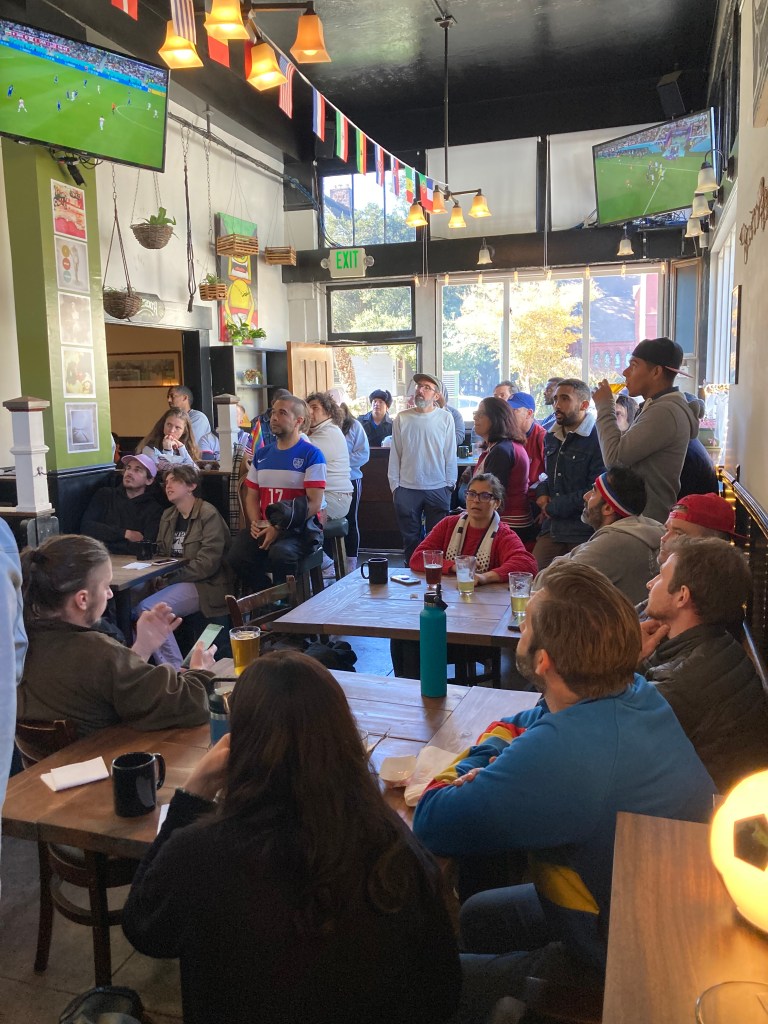
A sad note for East Bay soccer fans was the closing of Commonwealth Pub in Oakland at the end of the World Cup. It was a fine, friendly location with good food and drink that drew a diverse crowd. I went to the US-Iran final group game. The place was packed. Brian Watt from KQED radio was working the room, interviewing fans. I have always enjoyed his work, so it was a fun sidebar seeing him in action.
*****
Women’s World Cup 2023
I plan to write more about football in a sub-section of the blog titled Foot Notes. I will be in New Zealand next summer for the Women’s World Cup and I plan to offer a series of pieces about the teams and the players before and during the competition. I have tickets for six games, four in Auckland and two in Wellington. The competition opens in Auckland with New Zealand against Norway followed by the United States versus Vietnam, a meeting with a big historical shadow. Can the women’s game transcend the misogynistic FIFA culture? We shall see. If you come for the football, please stay for the music.




 The Old Blog Node