Tabharthas was one of the lovely, loamy Irish words I learned from Manchán Magan’s brilliant book, Thirty Two Words for Field. The word has several meanings, including gift, tribute, and bequest. Magan died this week, leaving a gap in the energy field of Irish land-rooted, indigenous spirituality. His loss will echo across the world. His life was a full-blooded tribute to his Irish heritage, lineage, land, and culture.
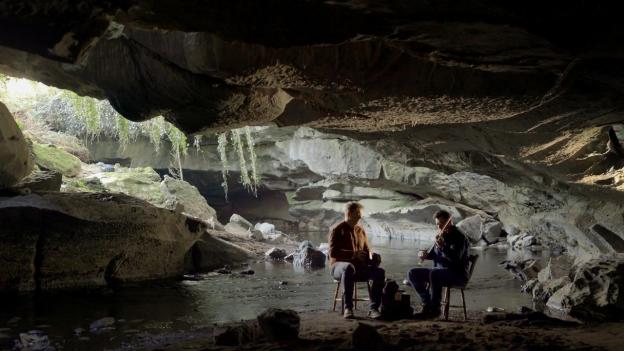
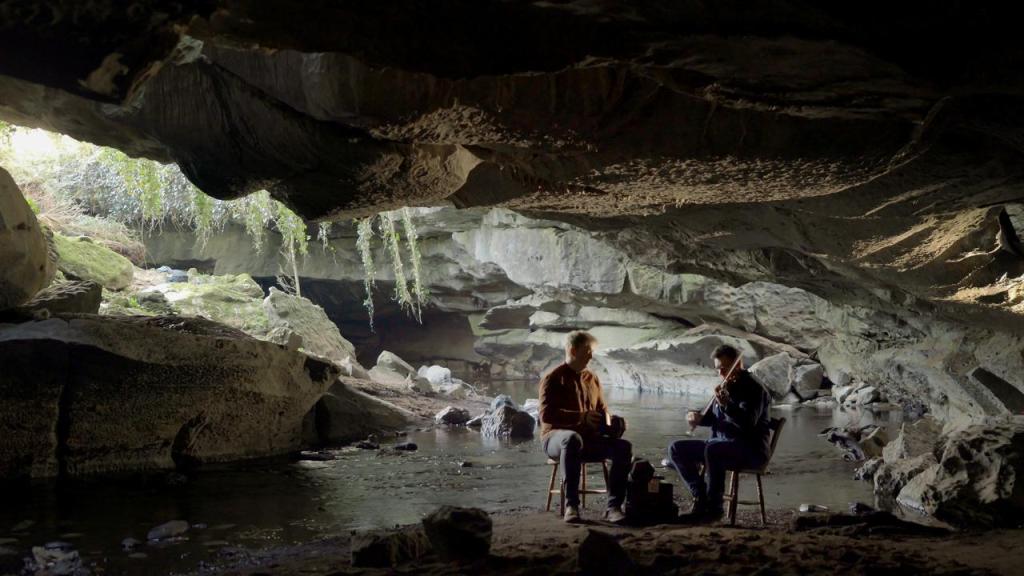
By coincidence (or perhaps not), I was listening to the new recording from Cormac Begley and Liam O’Connor, titled “Into The Loam.” The phrase ‘drawing from the well’ often comes up in discussions of traditional music, but Begley and O’Connor seem to have found one of those mythical places to play and film some of their new music.
This selection is called Bogadh Faoi Shusa. It struck me that it would make a good lament for Magan’s passing, especially the second part where the melody winds down. He would have appreciated the location, a cave of sorts, half underground and half overground, with nearby running water. He was on the verge of much wider recognition for his culture-changing work. If you have not read, seen, or heard him, seek out his work. A number of his films were made for TG4, Ireland’s Irish-speaking TV channel, and may be found on the TG4 Player.
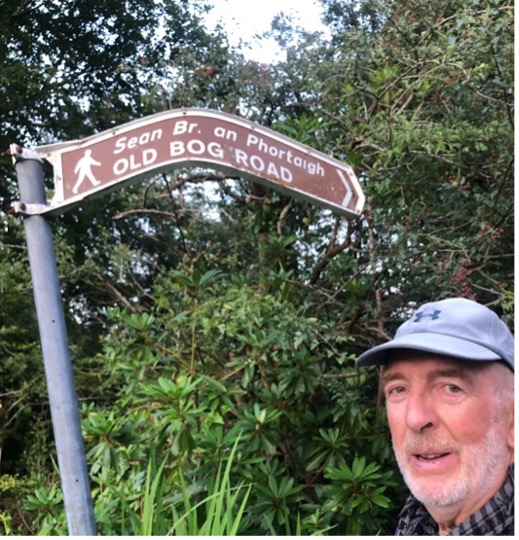
On a visit to Ireland earlier this year, I visited my old childhood summer home-away-from-home in Oughterard, Co. Galway. On an evening walk down the Pier Road, I came upon this sign. This was one of the inspirations for the title of this blog, although I had utterly forgotten the connection. This old road sign points towards Lemonfield, where I had a formative experience listening to two local fiddle players, Matt and Pete Conneely, with my friend John Clancy. You can find that story here, in one of the most widely read posts, “The Power of the Pattern”(in 2 parts), from 2010.
Many of the older posts from my original blog have not been referenced or reprised in the WordPress version, which I started in 2020. It’s about time I cross-posted some of those earlier pieces. All of my recent posts have been published on both sites. I maintain the original Blogger site because I want to keep track of my “readership,” which has now exceeded 120,000. Not bad for a part-time, unpromoted publishing effort focused on Irish music and arts, dating back to 2008, when blogs, depending on your perspective, were either still a big thing or already passé.
One goal was to create a space for informed and insightful writing about Irish culture and arts with a focus on traditional music from an immigrant perspective. The music served as a primary cultural lifeline back to Ireland after I emigrated to the United States in the 1980s. I wanted to share my passion and inspire others to acquire an interest in the country’s music and arts.
Initially, I wanted to have more than my voice on the site. I had hoped to persuade musicians to write about music-making, insights into the creative process, or aspects of performance or stage-craft. That dream remained unrealized. Musicians, I came to understand, place more value on playing and performing over sitting down to write, and who can blame them? However, my posts contain links to other writers, many of whom are more polished than I, providing additional resources to contextualize my commentary and address the Node mandate in the title.
Writing about music is an odd preoccupation. Listening is always required to get into music, but sometimes the right words can change perceptions of new or old music. I’ve benefited from that exchange more than a few times myself, and I aspire to offer the same opportunity to my readers.
I was fortunate to have a bi-cultural, urban and rural upbringing in Ireland before the effects of television, telephones, and technology began to erode our traditional culture. Radio was the dominant technology, and thanks to Ciarán Mac Mathúna, Séamus Ennis, Seán Ó Riada, and others, I heard some of the best traditional players and singers on RTE Radio. I reveled in the trad and folk revival of the 1960s, tuning in to the Clancy Brothers, the Johnstons, the Dubliners, and the Chieftains. Then, my tastes were further expanded (maybe even exploded) by Planxty, featuring Donal Lunny, Christy Moore, Andy Irvine, and the late Liam O’Flynn—the Holy Trinity Plus One of Irish music.
In California, my writing practice was revived by the encouragement and persistence of Catherine Barry and Elgy Gillespie, who were editing the Irish Herald, a monthly newspaperin San Francisco, until the early 2000s. I had three very prolific years with the Herald, covering CD and concert reviews, as well as interviews with visiting musicians. For example, I was fortunate to talk with Maria and Simon O’Dwyer of Coirn na hÉireann (Horns of Ancient Ireland) on their first trip to San Francisco. Their revival work on early Irish instruments was featured in John Creedon’s excellent 2024 documentary, Creedon’s Musical Atlas of Ireland. I saw and wrote about Tony Mac Mahon playing two extraordinary concerts with the Kronos Quartet in 2002 and 2003.
I wrote regularly for Irish Music Magazine for over ten years, conducting interviews with musicians and writing reviews of performances and recordings. Some of these have been reproduced or referenced on the blog, but I plan to “digitize” a few more in a selective fashion. And, as if that was not enough, when I resumed my sidebar writing activities, it intersected with the stratospheric trajectory of Martin Hayes’ career. I was fortunate to see him play live in San Francisco, Berkeley, and Sebastopol many times. My first piece on Hayes in the Irish Herald in September 2000 was titled Zen and the Art of Fiddle Playing. I heard him play at the San Francisco Celtic Music Festival each spring for ten years from 1991.
I have written about Hayes several times, and it has always been a rewarding experience. The first blog essay, titled “Hayes and Cahill: Recalibrating the Tradition,” was published in October 2008. I include it here since the post went up before the counter was initiated, and many readers may never have had the opportunity to read it. It is one of my favorites with extended quotes from an interview with the two masters conducted at the legendary Freight (formerly known as The Freight and Salvage) in Berkeley.
Hayes and Cahill graced the stage and enthralled audiences many times at the Freight, sometimes in their pluperfect partnership, other times with larger musical groupings. There was a riveting evening with The Gloaming in 2014. Another unforgettable performance I titled Quadruple Delights in 2018, showcased the Blue Room CD and Hayes’ quartet.
A good part of my continuing education in traditional music came from some of the well-known figures I have mentioned and a slew of lesser-known musicians who schooled me in the music. In fact, it is the countless hosts of musicians who play and perform for little or no reward that keep the music alive. Irish roots music is in fine shape, and each new generation of players seems to be more talented and innovative than their forebears.
These time-machine reposts will be continued in the future with other widely read posts on Susan McKeown, Paddy O’Brien, John Doyle, the Black Brothers, the late Mick Fitzgerald, Brendan Begley, Christy Moore, and others.
Dublin can be heaven if you are seeking cultural stimulation, and the Hodges Figgis’ bookshop is a good place to look. In June, I was fortunate to be there for the book launch of Camarade by my friend, Theo Dorgan. The audience was studded with poets, writers, scholars, musicians, and sundry cognoscenti: I was perhaps the most anonymous attendee. I sat next to a distinguished-looking gentleman with a lilting Northern accent. We chatted amiably, but initially I did not catch his name.
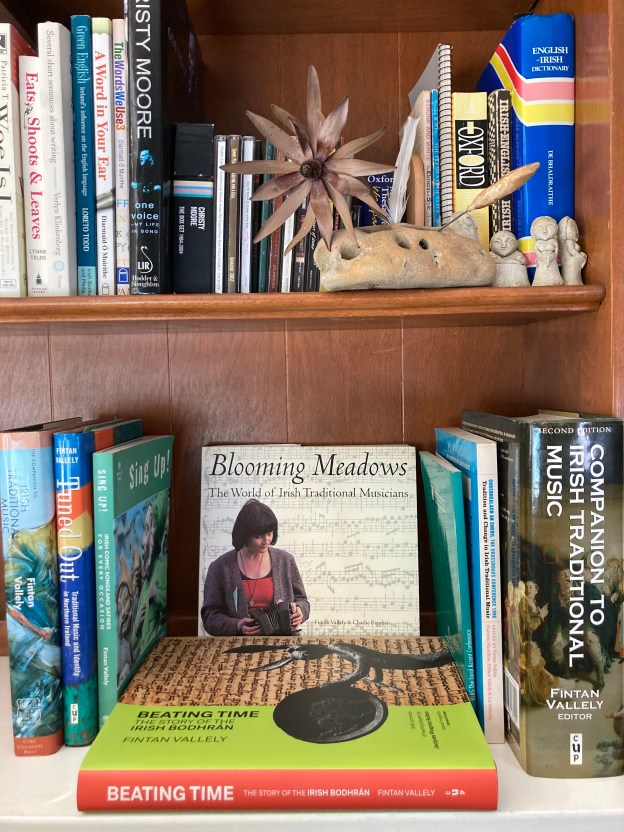
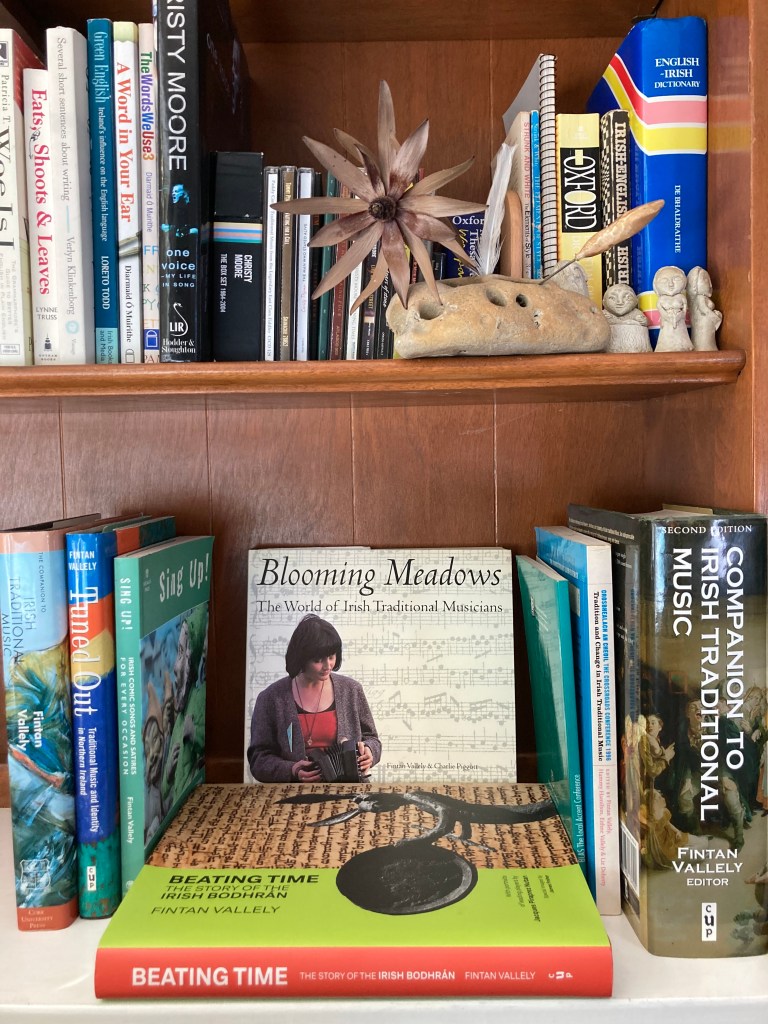
Imagine my astonishment, then, when I realized I was talking with Fintan Vallely, Ireland’s preeminent expert on Irish traditional music and a highly accomplished flute player. He has been writing, speaking, teaching, and advocating for traditional music for over fifty years. I have a decent collection of his writing, suitably curated in the title photograph. I have relied upon his books and articles as sources of sound information (especially the series of Companion Guides), stimulation, and writing inspiration.
His newest book, Beating Time: The Story of the Irish Bodhrán, explores the history of Ireland’s favored percussion instrument. The frame drum is not nearly as old as many people think. Vallely dates its high-profile arrival in Irish music to 1959, when it featured in the music for Sive, John B. Keane’s play, at the Abbey Theater. Sean O’Riada was the Abbey’s music director, and he was drawn to the drum’s possibilities. He made room for a bodhran player, Peadar Mercier, when he created a new ensemble, “ceili” band, Ceoltóirí Chualann (“The Band that Changed the Course of Irish Music”) in 1961.
The new book features vivid portraits by Jacques Piraprez Nutan and James Fraher and an extraordinary array of archival material, photos, and illustrations. Vallely establishes the tambourine as the origin of the drum. There is little evidence that it was present or necessary historically in the deeply melodic traditions of Irish music, Vallely asserts. However, improvised drums were fashioned from frames used for winnowing and sifting, particularly by Wrenboys on St. Stephen’s Day.
His book is suffused with organic intelligence. There are no artificial ingredients. Every chapter is rigorously researched, carefully arranged and annotated, and beautifully presented. The writing smoothly weaves dazzling details into the larger narrative. He is a Master collaborator. Each edition of the Companion guides involves contributions from dozens of musicians and music scholars. He is generous in his credits and acknowledgements and wears his erudition lightly.
Nicholas Carolan, former Director of the Irish Traditional Music Archive, introduced Vallely’s book at the Willie Clancy Summer School this July. He said Vallely had tirelessly researched the bodhran for many years and drew from a great range of recently digitized information. “He’s produced here both a definitive history of the Irish drum, and also an exemplar, a template for writing the social and musical history of other instruments of Irish traditional music.” On that last point, the concertina would be an excellent topic.
My favorite among Vallely’s works is Blooming Meadows, The World of Irish Traditional Musicians, a book of 30 interviews and portraits of Irish musicians published in 1998. Co-written with Charlie Piggott and featuring Nutan’s photographs and a “borrowed’ bar stool, the book is a treasure of lore and legends. The timely book offered a wealth of stories on long-established musicians, including Joe Burke, Ann Conroy, Paddy Canny, Joe Cooley, Lucy Farr, and Ben Lennon. It features many others who were on the cusp of greater recognition: Martin Hayes, Sharon Shannon, Liz Carroll, and Brendan Begley, among others. The format of short essays paired with a good image was one inspiration for my blog when I started it in 2008.
His other works in my collection are Tuned Out, a comprehensive and authoritative (like all Vallely’s writing) exploration drawn from interviews with musicians of how Irish traditional music fell out of favor with many Northern Protestants, regrettable collateral damage in the political polarization wrought by The Troubles. Sing Up is a humorous, clever collection of Irish comic and satirical songs. It’s got a whole section called Goatery and Percussion with songs about the bodhran.
Arguing at the Crossroads goes back to 1997 with ten essays on a changing Ireland. Vallely’s essay surveyed the state of Irish music at that point (post-Riverdance) and found it in rude health. The Local Accent, Selected Proceedings from BLAS also dates from 1997, and includes his provocative essay, The Migrant, the Tourist, the Voyeur, the Leprechaun. Vallely edited Crosbhealach An Cheoil (The Crossroads Conference, 1996) with Hammy Hamilton, Eithne Vallely & Liz Doherty.
Vallely is a walking/talking encyclopedia of Irish traditional music. In our brief conversation at the book launch, he summarized the key points of his bodhran research, mentioned his studies of The Princess Grace Song-Sheet Collection in Monaco (an astounding piece of catalogue work), and described the evolution of the Third Companion Guide into recordings on CD and DVD. He also gave me a copy of his 2021 CD, Merrijig Creek, an enchanting album of his compositions and arrangements with a powerhouse set of musical partners: his sister, Sheena, on flute, Caoimhin Vallely, their cousin, on piano, Liz Doherty and Gerry O’Connor on fiddles, Daithi Sproule on guitar, and Brian Morrissey on, you guessed it, the bodhran.
Vallely is an ubiquitous presence in the Irish music literature. I like to think of him as a key “influencer” before it was a popular or profitable role. Beating Time has everything you would want to know about the bodhran (including brass tacks) and much more that you may find intriguing and enlightening.
Links and additional sources:
All of Vallely’s prodigious work, books, recordings, articles, and other musical projects can be found at his website imusic.ie:
Irish arts suffered a tremendous loss this month with the untimely death of Sean Rocks, the voice of arts coverage on Irish radio for 20 years. Here are two short clips from his RTE programme, Arena:
First, an interview with Fintan Vallely about Beating Time.
 The Old Blog Node