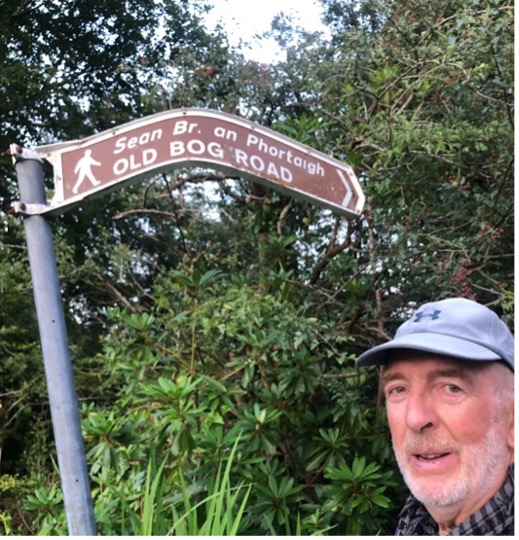
On a visit to Ireland earlier this year, I visited my old childhood summer home-away-from-home in Oughterard, Co. Galway. On an evening walk down the Pier Road, I came upon this sign. This was one of the inspirations for the title of this blog, although I had utterly forgotten the connection. This old road sign points towards Lemonfield, where I had a formative experience listening to two local fiddle players, Matt and Pete Conneely, with my friend John Clancy. You can find that story here, in one of the most widely read posts, “The Power of the Pattern” (in 2 parts), from 2010.
Many of the older posts from my original blog have not been referenced or reprised in the WordPress version, which I started in 2020. It’s about time I cross-posted some of those earlier pieces. All of my recent posts have been published on both sites. I maintain the original Blogger site because I want to keep track of my “readership,” which has now exceeded 120,000. Not bad for a part-time, unpromoted publishing effort focused on Irish music and arts, dating back to 2008, when blogs, depending on your perspective, were either still a big thing or already passé.
One goal was to create a space for informed and insightful writing about Irish culture and arts with a focus on traditional music from an immigrant perspective. The music served as a primary cultural lifeline back to Ireland after I emigrated to the United States in the 1980s. I wanted to share my passion and inspire others to acquire an interest in the country’s music and arts.
Initially, I wanted to have more than my voice on the site. I had hoped to persuade musicians to write about music-making, insights into the creative process, or aspects of performance or stage-craft. That dream remained unrealized. Musicians, I came to understand, place more value on playing and performing over sitting down to write, and who can blame them? However, my posts contain links to other writers, many of whom are more polished than I, providing additional resources to contextualize my commentary and address the Node mandate in the title.
Writing about music is an odd preoccupation. Listening is always required to get into music, but sometimes the right words can change perceptions of new or old music. I’ve benefited from that exchange more than a few times myself, and I aspire to offer the same opportunity to my readers.
I was fortunate to have a bi-cultural, urban and rural upbringing in Ireland before the effects of television, telephones, and technology began to erode our traditional culture. Radio was the dominant technology, and thanks to Ciarán Mac Mathúna, Séamus Ennis, Seán Ó Riada, and others, I heard some of the best traditional players and singers on RTE Radio. I reveled in the trad and folk revival of the 1960s, tuning in to the Clancy Brothers, the Johnstons, the Dubliners, and the Chieftains. Then, my tastes were further expanded (maybe even exploded) by Planxty, featuring Donal Lunny, Christy Moore, Andy Irvine, and the late Liam O’Flynn—the Holy Trinity Plus One of Irish music.
In California, my writing practice was revived by the encouragement and persistence of Catherine Barry and Elgy Gillespie, who were editing the Irish Herald, a monthly newspaperin San Francisco, until the early 2000s. I had three very prolific years with the Herald, covering CD and concert reviews, as well as interviews with visiting musicians. For example, I was fortunate to talk with Maria and Simon O’Dwyer of Coirn na hÉireann (Horns of Ancient Ireland) on their first trip to San Francisco. Their revival work on early Irish instruments was featured in John Creedon’s excellent 2024 documentary, Creedon’s Musical Atlas of Ireland. I saw and wrote about Tony Mac Mahon playing two extraordinary concerts with the Kronos Quartet in 2002 and 2003.
I wrote regularly for Irish Music Magazine for over ten years, conducting interviews with musicians and writing reviews of performances and recordings. Some of these have been reproduced or referenced on the blog, but I plan to “digitize” a few more in a selective fashion. And, as if that was not enough, when I resumed my sidebar writing activities, it intersected with the stratospheric trajectory of Martin Hayes’ career. I was fortunate to see him play live in San Francisco, Berkeley, and Sebastopol many times. My first piece on Hayes in the Irish Herald in September 2000 was titled Zen and the Art of Fiddle Playing. I heard him play at the San Francisco Celtic Music Festival each spring for ten years from 1991.
I have written about Hayes several times, and it has always been a rewarding experience. The first blog essay, titled “Hayes and Cahill: Recalibrating the Tradition,” was published in October 2008. I include it here since the post went up before the counter was initiated, and many readers may never have had the opportunity to read it. It is one of my favorites with extended quotes from an interview with the two masters conducted at the legendary Freight (formerly known as The Freight and Salvage) in Berkeley.
Hayes and Cahill graced the stage and enthralled audiences many times at the Freight, sometimes in their pluperfect partnership, other times with larger musical groupings. There was a riveting evening with The Gloaming in 2014. Another unforgettable performance I titled Quadruple Delights in 2018, showcased the Blue Room CD and Hayes’ quartet.
One of their most unique duo performances was in 2012 at the Freight, where sound engineer Tesser Call created a magical, intimate evening. Hearing them play in smaller settings, such as churches, in the early days (2011) was always a special pleasure.
A good part of my continuing education in traditional music came from some of the well-known figures I have mentioned and a slew of lesser-known musicians who schooled me in the music. In fact, it is the countless hosts of musicians who play and perform for little or no reward that keep the music alive. Irish roots music is in fine shape, and each new generation of players seems to be more talented and innovative than their forebears.
These time-machine reposts will be continued in the future with other widely read posts on Susan McKeown, Paddy O’Brien, John Doyle, the Black Brothers, the late Mick Fitzgerald, Brendan Begley, Christy Moore, and others.
 The Old Blog Node