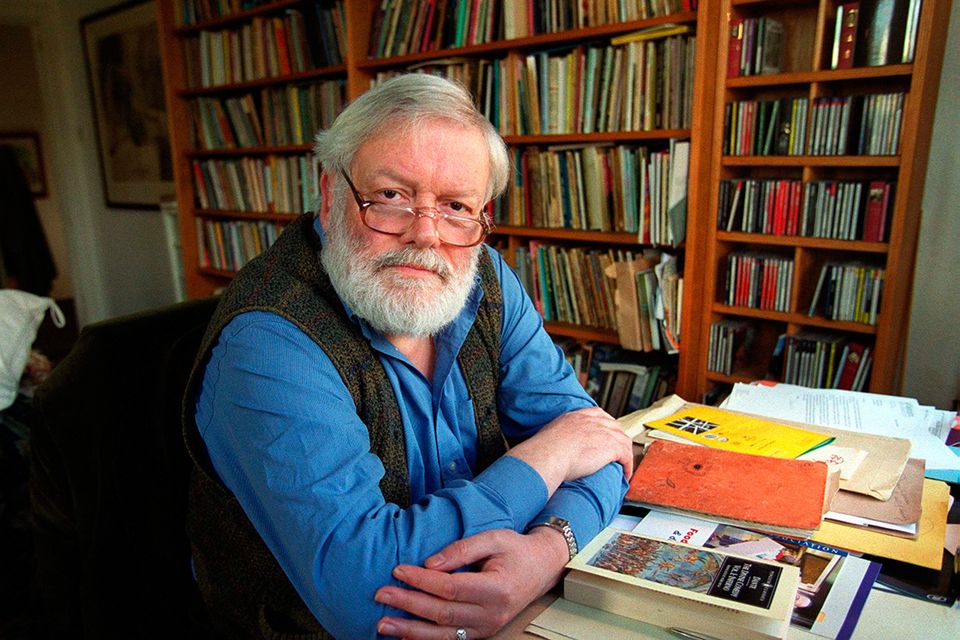
The news of Michael Longley’s death today prompted me to search through the blog archives for my review of books by Longley and Ciaran Carson. Carson died in 2019, and Longley has now departed. Many tributes will be paid to Longley over the next few days and weeks. The Irish President, Michael D. Higgins, led the way in today’s Irish Times:
Michael worked to give space and actuality to the moral imperative that we must live together with forbearance, with understanding, with compassion and insight, and above all else, perhaps, with hope.
One of the first pieces I wrote for The Irish Herald in San Francisco in May 2000, at the instigation of Elgy Gillespie and Catherine Barry, was a review of two books of their poetry. This edited version appeared in the blog in August 2010, and I reproduce it here as a small tribute to Longley’s work and genius.
The Honest Ulstermen
A review of The Twelfth of Never by Ciaran Carson; Wake Forest University Press, 1998, and The Weather in Japan by Michael Longley, Cape Poetry, Jonathan Cape, 2000.
I first came to Carson’s poetry through his prose. Last Night’s Fun (North Point Press, 1996) is a masterly piece of work, arguably the finest book ever written about the mysteries of the music-making process. His new book of poetry, The Twelfth of Never, continues in that vein. He uses tune titles –notoriously misleading in the Irish tradition- for many poems. He poetically plagiarizes many old ballads, twisting and turning familiar lines into a darker tapestry such as this from The Rising of the Moon:
The pale moon was rising above the green mountain,
The red sun declining beneath the blue sea,
When I saw her again by yon clear crystal fountain,
Where poppies, not potatoes, grew in contraband.
Carson writes like a man possessed. The Twelfth of Never reads like it was written in one passionate, pellucid night when the words flowed freely, and his magpie mind couldn’t be stopped. And, as if living in the North was not strange enough, Carson’s forays into Japanese culture bring him to locations where he finds,
The labyrinth to which I hadn’t got the key.
Poetry is, at its best, an intellectual and emotional con game. The poet hopes to trick us into thinking anew about things or rethinking familiar things by sleight-of-word. Carson riffs, raps, trips, traps, rocks, and rolls our perceptions in his poetry. In The Display Case, Carson seems to express some regret that his oeuvre is nearly all in English, not his native Irish language. But this is English writing that could only emerge from an Irish consciousness,
Where everything is metaphor and simile (Tib’s Eve).
Carson’s poems are odes to complexity, a dissection of that hairball of historic proportions, that nest of co-dependent hostilities that is Northern Ireland. And discussion of Northern Irish poetry is no less fraught with difficulty, a minefield sown with words.
Both Carson and Longley are distinctly Northern Irish. Longley describes being there as living in three places at once: one partly Irish, one partly English and one that’s “…also its own awkward self.” Each covers the touchstones of Northern identity and the struggle of people to lead normal lives in the mayhem, including their efforts to play an artist’s role in a society given more to ideology than to introspection.
Both are famous as the artists that stayed home, laboring in the bloody northern field. They served long stints with the Arts Council of Northern Ireland before retiring in recent years to focus on their writing. As John Hume has noted (Arguing at the Crossroads, 1998), Northern artists were mainly responsible for keeping the flame of diversity and multi-culturalism alive during the years of strife and political polarization.
In All of These People, Longley ruminates:
Who was it who suggested that the opposite of war
Is not so much peace as civilisation? He knew
Our assassinated Catholic greengrocer who died
At Christmas in the arms of our Methodist minister.
The North, despite George Mitchel’s valiant efforts to impose some American pragmatism, remains an immensely complex place where words can and do explode –just think of the recent haggling over “decommissioning.” As Fintan O’Toole noted in the New Yorker (The Meanings of Union, April 27, 1998), crafting agreements in the North will require a poet’s skill, not a pragmatist’s words.
The ancient words of the Persian poet Rumi seem particularly pertinent to the current impasse in the North of Ireland.
Out beyond ideas of
Right doing and wrong doing
There is a field.
I’ll meet you there.
And if the Catholic and Protestant diehards ever make it out to that field, they’ll find Michael Longley and Ciaran Carson waiting to have words with them. High kudos to them for these collections. I can think of no two better Irish people to lead the charge of the write brigade across the field of new Irish dreams.
 The Old Blog Node