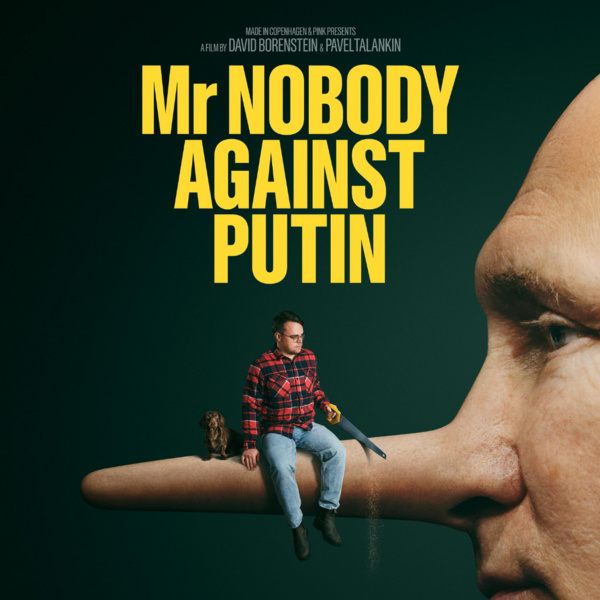
Mr. Nobody Against Putin is an Oscar-nominated documentarywith a compelling portrait of resistance to autocracy and fascism. I had the privilege of seeing a special screening of this film at the Smith Rafael Film Center with the director, producer, and Mr. Nobody in attendance for a Q&A. Mr. Nobody is Pavel Talankin, Pasha, a primary school teacher in a small Russian town, who decides to use his skills to fight back against Vladimir Putin’s school-based propaganda campaign justifying his war in Ukraine. It begins with his annoyance at how Moscow’s demands are making his work and that of other teachers more burdensome, then quickly pivots into filming an undercover documentary in his role as the school videographer.
The propaganda campaign becomes more and more intrusive until students are marching in military-style uniforms and getting weapons presentations from Wagner Group mercenaries. Pasha is increasingly frustrated and outraged, and his opposition to the propaganda becomes more evident. He clearly sees the effects of mobilization and conscription on the young people in his town. Young men with few good job options join the army and serve in Ukraine. Some do not return.
It would make an excellent double-feature with the film Porcelain War, which I wrote about in 2025. This film is available for streaming in the PBS POV series. Both films offer a close-up view of how ordinary people exercise their agency and courage to resist oppression. And both films focus more on acts of grace, love, and humanity than on war. That’s what makes the films so dramatically powerful.
The film is now showing at the Smith Rafael Film Center and other independent film theaters in the Bay Area. It is also available for streaming on Apple TV. Putin, like Trump, is a big believer in HIS freedom of expression. This film shows how ruthlessly he peddles his big lies to school children and teachers. Trump has not extended his propaganda in this sector, but you can be sure he admires the roadmap.
The war in Ukraine is still with us, a seemingly endless, everyday tragedy. I described the documentary, Porcelain War,as a terrible beauty of a film when I reviewed it earlier this year. Christy Moore’s album of the same name features a track called Sunflowers, another commentary on the war. Initially, the film had a limited theatrical release but no streaming deal. Now, it has been acquired by the Public Broadcasting Service’s POV series, and is available to watch on the PBS Player and on KQED in the San Francisco Bay Area. The film remains hugely relevant as the U.S. and Russia seem bent on forcing a one-sided resolution on Ukraine where the autocratic aggressor gets all its demands met, and the democratic state gets shafted.
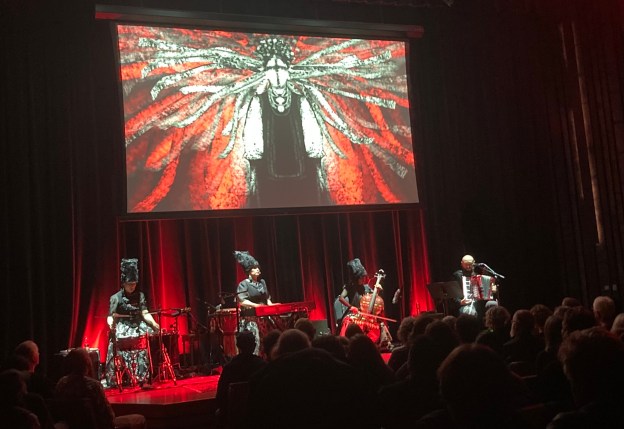
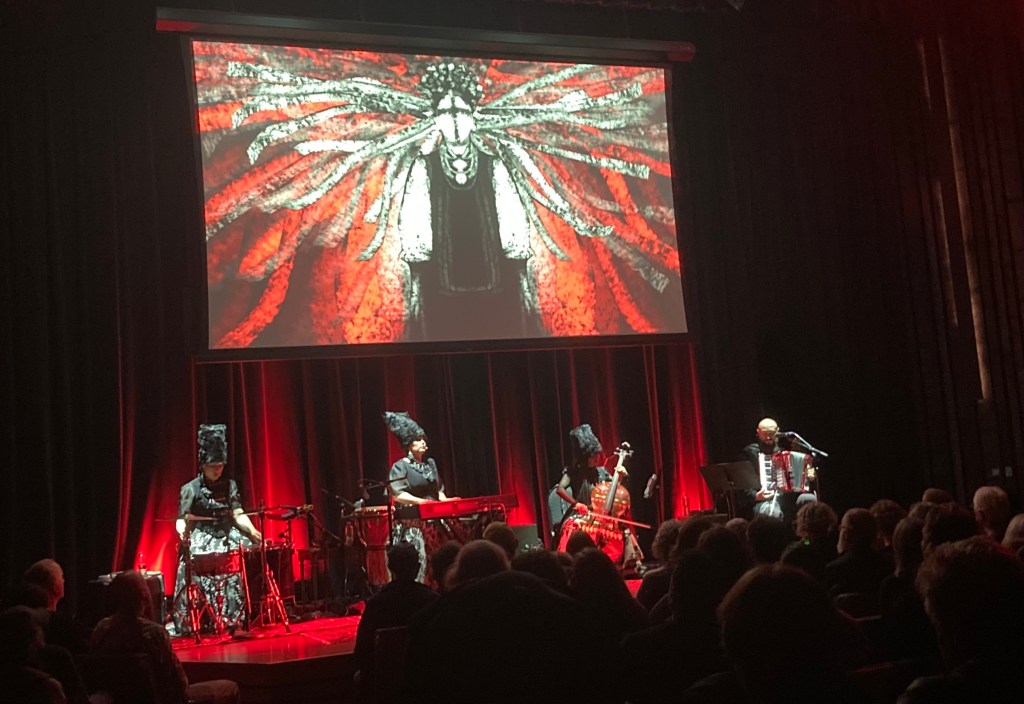
Ukrainian band DakhaBrakha lit up The Freight and Salvage in Berkeley with three sold-out shows last weekend, April 4, 5, and 6. The group’s performances are an audio-visual extravaganza. Their music cuts across a broad spectrum of folk/trad/rock/jazz/techno: ethno/techno, in their words. Think of them as musical anthropologists. They play with passionate intensity and muscular musicality—rigorous and vigorous. The quartet comprises Marko Halanevych, Iryna Kovalenko, Olena Tsybulska, and Nina Garenetsk.
Every instrument has a percussive role, supplementing the array of drums (Indian, African, and Arabic) on stage. Everyone sings, and the women’s voices meld into soulful, sharply cadenced choruses. The cello brings dark energy to sonic arrangements. The accordion sound is minimal in many songs and often resembles uilleann pipes, organs, or harmonica.
Some of their music was featured as the soundtrack for Porcelain War, a terrible beauty of a documentary, that played earlier this year at the Smith Rafael Film Center. A streaming service has not taken up the powerful anti-war film, but some clips can be seen here: https://www.porcelainwar.com/videos
DakhaBrakha was created in 2004 at the Kyiv Center of Contemporary Art “DAKH” by avant-garde theatre director Vladyslav Troitskyi. Theatre work has left its mark on the band’s performances—their shows are always staged with a strong visual element of projected imagery and animations.
Their U.S. tour ends this month and they have one more Northern California gig in Davis before returning to Ukraine for a series of summer concerts. They are a uniquely powerful ensemble expanding Ukrainian folk and traditional music into a wild world of sonic adventures. And, in the You-know-you’re-in-Berkeley-When category, a Ukrainian immigrant, Igor Tregub, who serves on the Berkeley City Council, introduced the group.
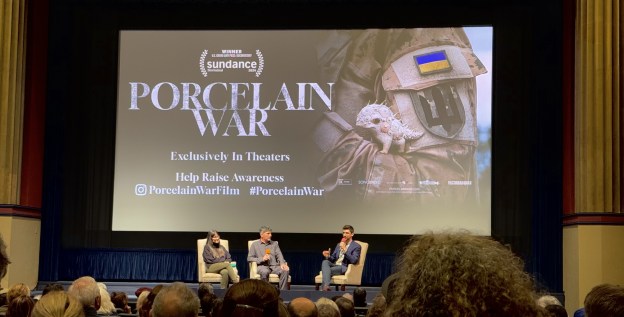
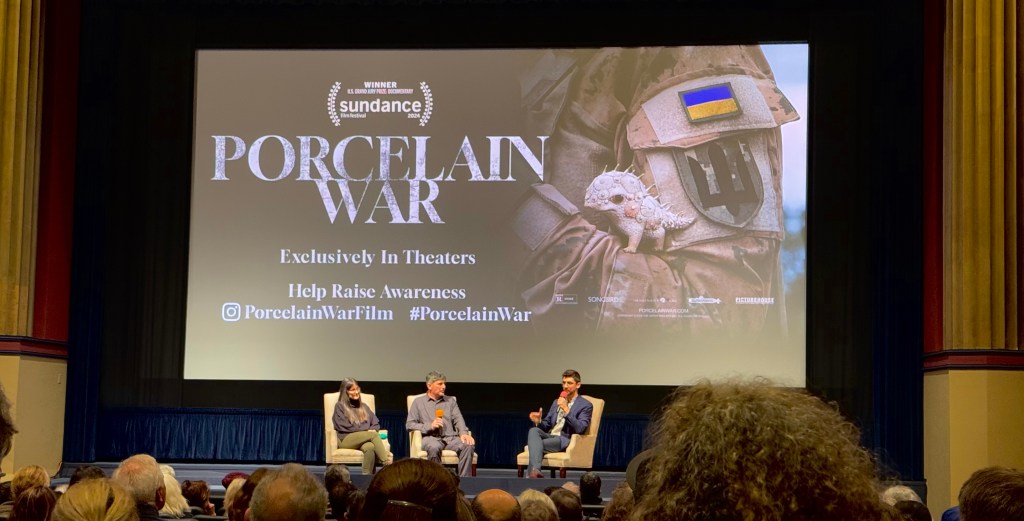
Porcelain War Filmmaker Slava Leontyev and producer Paula Dupre Pesmen were interviewed by the Ukrainian Deputy Consul General Yevgeniy Drobot at the Smith Rafael Film Center on February 4, 2025. (Photo by Dave Mackie)
Porcelain War is a terrible beauty of a documentary, an improbable and almost impossible achievement by a group of Ukrainian artists. Slava Leontyev, Anya Stasenko, and Andrey Stefanov stayed in the war zone around Kharkiv, armed only with their art, cameras, and, for the first time ever, guns. Ordinary extraordinary civilians electing to fight for their lives, culture, freedom, and democracy in a war waged against professional soldiers.
The filmmakers decided not to make a film that presents a balanced narrative of the horrors and successes of war. They wanted to show as much beauty, bravery, grace and decency as possible. There is no fog of war for the Ukrainian resistance. They fight in the most moral way, lamenting the brutal power of the weapons they use while showing compassion and empathy for Russian soldiers being sacrificed for Putin’s delusion of a restored Russian empire.
When I first saw it, I had the revelation that Ukraine’s war is the frontline of the worldwide struggle to save democracy. Many people already understood this, but the film hammered it home for me. That was before President Trump’s inauguration. Now, I see that the frontline has shifted to the United States and that Ukraine may become collateral damage in the worldwide anti-democratic surge.
Both films have useful lessons on resistance. Firstly, everyone who sees the authoritarian dangers must resist in their own way. In Ukraine, two porcelain artists and a painter became movie-makers. Other professionals, teachers, farmers, engineers, human resources specialists, and tech-savvy young people joined the army and put their skills to patriotic use.
In Hungary, three women- a journalist, a politician, and a nurse- led resistance work to counter Viktor Orbán’s corrupt, persistent, and largely successful campaign to undermine democracy. As many commentators have noted, Orban’s playbook is the model for Project 2025 and the barrage of executive orders Trump has signed in the first two weeks of his “reign.” Orbán took carefully crafted, methodical steps to chip away at Hungarian democratic institutions (the media, universities, arts organizations, and Non-Government Organizations) while maintaining popularity with a majority of citizens. His authoritarian project is over fifteen years strong.
I have already seen Porcelain War twice this year, thanks to the generous and activist programming of the California Film Institute and the Smith Rafael Film Center. The film is on a limited theatrical release and has not secured a streaming arrangement so far. It has been Oscar-nominated for Best Documentary Feature. Don’t miss it if it is showing near you.
The soundtrack features the sweet and startlingly tart music of the Ukrainian band DhakaBrahka. The band is touring the United States in March and April and will play some concerts at the Freight and Salvage in Berkeleyat the end of March. Described as being,
“At the crossroads of Ukrainian folklore and theater, their musical spectrum ranges from intimate to riotous, plumbing the depths of contemporary roots and rhythms.”
The film’s focus on people trying to live their best lives in a time of unrelenting war is inspiring and motivational. The scenes of beauty in nature and people are captivating. When the filmmakers were asked how people could help the cause, not once did they ask for money. Their goal was to raise awareness of how people are dealing with the tragedy in their country and raising money would be a crass and useless gesture. The film stands on its own merits.
The struggle for democracy is going on now in the United States and other countries. Very wealthy people are no longer rooting for democracy or for the common good. Towards the end of the film, Anya Stasenko says that she is lucky to have met so many brave people in the resistance and is amazed at how much good work they have accomplished together. Do we need to have wars to see this truth?
It would be easy to lose hope. Perhaps hope has finally risen to the level of strategy, to rework that Obama-era cliché? The lesson from these films is to do whatever you can; every little gesture of resistance is important. Support local arts organizations, especially for music, movies, theater, and visual arts. Stay informed by supporting independent and local media outlets while we still have some. Find community groups doing work for the common good and volunteer to help. Contact your elected representatives at the local and state levels to express your dissatisfaction with the outrageous power grabs underway. Take to the streets, like some Democrat leaders are finally doing. Speak out on behalf of the most vulnerable, demonized people and groups. Try to be as courageous, honorable and resourceful as Ukrainians.
 The Old Blog Node