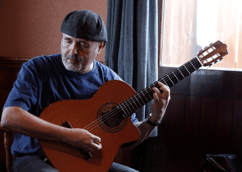
(from his Facebook post at Nutan Jacques Piraprez’s )
Dennis Cahill died this week at his home in Chicago. His low-key style, superb guitar playing and authoritative musical presence expanded and enriched Irish music. His relationship with Martin Hayes is one of the most enduring and inspiring musical achievements of the past 30 years, one that extended into two other influential groups, The Gloaming and The Martin Hayes Quartet. Accompaniment always seemed like a pale descriptor for his beautiful work.
Dennis Cahill was the quiet man in the Hayes-Cahill partnership. But his silence was studied, voluminous and eloquent. In other settings like workshops or classes, he had plenty to say, much of it pointed, precise and passionate. And, he had a good ear for humor and jokes.
He embodied the traditional value of modesty which takes a particular variation in Irish culture. He never flaunted his universal musical wisdom and experience. It was this very global reach which drew Hayes to him, first as a friend, and later as a harmonic partner. In his recent biography, Hayes describes their second round of playing together on tour in Norway. (There was some serendipity around them becoming a pair.) Instead of becoming a traditional guitarist in a generic sense, he encouraged him, “…to look at these tunes in the way one might imagine a Bach partita or a Beatles song.” The harmonic and chordal side of traditional music is not so clearly defined and Hayes felt that together they could find some unexplored territory.
I had the great privilege, with a cohort of other Bay Area admirers, of seeing their partnership grow and flower over almost thirty years. I saw them play many times in San Francisco and Berkeley before I ever tried to write about their music. One element of their performances I always enjoyed watching was their on-stage communication. Traditional music is full turns, repetitions, not-quite-repetitions, and shifts in cyclical patterns. Rabbit holes of a sort. Someone has to call the changes even in a duo. Early on, Hayes’ signals were broadly visible: the headshake, the direct stare or the half-turn. Over time, though, this communication became subtle, almost imperceptible. Hayes says in his Facebook tribute to Cahill: “There were so many times on stage when you were simply able to read my mind…”
One of my favorite passages in Martin Hayes’ book describes their routine when they drove to gigs, Martin behind the wheel and Dennis on the maps:
We were both OK with long stretches of silence where an hour or two would pass by without either of us saying a word.
This was easy to imagine since in any long-term relationship there is a plateau where people are content to say only what needs saying.
One reality that is painfully illustrated in Martin Hayes’ biography is how precarious a pursuit of artistic integrity can be. There are many years spent playing to small audiences, in cramped venues with relentless travelling and very limited income. There is no guarantee of a safe and successful passage from the noisy stage in the cavernous Fort Mason or the tent in Sebastopol or the old Freight and Salvage in Berkeley.
The last time I saw Cahill play live was in 2018 when Hayes and his Blue Room Quartet were featured at the Freight. I noted that Hayes was, “Doubling down fruitfully on his long association with guitarist Dennis Cahill, Hayes has now created a Quartet..” The full review is found here. One of the duos most memorable shows at the Freight was 10 years ago when sound engineer Tesser Call created a sonic wonder for the enraptured audience.
Interviews with Hayes and Cahill were always enlightening, a colloquium in the finer points of playing music and the creative process. One of my most memorable interviews with the pair also took place at the Freight in 2008. When I asked about how they prepare for concerts, Hayes explained their shows this way:
“Our live performance is sort of its own thing. Whatever happens, happens. They go a certain way. The live show doesn’t vary hugely from night to night, it kind of gradually changes. No two nights are the same –I might like it to be- but some tune will fly and another one won’t. There’s not much you can do about that. You have to feel it out every time.”
Dennis weighed in with this observation:
“And you have to do it that way for two reasons. One, there’s only two of us up there, so you’re very exposed. And if you don’t let it flow, and get in the habit of doing that, you run the risk of becoming your own tribute band –sounding like somebody doing a version of you.”
You could tell from his expression that this was the worst fate he could envisage for them.
Then, he added this acute analogy:
“You have to have a framework and you have to keep it in your head. I think of it as being like one of those chairs you need to assemble –you can put the screws in place but don’t tighten them. Because if you do, it may not fit and you’ll end up with one leg hanging too high in the air. Each piece, each performance has to work like that.”
With exquisite communication and profound intuition, Hayes and Cahill assembled many magical musical chairs over their years together. Hayes says Cahill was one of a kind, a very special blend of talent, humility, grace and good humor. He will be deeply missed by the music, the musicians, the audiences, his family and friends.
 The Old Blog Node
This is a wonderful piece, Tom. I tried posting my comment but I do not know what an URL is so I was unable to post it. Again, you write beautiful with depth and sensitivity and insight. The part about traveling in silence for long stretches was particularly moving for me.
Jeff
>
LikeLike
Tom
This is a delicious honoring of an amazing musician. You are a bit of a magician with words, sharing the most amazing bits, all connected with the feelings , settings and wisdom that pull me in. Thanks so much
LikeLike
Pingback: Dennis Cahill: Litir ó Do Chara | The Old Blog Node