This is a re-post from earlier in July contextualizing the Women’s World Cup.
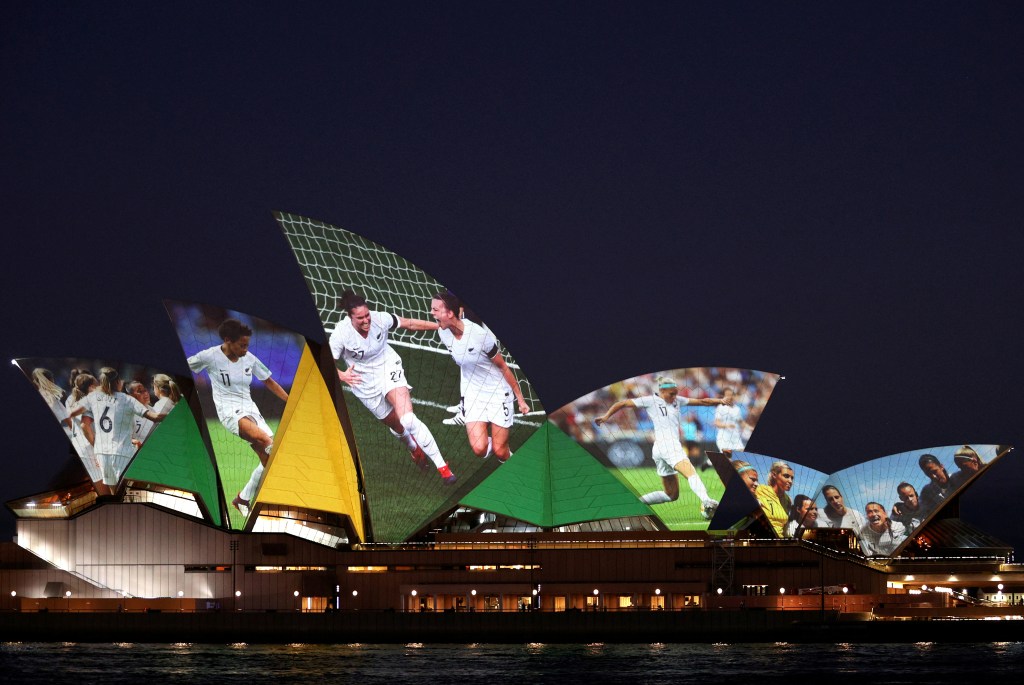
The Women’s World Cup hosted by Australia and New Zealand is just a few weeks away, and I will be there. I am opening a new strand on the blog for the next couple of months, shifting to covering the World Cup and women’s football generally. On our first trip to that part of the world, my wife and I will spend a month in Auckland with side trips to Wellington and Queenstown. We will see four games in Auckland and two in Wellington. Auckland’s Eden Park stages the opening game with New Zealand, The Football Ferns, taking on Norway on July 20.
Next up, the opening game for the U.S. women in Group E against Vietnam, first-timers against four-time winners. Two countries with a lot of shared history but not in football. Then, the most competitive game for the U.S. team is when they square off against the Netherlands in Wellington on July 26, a repeat of the 2019 World Cup final. And two days later, two other ambitious contenders, Spain and Japan, go head-to-head for the top spot in group C.
I will be on the ground in Auckland, which is the base for the U.S. team in the group stages. I plan to bring some impressions, insights, and highlights to followers of the blog. More stories and drama are sure to emerge as the World Cup gets going.
Plenty of pre-tournament stones in the road
Just as the hope that the women’s games would bring more moral clarity and less corruption, things went sour early on. The Cup has already weathered a few crises. Many of the women’s teams had issues with their national federations, often male-dominated. The Canadian women threatened to strike and not participate in the She Believes Cup in February. Spain and France had to resolve squabbles between the players, coaches, and administrators. Pia Sundhage, the former U.S. coach who now manages Brazil, has complained about how chaotic the administration of women’s football is below the level of the national team.
The payments for European broadcast rights to the Cup were only recently settled. For a time, FIFA contemplated a toxic intervention into their own tournament: a possible sponsorship deal between FIFA and Saudi Arabia’s tourism authority. The Australian and New Zealand soccer federations were outraged by the proposed deal because of Saudi Arabia’s human rights record, especially regarding women and LGBTQ individuals. USA forward Alex Morgan was forthright: “Pretty much everyone has spoken out against that because morally, it just doesn’t make sense.” Of course, there’s the rub. When was the last time FIFA’s top leaders were in the same room with morality? Money, not morality, is frequently the driving force in world soccer.
According to the global players’ union, Fifpro, footballers were placed “at risk” during qualifying for the Women’s World Cup by a lack of medical support and substandard working conditions. The survey involved responses from hundreds of international players and highlighted how fragmented and badly scheduled the games for qualification were. Some of the world’s leading women’s players will not be playing due to major injuries, notably torn ACLs.
United States: high expectations, but is the mix right?
The United States is the pre-tournament favorite but can expect stiff competition from other nations with high-quality squads. The U.S. roster for the tournament was announced last week. It’s a solid mix of experienced and first-time players. Alex Morgan, Megan Rapinoe, and Kelley O’Hara will be making their fourth appearance in a World Cup, while goalkeeper Alyssa Naeher and midfielder Julie Ertz will be playing in their third. However, the U.S. will be without Becky Sauerbrunn in defense and in-form goal-scorer Mallory Swanson, injured in a friendly game against Ireland in April. Julie Ertz’s return will improve the intimidation factor, along with the spiky presence of Rose Lavelle and Lindsay Horan in the U.S. midfield. Four of the six selected forwards are making their first World Cup appearance: Trinity Rodman, Sophia Smith, Ashley Sanchez, and Lynn Williams. A great deal may hinge on their goal-scoring success. The U.S. team will play a final friendly game against Wales on July 9 in San Jose.
The First-Timers
The Irish Women’s team join seven others, Haiti, Morocco, Panama, Philippines, Portugal, Vietnam, and Zambia, in making a first appearance at the World Cup. The famous luck of the Irish deserted them with the group C draw, which has to be considered “the group of death.” To add to the pressures, Ireland opens against Australia in Sydney and then crosses the country to Perth five days later to play Canada. Ireland’s second to last game before the big tournament was against Zambia last week in Dublin. The Irish women (minus two of their stars, Katie McCabe and Denise O’Sullivan) won 3-2, recovering from a poor first half to a victory against an African team below Nigeria in the FIFA rankings.
Irish coach Vera Pauw is under no illusions. She says that if people expect the team to win the World Cup, they will be disappointed, but they intend to make the Irish fans proud. She makes many good points in this Irish Times Women’s Podcast. Vietnam played Germany, a pre-tournament favorite, in a friendly game this week and lost 2-1. Morocco may have the best chance of advancing to the second round, but all the debutants will face stiff competition and little mercy from their group rivals.
Australia looks strong and ready, New Zealand less so
Host nation Australia has high hopes, and their top-class players, Chelsea’s Sam Kerr and Arsenal’s Caitlin Foord, are in fine form. Canada, the 2019 Olympic Champions in Tokyo, is the other force in that group and will fancy their chances of advancing. Underappreciated Nigeria, who have played in every women’s World Cup since 1991, round out the group. They have won their last three friendly games this year and will be looking to advance further than before in the competition. New Zealand lost two games in Auckland to the U.S. in February and don’t look ready for prime time.
Happy and unhappy squads
Some nations have had relatively drama-free build-ups to the World Cup, others not so much. The U.S., England, Germany, Sweden, Denmark, and Norway have been preparing diligently. The English women have some significant advantages: reigning European Champions, a settled camp, and longer prep time than other countries. But key players are injured: Captain Leah Williamson and Beth Mead, leading scorer in Euro 2022.
France had lots of off-field drama, firing manager Corinne Diacre after falling out with some of the star players, Wendie Renard, Eugénie Le Sommer, and Amandine Henry. All the players have since resumed their French careers. The team is now managed by Herve Renard, an experienced World Cup specialist who has managed the men’s teams of Morocco, Zambia, and Angola.
Spain had similar problems going back to the Euros in 2022 when the coach, Jorge Vilda, refused to pick some key players due to disagreements about preparation and attitudes. A few players have since returned to the fold, especially the Barcelona (European Champions League winners) stars Irene Paredes, Aitana Bonmati, Alexia Putellas, and Mariona Caldentey.
The Big Picture on Women’s Rights
The global showcase of women’s sports is happening in a socio-cultural context that continues to be challenging and depressing for women’s rights. A recent United Nations Development Programme report concluded that nine out of ten people (of all genders) have a bias against women. This figure is the same as a similar study from ten years ago. You can be sure that this misogynistic bias has been operating in the build-up to the competition and will be reflected in the coverage and viewership of the Cup.
I have been lucky enough to see men’s World Cup games during the 1994 competition held in the U.S., and I hope to see some more in 2026 when the competition returns to these shores. My best years playing soccer were in the San Francisco Co-ed league with the character-laden, ironically named MUD team. Most of the women players (let’s hear it for Title IX) were better than the men, myself included. It was the most engaging, satisfying, and sporting experience in my many years of team play.
I am conscious of the dangers of men writing about women’s soccer. I hope to judge the games on their own terms and limit over-simplified comparisons with the men’s game. I enjoy women’s soccer because teamwork and cooperative patterns of play are more visible. The team’s the thing in women’s football. There is significantly less ego, grandstanding, and “diving” to draw foul calls. Games are competitive, particularly on the World Cup stage, but also more sporting and compassionate. There is more respect for match officials. I plan to use no disrespectful terminology, like “girls” or the patronizing “ladies.”
My Early Group predictions: Winners, Second
Group A: Norway, Switzerland (Sorry, New Zealand)
Group B: Australia, Canada (Sorry, Ireland)
Group C: Spain, Japan
Group D: England, Denmark
Group E: U.S.A, Netherlands
Group F: France, Brazil
Group G: Sweden, Italy
Group H: Germany, Morocco
I use a variety of sources for football news and updates: The Irish Times, ESPN, San Francisco Chronicle. And the Guardian, especially the weekly newsletter, Moving the Goalposts covering women’s soccer:
https://www.theguardian.com/football/series/moving-the-goalposts
The Athletic:
https://theathletic.com/football/womens-world-cup-soccer/
And Forza Football, an app for live scores and updates recommended by my granddaughter, Olivia.
https://forzafootball.com/news/women
I won’t be sad to miss Fox Sports coverage which tends to be over-hyped with too much flag-waving (USA, USA!).
 The Old Blog Node
Hi Tom
Another well written and comprehensive summation. This time of whatâs going on in the football world, particularly with women.
I couldnât agree with you more about Fox Sports (sic) coverage. Over hyped. It feels like the very SOUL of the game, the sport, is ripped out by the commercialization. The focus goes to creating stars with attention going to individuals and fame. Rather than to teamwork and the team, working together as one.
Thanks, Tom, for enriching my understanding of this game.
Jeff
>
LikeLike
Excellent stuff Tom. I had divided loyalties. Living in UK (England) from Ireland, and with a daughter and her family living in Australia. My daughter’s partner (Debs) took our grandson (7) to a couple of the matches. He went into an angry hurt sulk when Australia was defeated. The Love.
LikeLike