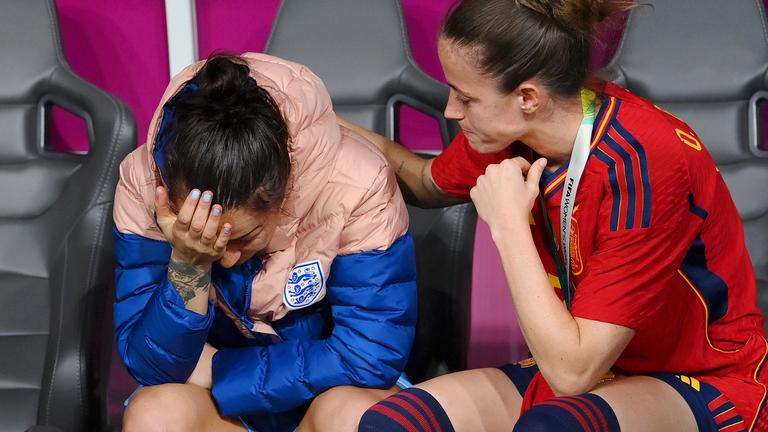
Photograph: Stephanie Meek/CameraSport via Getty Images
Spain’s victory over England in the Women’s World Cup final was about much more than football. The Spanish women were beautifully ruthless over the ninety-plus minutes. They kept England constantly off balance and frustrated their every attempt to acquire momentum. Twenty days earlier in Wellington, New Zealand, I watched Spain endure their biggest humiliation of the tournament, a 4-0 defeat by Japan. Their pride was stung by the elegant effectiveness of Japan’s press that denied space and time to their best players.
They took on board the hard lessons (suffering was a term many of them used) and grew into a solidified team that would not be denied. The Spanish players had multiple reasons, personal and collective, for winning the final. The sting of the loss to Japan; anger at the inept response of the Spanish Football Federation to a player protest in 2022, and the absence of key players who were frozen out after that protest. The sum total of those motivations always exceeded the English commitment. That old commentary cliche, They wanted it more, applied.
This is a Spanish movie that we have seen before. (Maybe Pedro Almodovar is looking for another script with a group of heroic women?) The backbone of this team are Barcelona players, the current European Champions. They had a variation on the Spanish midfield regulators from the men’s dominant era. You could think of Aitana Bonmati as a Xavi stand-in and Hermoso as a tall Andres Iniesta. The pair controlled the midfield action, creatively improving their performances against Switzerland, Holland, and Sweden. Hermoso has an uncanny facility for short passing that ensures possession and prises open threatening spaces for colleagues.
Spain emulated the Japanese-style press to unsettle England in every section of the field, with one player challenging for the ball while two others cut off the passing options. England’s two Barcelona players, Keira Walsh and Lucy Bronze, had a less happy evening in Sydney. Bronze went walkabout in the packed Spanish midfield, lost the ball, and in a flash, the play was switched to where she should have been. Russo was slow to cover and Carmona raced up to take a Caldentey pass and strike with deadly precision. Spain had been having a lot of success attacking up the left flank, and it finally paid off.
England contributed greatly to the contest. They rolled the tactical dice at halftime, bringing in Lauren James and Chloe Kelly and later pushing Millie Bright up to center forward. Mary Earps saved a penalty after some Bronze gamesmanship rattled Hermoso. It was all to no avail. Spain was not for shifting.
The photos in The Guardian article by Jonathan Liew and the one I used at the top of the blog are iconic and symbolic. The women’s game embodies levels of respect and compassion that are harder to find in men’s international football. For women players, the road to international representation is littered with stones, rocks, blocks, and (sometimes) kisses from the patriarchy. The fine line between victory and defeat may be more permeable for women. And, as noted by Liew, the top women have supportive friendships, alliances, and even rivalries that develop at their clubs.
My Petaluma correspondent, Charles Little, had this revelation after the U.S. exited the tournament. Currently, only one U.S. player, Lindsay Horan, plays for a top European club, Lyon. Maybe, Charlie said, the National Women’s Soccer League is no longer the best high-level, competitive league. The European leagues are the source of the best women’s football now. Three of the four semi-finalists were European, and Australia, the other semifinalist, has the majority of their players earning their living at European clubs.
The NWSL is still an invaluable proving ground for players from outside the U.S. with international aspirations. Ireland, for example, benefitted from the NWSL experience of Denise O’Sullivan, Sinead Farrelly, Kyra Carusa, and Marissa Sheva. How will the U.S. Women’s team be rebuilt, and how long will it take? It’s hard to imagine the program will not bounce back strongly, but the rest of the world has caught up fast. Spain, England, and other nations will not give up their leading roles easily.
 The Old Blog Node
âBeautifully ruthlessâ â perfect way to catch the spirit of the Spanish team.
In USA Press a big deal is being made of the Spanish soccer folks, the men, who, apparently, kissed one or two of the soccer players, uninvited kisses.
Looking forward to seeing you folks when you return,
Jeff
>
LikeLike
Tom, you capture the final well, and I appreciated your observance of the warm connections between the women who, even in the best supported nations, face constant obstacles. Perhaps, however, the horrendous behavior of the Spanish FA head, having been called out by so many, may lead to some tiny glimmer of understanding of some men in the sport (and elsewhere). There was a burst of thinking here in the U.S. about white privilege. Clearly we need to spend more time and energy in exposing male privilege, and recognizing it in ourselves.
LikeLike
Also, I’m a sucker for stuff like “The Reign in Spain!” Eliza couldn’t have said it better herself.
LikeLike