Northern Protestants: On Shifting Ground, a book of revelations

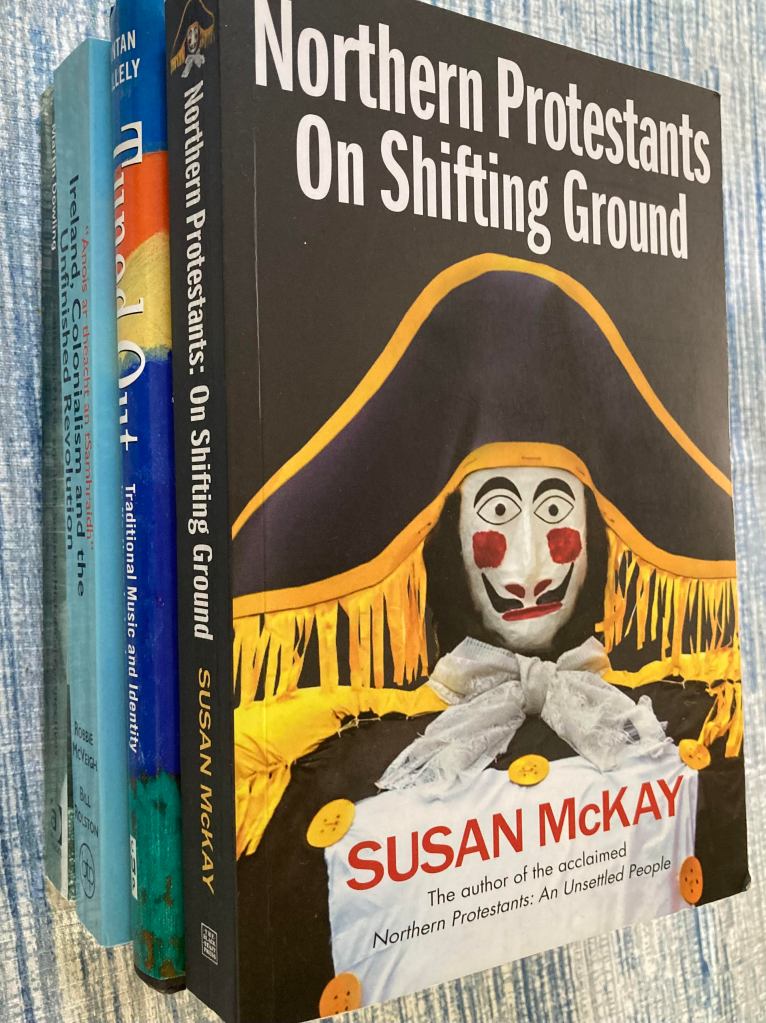
In Nostalgia for the Light, the powerful meditation on memory and trauma by Chilean film maker, Patricio Guzman, an astronomer states that the present is, at best, a fleeting entity. Everything comes with a delay, however minute. We are always dealing with the past and in some places, like Chile and Northern Ireland, this struggle is very visible and often confounding. One book that has clarified some questions for me is Northern Protestants On Shifting Ground by Susan McKay. I have not read a more eye-opening and heart-wrenching book in a long time.

This book is required reading for all, at home or abroad, who espouse romantic wishes for Irish unity. I count myself among them. And while distance makes the heart grow fonder, it can and should, also bring a more critical and comparative perspective. (Every Irish immigrant has been asked more than once to explain the “Troubles” in Northern Ireland: it is usually an unsatisfactory experience all round.)

McKay cuts right through the rigid politics and blustering binaries that often infest policy discussions about Northern Ireland. The major myth the book explores is that there are two monolithic, irreconcilable sides in the Northern Irish story, one Protestant, loyalist and unionist and the other Catholic, republican and nationalist. A careful look at the history of the Northern statelet would indicate that it was never so but the ruling Protestant majority nurtured that supremacist illusion for almost 50 years in Northern Ireland.

The revelations come thick and fast. Prepare to be schooled on the wide range of perspectives, values and opinions held by people who embrace the term unionist, often without the big U. McKay seeks out people from Protestant backgrounds, like herself. We hear from many women, feminists and otherwise. From a range of LGBTQ Protestants. From Unionists who fear any form of United Ireland and unionists who, surprisingly, would accept that outcome if that was how a referendum played out.

There are socialists, activists, community organizers, and local elected representatives. A revealing number of her interviewees come from mixed backgrounds, are married to Catholics, or have Catholics in their extended families. Kenneth Branagh’s heartfelt film, Belfast, is set in a mixed residential neighborhood before the violence drove everyone back into sectarian enclaves.

McKay speaks with a number of artists who offer wide-ranging, open-minded and hopeful perspectives on the way forward. Colin Davidson is a painter who created an exhibit called Silent Testimony that was widely seen in the North. He speaks about people’s reaction to his paintings of survivors of the violence: 

People went in and were struck by the fact they weren’t told who the Protestants and Catholics were, and some of them said to me they were ashamed at themselves for even thinking they needed to know. That actually goes to the very heart of what the enduring problem in this place is. We still haven’t got over the “them and us.” In fact, I wonder if we’ve even scratched the surface.

Stacy Gregg is a playwright and filmmaker who says, “a lot of my identity has straddled binaries: gender, nationality, class.” She attended Cambridge where she became painfully aware of her working class status.

You can’t grow up here and not be political. I’m very aware that Protestants don’t get a good rap. I feel uneasy when people mock working-class Protestants -it shows a poverty of empathy.

But she also comments on the waning of Protestant privilege:

I think most of that protestant privilege is essentially gone or going, but the residual entitlement remains, and can become brittle or defensive. So this bizarre Protestant entitlement helps me understand why some behave as they do.

An Irish language revival has been underway in the North for some years primarily in nationalist areas. The official use of the Irish language has been championed by Sinn Fein and is bitterly opposed by many Unionists. The real story is more nuanced. The fastest-growing group of Irish language learners in the North are Protestants. Linda Ervine runs an Irish language school, Turas (Journey), in East Belfast and speaks about the long history of Irish-speaking Protestants, something which I was sadly ignorant about:

We are steeped in this language. Protestants who reject it don’t know their history. Catholics who claim it as their own don’t know it either. Language doesn’t vote, doesn’t sectarianise, doesn’t fly a flag.

And, with a nod to the book’s cover image of the effigy of “Traitor” Robert Lundy that is burned annually in Derry, scholar Sophie Long says she accomplished a Full Lundy by learning Irish in England.

Jan Carson, author of the acclaimed novel The Fire Starters, is grateful for her upbringing enriched with biblical language and stories. But she is critical of how reductionist the church teachings have become.

I’m interested in an inscrutable God. That’s how the church has failed artists over and over again, because it’s not about the unknown and it should be. Instead the model of the church is corporate worship, for we all sing the same thing at the same time. Artists want to play and think and work outside the box.

And Pamela Denison, a Protestant businesswoman from Antrim, believes the churches were to blame for their decline.

I think religion can be dangerous, very dangerous. I’m not anti-Protestant. I’m just anti-religion.That is how they were reared, a lot of people can’t see past the end of their own lanes. They haven’t opened their minds to other cultures and ideas.

The paucity of politics among loyalists is highlighted. One interviewee calls it geriatric politics, with its singular focus on slogans like No Surrender and What We Have We Hold. Dawn Purvis, from the progressive Unionist party, pinpoints the barrenness:

Northern Ireland for the British. What does it mean? What does it mean when that happens for people who hold onto this notion of identity that they can’t explain, but it is something that they hold onto, like somebody’s trying to steal it from them.

The book also explores the differences between Protestants and Catholics in higher education and career pursuits. Queens University in Belfast is described as a “cold house for Unionists” since Catholic students are the majority and exhibit a stronger drive for educational advancement. Younger Protestants often leave to study in British universities and don’t return. This is considered a grievous generational loss.

History gets a nationalistic spin in most countries. I was taught Irish history by a rabidly republican Kerryman: Britain never did anything right in 700 years of occupying Ireland and propped up the sectarian statelet in the North. The Irish, heroically, never did any wrong. It’s an old story. Even Theobald Wolfe Tone, a hero and martyr of the 1798 rebellion, admitted that hatred of England was always “an instinct rather than a principle.” It’s still being taught with a slant. My 10-year old granddaughter completed a class assignment on The Troubles at her parochial school in South Dublin last year. She came home with this revelation: Protestants were the bad guys here.

The book is a set of interviews with a wide range of Northern Irish unionists and Protestants conducted between 2019 and 2021 and a sequel to her earlier book, Northern Protestants: An Unsettled People. It’s an ethnographic tour-de-force with journalistic flourishes. Many of the segments, pithily headlined, open with the words of the interviewee, some are almost entirely quotes from the person’s testimony. McKay only intervenes to contextualize key events or provide some history for violence or atrocities from the “Troubles” for general readers.

The place of Unionists in some form of a United Ireland (United Island? New Ireland?) has been front and center in the public conversation especially since the passage of Brexit. Andrew Trimble, a retired Irish rugby star, offered his argument in a recent interview in the Irish Times. Rugby people should be heard since it is the one major sports that resisted division after partition and always fielded an All-Ireland team.

Any talk of uniting Ireland must explore this set of fundamental questions. How are the Unionist Protestants accommodated? How do you learn to accept a somewhat unlovable crowd, people who are not just British or Irish but their own awkward selves as Michael Longley put it? What kind of neighbors would they be? How do you avoid creating a “cold house” for them in the new arrangement? And, for some Sinn Fein supporters, how do you resist the temptation to include payback for years of running a vicious, sectarian statelet?

The book offers satisfying answers to those questions. Many of the interviewees come across as sound, thoughtful, and reliable persons. They would be good neighbors, resourceful in an emergency, and respecters of boundaries. The politics and religious attitudes of some would be hard to live with but the present-day Republic is a more diverse, multicultural and tolerant community. The Reverend Ian Paisley’s old jibe about the South being ruled by Rome seems utterly outdated now. One interviewee notes that a unified Ireland would work out all right in the end but the 10-20 years it took to get there could be hellish.

One way or another, Catholics, Protestants and Dissenters (largely from the Presbyterian tradition) have been interacting and cohabiting in those six counties for hundreds of years. Now a critical point has been reached where the dissenters of various persuasions are edging out the unionist and republican extremes, as Emma de Souza argues recently in the Irish Times. Young people have moved away from traditional religious affiliations making the Catholic-Protestant binary more irrelevant than ever.  The elections coming up in May will reveal the strength of the center and how likely it is to hold.

It’s time to stop the “Othering” of groups of people that has plagued Northern Ireland and many places in the world. The present is fleeting but also immensely fragile. Politics everywhere cannot be simply local when the effects of climate change are omnipresent and poised over our future like a tsunami. Fighting over power and control in a small corner of the world is futile, foolish, feeble and wasteful.
Martin Hayes, the good ancestor.

A review of Shared Notes: A musical journey by Martin Hayes

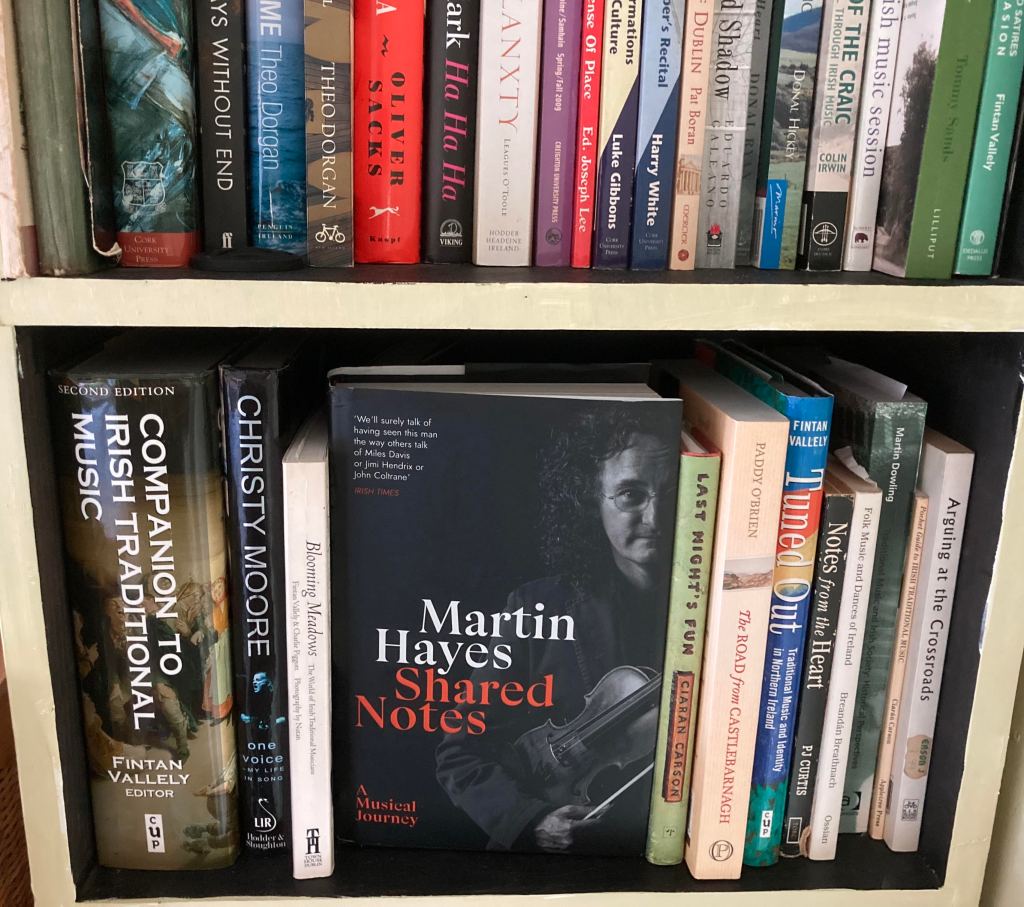
Martin Hayes has written a memoir that’s every bit as brilliant, engaging and moving as one of his famous extended performance sets. The Irish fiddle player was forced onto the sidelines by the Covid epidemic in 2020 but that gave him the time and space to complete the book. In his music, he’s a master of time and space and those skills transfer to the flow, structure, and measured pace of the narrative. It’s a substantial and welcome addition to the meager store of good books on Irish music. The photograph shows a selection from my own modest collection with Hayes’ book in pride of place.

His story starts in the heart of a hotbed of traditional music in East Clare. He grew up immersed in that culture working on the family farm, walking to and from school, and absorbing the music organically along with its “doctrine of soulfulness.” Hayes opens with a lovely portrait of his mother who was “an independent-minded, free-thinking spirit.” She had worked as a nurse in the psychiatric hospital in Ennis and as a waitress in an upscale restaurant in London. She had also spent a year training to become a nun, something Hayes did not learn about until his father’s death in 2001. Irish mothers can diligently secure their secrets. She only lasted a year in the convent, emerging with a lifelong suspicion of authority and a watchful eye for hypocrisy.

Like mothers in many traditional cultures, she gave up her ambitions and dreams to nurture and tend to her husband and family. Not to mention feeding the steady stream of musical visitors who came to commune with Martin’s father, PJ Hayes, leader of the famed Tulla Céilí Band. His father was a huge influence on him but he had other sound ancestors like his uncle, Paddy Canny and local fiddler and piper Martin Rochford. Other early musical influences included Tommy Potts, Joe Cooley, Tommy Peoples, Peadar O’Loughlin, Junior Crehan and Tony Mac Mahon.

Hayes has a number of aphorisms that he regularly delivers with style and precision. One of them is, “… the 1970s were the 60s in Ireland.” More sociologically sound than it seems on the surface, Hayes was a teenager in the late 70s so he knows whereof he speaks. Early on, he was a conforming non-conformist, a position that many young Irish people began to adopt in that era. He worried that he was, “… a socially compliant cultural manikin at the cost of a normal teenage life.”

But, wanted or not, social change was coming to rural Ireland in the 1970-80s and Hayes, like many others, took off for elsewhere. He is unsparing in describing the ups and downs of his life journey. He was enamored of the drink for a few years but giving it up brought more clarity and focus to his search for meaning. He ended up for a time living illegally under the radar in Chicago on an expired tourist visa, suffering the embarrassment of being ripped off by a shyster immigration attorney when he tried to become a legal resident. He had his fallings-out with fellow musicians and once smashed his fiddle on the head of band member.

His detailed and loving memories of childhood and adolescence are extraordinary. The book covers the paths not taken. At various points Hayes could have been lost to music by becoming a Fianna Fail political figure or a frozen food salesman or, briefly, a stock market trader in Chicago, or even a college graduate with a business degree (he dropped out after a year.) And his musical journey had some unproductive byways. Like playing banjo for a time in the Tulla Céilí Band, or playing an electric fiddle in a Chicago folk-rock band, Midnight Court, or accompanying ballad singers in a bar band.

At one concert, Hayes has had enough of the audience members who talk and drink noisily during the show. He asks them to leave, offers a refund, and they reluctantly depart. It’s an empowering moment when he exercises his right, with righteous anger, as a performer to play in conditions that suit his musical goals and ambitions.

Hayes has done the work to arrive at an authentic self and a workable philosophy of life. He came through a tough period when he felt he was losing his past, was disengaged from the present, and not creating a future. His personal spiritual search brought him back to the music. Integrity for any musician or artist is complicated, Hayes says, and “Sometimes, we’re just not ready to handle our own gifts.” He writes eloquently about his experiences teaching music where he revels in the mutual learning possibilities in that creative exchange.

He is deeply committed to making his music “invitational,” drawing the audience into emotional participation, a reciprocity that can be transcendent. Many older musicians frowned upon stage craft but Hayes found that he had to grapple with the dynamics of performance to bring his playing up to the highest possible levels.

Hayes is the preeminent exponent of Irish traditional music in the world. He has transcended his status as an Irish fiddler to achieve parity with other artists, classical and otherwise, in concert halls far beyond Ireland’s borders. He plays, “Music in the universal sense first, and Irish music second.” And performing in more formal settings brings its share of stress. Since traditional musicians don’t usually read music, playing extended pieces with an orchestra can produce a unique kind of terror and sense of inadequacy. Hayes describes this clearly in the book and it matches the experience that Tony Mac Mahon endured in his first performance with the Kronos Quartet.

He brings a high degree of artistic, intellectual and cultural credibility to Irish music, universally defined. Hayes was fortunate to have a long line of ancestors, many with musical abilities. In turn, he has become a good ancestor, taking the long view back and into the future. He is a master practitioner with the right blend of character, charisma and modesty for younger players to emulate. He has done a great deal to expand and enrich Ireland’s cultural capital as a musician himself and as a facilitator of combinations that have led Irish music into new pastures.

In the first post on this blog in 2008, Hayes and Cahill: Recalibrating the tradition, I concluded: “This is quantum music played with a bonsai sensibility, centrifugal explorations of notes and the spaces in between, pulsing with possibility.” Hayes observes that particular notes in tunes carry more weight than others. In Shared Notes, he weighs his words and deploys them as artfully as he draws out the ancient melodies.

Martin Hayes annotated Blogiography

I was fortunate to hear and see and, in time, talk with Hayes as his playing career ascended the heights. Here’s a collection of blog posts on Martin Hayes. He has been a source of great inspiration for my writing over the years. My first piece on Hayes in the San Francisco Irish Herald in September, 2000, was titled Zen and the Art of Fiddle Playing. I first heard him at the San Francisco Celtic Music Festival held each spring for ten years from 1991 under the watchful eye and ear of the late Eddie Stack.

https://theoldblognode.blogspot.com/2018/08/fiddling-on-dock-of-bay-review-from.html

Later, in that same timeframe, I heard him play in various combinations at the Sebastopol Celtic Music which was guided by Cloud Moss. His book honors the memory of those festivals as seminal influences in his playing career. In the 1990s and early 2000s, Hayes made regular appearances in the San Francisco Bay Area. He savored the spaciousness and freedom he experienced in the city and felt that the spirit of Joe Cooley was still in residence.  

https://theoldblognode.blogspot.com/2008/10/hayes-and-cahill-recalibrating.html

There was something very fitting about seeing Hayes and Cahill play in church buildings around the area. Apart from the acoustics, the settings induced a certain reverential expectation that was often fulfilled.

https://theoldblognode.blogspot.com/2011/10/hayes-and-cahill-at-skyland-church.html

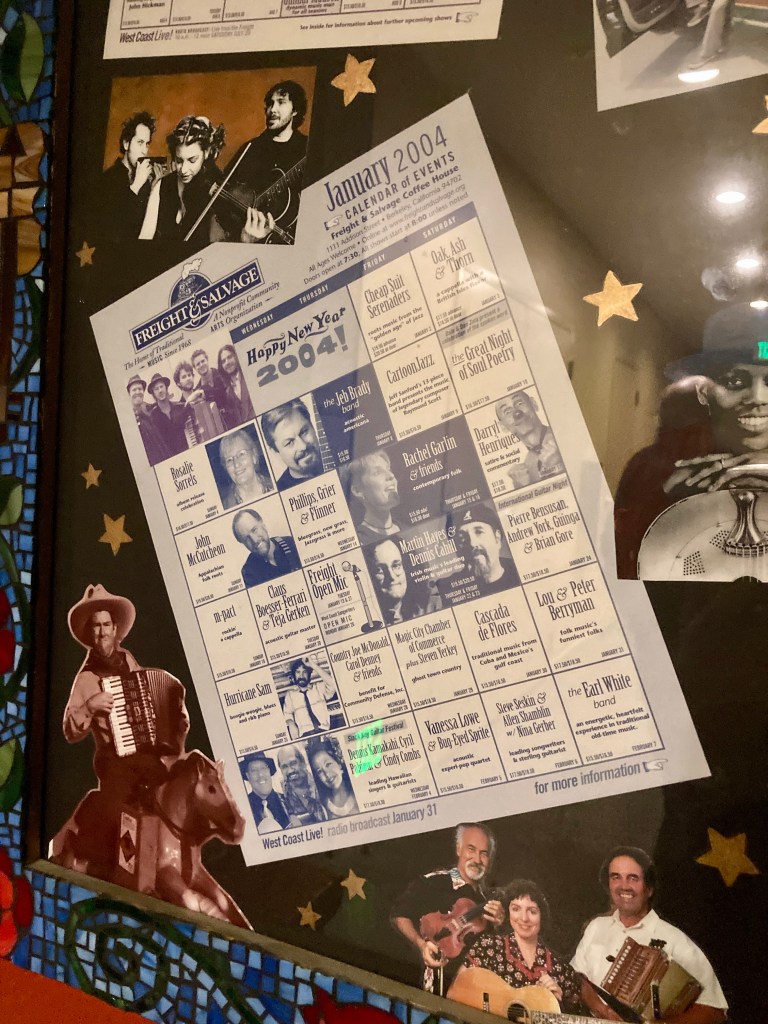
Hayes played many times at the legendary Berkeley concert venue, the Freight and Salvage. One of his appearances with Dennis Cahill from 2004 is recorded on the venue’s calendar wall.

One unique evening is recorded here when sound engineer Tesser Call facilitated an acoustic miracle.

https://theoldblognode.blogspot.com/2012/03/hayes-and-cahill-break-sound-barrier-at.html

Hayes brought every one of his musical groups to Berkeley: twice with The Gloaming, once with his Blue Room Quartet, and once with Masters of the Tradition. Every show was memorable and magical. The two Gloaming concerts are reviewed here:

https://theoldblognode.blogspot.com/2014/12/roaming-with-gloaming-in-berkeley.html

https://theoldblognode.blogspot.com/2017/10/the-gloaming-returns-to-berkeley.html

And the mesmerizing evening with Hayes’ Quartet playing their Blue Room album is reviewed here:

https://theoldblognode.blogspot.com/2018/10/quadruple-delights-from-martin-hayes.html

And here are two insightful reviews of Hayes’ memoir by fellow-fiddle players, Niamh Ni Charra in the Irish Times and Toner Quinn in the Journal of Music.

https://www.irishtimes.com/culture/books/shared-notes-by-martin-hayes-personal-poignant-and-immensely-profound-1.4706747

https://journalofmusic.com/opinion/persist-other-side

Mac Mahon and Moloney: Two Irish music titans leave the scene

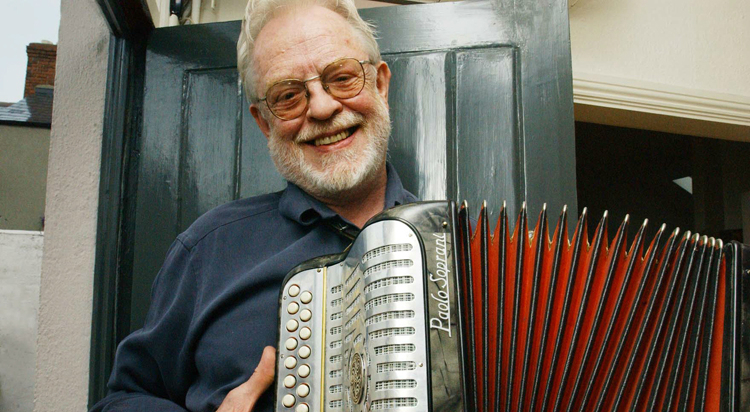
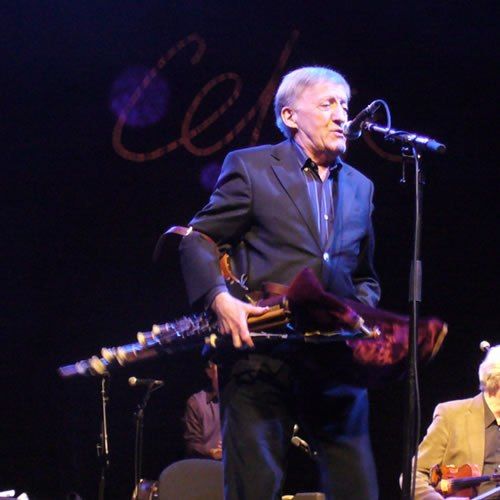
Two Irish music giants died last month. Tony Mac Mahon was a fervent guardian of the music traditions, an accordion maestro, a folklorist, and communicator par excellence. He lovingly championed the cultural riches of Irish music for his fellow citizens and shared that huge heritage with the world. Paddy Moloney was a genius and a musical entrepreneur, taking the ensemble structure initiated by Seán Ó Riada with Ceoltóirí Chualann to glorious and enduring heights with The Chieftains. With that ebullient band, he passionately presented the cornucopia of Irish music to the world, taking the music out of the pubs and into concert halls.

Both men leave behind immense cultural legacies, preserving and renewing melodic masterpieces and rare tunes, and seeding the revival of Irish traditional music. Mac Mahon was a collector, curator, broadcaster and often provocative commentator. Moloney was a brilliant band leader, a fine composer, and a generous musical partner.

Moloney was a master of the notoriously temperamental uilleann pipes, a skill characterized by the late Mícheál Ó Súilleabháin as akin to wrestling with an octopus. It’s fair to say he popularized octopus wrestling in many surprising corners of the world. Mac Mahon had a famously ambivalent relationship with the accordion and occasionally wished that he could have played the pipes, a more authentic traditional instrument, in his view.

Paddy Moloney’s life was celebrated recently on the RTE radio Rolling Wave show. One of his early achievements (sometimes forgotten with all his subsequent accomplished) was as CEO and producer for Claddagh Records. These included classic records like The Liffey Banks by Tommy Potts and The Star Above the Garter by Dennis Murphy and Julia Clifford. The role Moloney played in expanding Claddagh Records and the work of reinventing the label are described by Siobhán Long in a recent piece in the Irish Times. The Chieftains played regularly in the Bay Area and they were the last live concert I attended before the Covid lockdown in February 2020.

Moloney was often described as an ambassador for Irish music and culture but Mac Mahon had the equally vital role as emissary from the recent and not-so-recent past. He spoke for the vernacular Irish artists who kept the music alive during the worst of times, before and after the state achieved a measure of independence.

The Rolling Wave (another tune Mac Mahon favored) radio show also memorialized his contributions with praise and recollections from Liam O’Connor of the Irish Traditional Music Archive, Noel Hill, a musical partner and soul-mate, and Caoimhín Ó Raghallaigh who persuaded Tony to record Farewell to Music, his last album released on Raelach Records in 2016.

Mac Mahon, like Martin Hayes and Iarla Ó Lionáird, served as messengers from our traditional musical history, loyal spokesmen for the ancestors. His message was directed at Ireland and the Irish, his plea echoing Breandán Breathnach, that we love and respect the music because it is our own. Mac Mahon’s lifework may be viewed as a Tabharthas, an offering to the artists who preceded him and his peers. According to Manchán Magan’s fascinating book, Thirty-Two Words for Field, the term also means sacrifice. And there is little doubt that Mac Mahon sacrificed some parts of his life for his work. One of his favorite pieces was the lament The Wounded Huzzar and the title may have resonated with his experience.

O’Connor describes Mac Mahon as a force of nature, a sweet and forceful player who did not value technique but had tons of it. Noel Hill, who played with Tony on the classic recording, I gCnoc na Graí/Knocknagree, noted that their way of thinking about the music was very much aligned. They shared a sadness about what had gone before and the loss of the Irish language. And it could be heard in his playing. Caoimhin O’Raghalaigh said that Mac Mahon felt the real music is in the slow airs. He loved the sean-nós singers. His playing was like brushstrokes bringing out the dramatic depths and spaces in the tunes.

I never had the opportunity to meet Moloney in person, other than the time a few years back I saw him in his favorite Indian restaurant in Glasthule but chose not to intrude on him. I did have a phone interview with him once for a San Francisco Irish Herald article during one of the Chieftain’s almost annual U.S. tours. His “people” offered me ten minutes but Paddy was happy to talk for longer as he bemoaned the lack of proper tea in his Denver hotel room. He was naturally gracious and generous.

I had more time and interactions with Mac Mahon and count myself fortunate to have crossed paths with him as an aspiring music writer. I saw him play two extraordinary concerts with the Kronos Quartet at Stanford University in 2002 and at a Napa winery in 2003. David Harrington of the Kronos Quartet told me, “…when I hear something as remarkable and rare as Tony, I believe it. His playing has an extraordinary singing quality in the way he molds and shapes every note.” He was gracious and eloquent, eager to share his insights about the rich store of traditional music. He had an edge to him but his curmudgeon persona could be brilliant and funny.

He played a number of other concerts at smaller Bay Area venues during his 2002 visit. One was at the Resource Center for Non-Violence in Santa Cruz, hosted by Bob Breheny of the Celtic Music Society of Monterey and recorded by Pete Haworth of Molly’s Revenge fame. Tony was in fine form and partnered up with Japanese guitarist Junji Shirota, who has a refined ear for Irish traditional music. It was a magical evening and Tony responded wholeheartedly to the energy generated by an audience of aficionados who were very familiar with his oeuvre.

I was in attendance and later received the recording from Haworth. I treasure it and listen back frequently. And since it is better to listen to Mac Mahon play than read about him, here’s a rare live recording from that house concert in Santa Cruz. It’s the mournful air Amhrán na Leabhar

One track only whets the appetite so here’s another from the superb album, Mac Mahon from Clare from 2000. This old march, The Haughs of Cromdale, was recorded at Mac Mahon’s house in the Liberties with Barney McKenna, John Sheehan and Liam Ó Maonlaí. This is one of the tracks flagged by Paul O’Connor in his mind-blowing survey of Irish music available on Soundcloud, 200 tracks to mess with your idea of trad

Mac Mahon and Moloney had the benefit of growing up marinating in complete universes of traditional Irish culture, one rural and one urban, with music at the heart of it. Both men were strongly committed to uncovering and displaying the shapeliness of the harp tunes, the song-airs, and the music of great, largely unrecorded, older players. They worked at mastering the technical elements of their art and willingly absorbed the codes, customs, and wisdom embedded in that life. That’s what made them such credible messengers and advocates for the tradition. They will live long in our hearts and ears.

Richmond, California
U.S.A.